
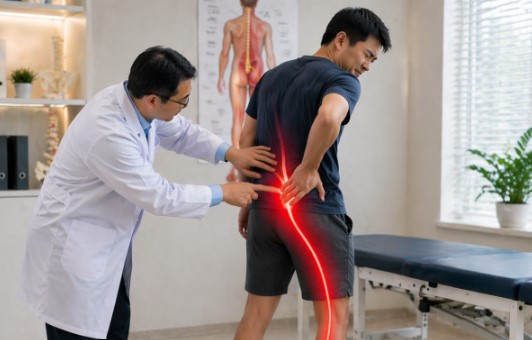
When to See a Pain Specialist for Sciatica?
April 23, 2026
CONTENTS
- What Is a Pain Specialist and What Do They Do?
- How a Pain Specialist Differs from a GP, Physio, or Surgeon in for Sciatica?
- What Can a Pain Specialist Do for Sciatica?
- When Should You See a Pain Specialist for Sciatica?
- When a Different Specialist Is the Right Call?
- How a Pain Specialist in Singapore Paincare Diagnoses Sciatica?
- Sciatica Treatment in Singapore: What a Pain Specialist Can Offer?
- A Pain Specialist’s Perspective on Sciatica in Singapore
- Managing Sciatica Day-to-Day
- When Should You See a Sciatica Specialist in Singapore?
- Conclusion
- Frequently Asked Questions
- Medical Disclaimer
You should see a pain specialist, rather than a GP or surgeon first, when sciatica has lasted more than four to six weeks, is involving nerve pain, numbness, or weakness, or when conservative care has not settled it. A pain specialist is trained in non-surgical, image-guided interventional pain procedures, diagnostic nerve blocks, and multimodal pain medicine, which sit between a GP’s first-line care and a surgeon’s operating room. Early sciatica treatment in Singapore from a pain specialist often removes the need for surgery altogether.
Sciatica can be confusing to navigate, especially when the pain lingers. A patient in Singapore might wonder whether to continue with their GP, start physiotherapy, book an MRI, or speak to a surgeon. Each of these clinicians plays a valuable role, and the right choice often depends on how long the pain has lasted, what your symptoms look like, and what has already been tried. For many patients, a pain specialist becomes the most suitable point of contact at a specific stage of the journey.
This article explains what a pain specialist does, how the role fits alongside a GP, a physiotherapist, an orthopaedic surgeon, and a neurosurgeon, and the specific situations in which sciatica treatment in Singapore is best led by a pain specialist. The aim is to help you understand your options clearly, so you can choose the right clinician at the right time for your situation.
What Is a Pain Specialist and What Do They Do?
A pain specialist is a doctor with advanced training in the diagnosis and treatment of pain, particularly chronic and complex pain. In Singapore, pain specialists usually come from an anaesthesia background, with further subspecialty training in interventional pain medicine. Their core expertise is finding the specific pain generator in your body and treating it with targeted, non-surgical procedures, supported by medication and rehabilitation.
For sciatica, that typically means three things. First, a multi-dimensional diagnostic assessment that looks beyond the MRI scan. Second, image-guided interventional procedures that deliver medication precisely to the nerve root, facet joint, or muscle causing the pain. Third, coordinated multimodal care, which combines medication, physiotherapy, and psychological strategies when pain has become chronic or sensitised.
At Singapore Paincare, pain specialists use the Painostic® methodology, a proprietary four-pillar framework that assesses pain patterns, pathology, pain perception, and psychology. This helps identify not only where the structural problem sits, but also why pain is persisting, which often dictates which treatment will actually work.
How a Pain Specialist Differs from a GP, Physio, or Surgeon in for Sciatica?
Each role has its place. Understanding the differences helps you choose the right step at the right time. None of this is about one being “better” than the others. It is about matching scope of practice to your specific clinical picture.
General Practitioner (GP)
A GP is typically the first point of contact for sciatica symptoms. They assess whether the condition is mild or potentially serious, prescribe short-term pain relief, and offer guidance on activity, posture, and daily habits. GPs also play an important role in identifying warning signs that require further investigation.
For cases where symptoms improve within two to three weeks, GP-led care is often sufficient. However, if pain persists, worsens, or begins to affect mobility and quality of life, the scope of treatment may become limited. At this stage, patients are usually referred to a specialist clinic for more targeted sciatica pain treatment options.
Physiotherapist
A physiotherapist is central to sciatica recovery. They use manual therapy, nerve mobilisation, postural correction, and graded exercise to reduce nerve irritation and rebuild the core, hip, and gluteal muscles that support the lumbar spine. Physiotherapists do not prescribe medication or perform injections, and they do not interpret imaging for procedural planning. When nerve pain is severe enough to stop a patient engaging in rehabilitation, a pain specialist’s injection can make physiotherapy possible again.
Orthopaedic Surgeon
An orthopaedic surgeon, particularly a spine surgeon, focuses on structural correction of the spine through surgery. Their scope includes decompression, discectomy, fusion, and instrumentation when a disc, bone, or nerve compression clearly needs surgical management. Orthopaedic surgeons are the right choice when surgery is genuinely indicated, such as severe or progressive weakness, cauda equina syndrome, or pain that has not responded to a full course of non-surgical treatment. In many sciatica cases, however, non-surgical options have not yet been fully explored, and a pain specialist can help clarify whether surgery is actually needed.
Neurosurgeon
A neurosurgeon also operates on the spine, with additional training in brain and spinal cord surgery. For sciatica, the typical reasons for a neurosurgical consult overlap with those for an orthopaedic spine surgeon. Again, surgery is one tool among several, and is most useful when non-surgical interventional options have been tried or are not indicated.
Pain Specialist
A pain specialist sits between conservative care and surgery. They are trained to diagnose which structure, disc, nerve root, facet joint, or muscle, is truly generating your pain, and to treat it with precise, image-guided interventions under local anaesthesia. Their toolkit includes diagnostic nerve blocks to confirm the pain generator, epidural injections, radiofrequency procedures, nucleoplasty, neuroplasty, and multimodal pharmacotherapy. When sciatica is persistent, nerve-driven, or complex, this interventional layer is often the one that resolves the problem without surgery.
What Can a Pain Specialist Do for Sciatica?
The unique scope of a pain specialist in sciatica care is practical and worth understanding, because it is often the missing layer in a patient’s journey.
First, a pain specialist performs diagnostic nerve blocks. A small amount of local anaesthetic is injected, under imaging guidance, around a specific nerve root or facet joint. If the pain significantly reduces for a few hours, that nerve or joint is almost certainly the pain generator. This answers a question that a scan alone often cannot, because many patients show disc changes on MRI without any pain at all.
Second, a pain specialist delivers image-guided therapeutic injections, such as epidural analgesia at the correct spinal level, Coreflex Injections into spasming muscles, and peripheral nerve blocks around specific nerves. These put anti-inflammatory medication precisely where the irritation is, rather than relying on oral painkillers circulating through the whole body.
Third, a pain specialist performs minimally invasive procedures designed to resolve, not just mask, the structural driver of sciatica. These include Nucleoplasty, which decompresses a disc through controlled plasma ablation, Neuroplasty, which frees trapped nerves by breaking down adhesions in the spine, and Pulsed Radiofrequency, which desensitises painful nerves without destroying them. These sit between conservative care, which has run its course, and surgery, which may not yet be necessary.
Fourth, a pain specialist manages multimodal pharmacotherapy. This goes beyond NSAIDs, and includes nerve-modulating medications such as gabapentin or pregabalin, low-dose antidepressants for chronic pain modulation, and careful, short-term use of stronger analgesics when needed. Doses are titrated based on how your nervous system is responding, not just on pain scores.
Fifth, a pain specialist coordinates the whole picture. When pain has become chronic, the drivers often include nervous system sensitisation, poor sleep, fear-avoidance, and deconditioning. The Painostic® methodology explicitly assesses these dimensions and builds a treatment plan that addresses more than the structural finding on MRI.
When Should You See a Pain Specialist for Sciatica?
There are specific situations in which a pain specialist is the most appropriate clinician to lead your sciatica care. Choosing well at this point can shorten recovery and reduce the chance of unnecessary surgery.
See a pain specialist:
- if sciatica has lasted more than four to six weeks without clear improvement, despite rest, activity modification, and basic painkillers. Beyond this window, the odds of spontaneous resolution drop, and targeted intervention usually speeds recovery.
- if the pain is clearly nerve-driven, with shooting, burning, or electric quality down the leg, along with pins-and-needles or numbness in the foot. GP-level medication is often not enough for neuropathic pain, and a pain specialist can introduce nerve-specific medication and consider a diagnostic or therapeutic nerve block.
- if you have had an MRI that shows a slipped disc, stenosis, or other structural finding, and you are unsure whether surgery is truly needed. A pain specialist can assess whether non-surgical interventional options, such as an epidural injection or Nucleoplasty, are likely to resolve the issue first.
- if conservative care, including physiotherapy and oral medication, has plateaued. This often signals a need for a precise diagnostic nerve block, targeted injection, or minimally invasive procedure to break the cycle and let rehabilitation progress.
- if your sciatica keeps recurring in flares. Recurrent episodes often point to an underlying structural or sensitisation pattern that a pain specialist can define, rather than simply treating each flare with another round of painkillers.
- if you are avoiding or postponing surgery and want to understand your full range of non-surgical options. A pain specialist can lay out the evidence, the realistic outcomes, and the order in which options make sense for your specific picture.
- if you are medically unsuitable for surgery, for example due to age, cardiovascular risk, diabetes, or bleeding issues. Interventional pain procedures are generally performed under local anaesthesia with minimal downtime, which is helpful when general anaesthesia is best avoided.
No GP referral is needed to see a pain specialist at Singapore Paincare. You can read more about sciatica treatment in Singapore and how a personalised plan is built.
When a Different Specialist Is the Right Call?
There are situations where a different clinician is the more appropriate first contact, and being clear about these is part of responsible patient guidance.
If your sciatica has just started, is mild, and you have no red flags, your GP can reasonably manage the first two to three weeks with medication and advice. If the pain is purely mechanical, your MRI is unremarkable, and a physiotherapist is already making good progress, continuing with rehabilitation is usually the right call.
If you have significant or rapidly worsening leg weakness, saddle numbness, loss of bladder or bowel control, suspected cauda equina syndrome, sciatica after major trauma, or signs of infection or tumour, you need emergency assessment. In those situations, an orthopaedic or neurosurgical team will usually be the lead, often via the emergency department.
If a full course of non-surgical care, including interventional pain procedures, has not resolved a clearly surgical problem, a spine surgeon becomes the right next step. A pain specialist can and should refer in this direction when it is the correct clinical answer.
Red Flags That Need Urgent Medical Attention:
• New or rapidly worsening weakness in the leg
• Numbness around the groin, buttocks, or inner thighs (saddle anaesthesia)
• Loss of bladder or bowel control, or difficulty passing urine
• Severe, unrelenting pain that does not settle with rest or medication
• Sciatica after significant trauma, such as a fall or road accident
• Sciatica with fever, chills, or unexplained weight loss
These can signal cauda equina syndrome, infection, fracture, or tumour, and need prompt assessment.
How a Pain Specialist in Singapore Paincare Diagnoses Sciatica?
A pain specialist’s diagnostic process is designed specifically around identifying and confirming the pain generator, which sets it apart from a general assessment.
History is the first layer. The specialist will take a detailed pain history, including timing, radiation, triggers, sleep impact, previous treatments, and response to medication. This often reveals clues that a brief consultation may miss.
Physical examination is structured around the nervous system. The specialist tests reflexes, sensation, muscle strength, and nerve tension signs, such as the straight leg raise and the slump test, to map which nerve root is irritated.
MRI is interpreted alongside symptoms, not in isolation. A pain specialist looks for the specific level and side of compression that matches your clinical picture. Imaging that does not match the examination often prompts further investigation.
Diagnostic nerve blocks, where appropriate, add a level of confirmation that other pathways do not routinely offer. A small, image-guided injection of local anaesthetic near a suspected nerve generator can definitively confirm whether that nerve is responsible for your pain, before any longer-term procedure is considered.
The Painostic® methodology is applied throughout. It assesses four pillars: pain patterns, pathology, pain perception, and psychology. This helps identify sensitisation, fear-avoidance, and sleep-related amplifiers that reshape the treatment plan, particularly when pain has become chronic.
Sciatica Treatment in Singapore: What a Pain Specialist Can Offer?
At Singapore Paincare, sciatica treatment follows a staged, diagnosis-first approach. Care begins with the least invasive option that fits your clinical picture and escalates only when needed. You can read more about sciatica treatment in Singapore on our condition page.
Multimodal Pain Medication
Pain specialists prescribe beyond standard painkillers. Short courses of NSAIDs are combined, where clinically appropriate, with nerve-modulating agents such as gabapentin or pregabalin, and low-dose antidepressants for chronic pain modulation. The goal is to calm the nerve and the nervous system, not just to blunt pain.
Physiotherapy Coordination
While physiotherapy itself is delivered by physiotherapists, a pain specialist often coordinates timing, intensity, and focus. A well-timed injection can make previously unbearable rehabilitation possible.
Coreflex Injections
Coreflex Injections deliver a mixture of local anaesthetic, anti-inflammatory, and muscle relaxants into tight, spasming muscles around the lower back and buttock. This is often used for piriformis-driven sciatica and for secondary muscle guarding.
Epidural Analgesia
An epidural injection of steroid and local anaesthetic at the correct spinal level delivers anti-inflammatory medication directly to the inflamed nerve root. It is one of the most useful interventions for disc-related sciatica that has not responded to conservative care.
Peripheral Nerve Block
A targeted injection of local anaesthetic and anti-inflammatory around a specific nerve root both confirms the pain generator and provides therapeutic relief. It is particularly useful when symptoms do not match a textbook pattern or when imaging is equivocal.
Nucleoplasty
For persistent, focal slipped discs driving sciatica, controlled plasma ablation decompresses the disc and reduces pressure on the nerve root. It is a minimally invasive procedure, performed under imaging guidance with short recovery time, and is usually not part of a non-specialist’s toolkit.
Neuroplasty
Neuroplasty involves inserting a small tube to create space in the narrowed spine. It frees trapped nerves by breaking down adhesions and delivering anti-swelling medication. It is considered for patients with persistent sciatica from scar tissue or tight neural pathways, often where a previous surgery has left adhesions behind.
Pulsed Radiofrequency
Pulsed Radiofrequency uses lower-temperature radiofrequency to desensitise pain-generating nerves without destroying them. It can be useful for patients with persistent nerve pain who are not candidates for more invasive options.
A Pain Specialist’s Perspective on Sciatica in Singapore
One pattern I see often in Singapore is the patient who has been told “it is a slipped disc, so you will need surgery eventually”. They come in braced for a recommendation to operate. In many cases, a careful history and examination, combined with an MRI and a diagnostic nerve block, shows that a targeted epidural or a nucleoplasty can resolve the sciatica without surgery. The surgical option remains on the shelf if needed. It is no longer the default.
A second pattern worth distinguishing is structural sciatica versus sensitisation-dominant sciatica. Structural sciatica has a clear culprit on MRI, matches examination findings, and often responds well to an interventional procedure. Sensitisation-dominant sciatica may have a modest scan but a nervous system that has been flared for months. It tends to respond better to graded exercise, pain neuroscience education, and careful pharmacotherapy than to more aggressive procedures. Telling these apart early is one of the specific strengths of a pain specialist’s assessment, and it can change the entire treatment arc.
The takeaway is simple. Seeing a pain specialist earlier does not mean more procedures. In many cases, it means fewer procedures, clearer decisions, and a surgery that never becomes necessary.
Managing Sciatica Day-to-Day
Small habits shift the recovery curve. Break up prolonged sitting every 30 to 45 minutes, even briefly. Set up your workstation so the screen is at eye level, your hips are slightly above your knees, and your feet rest flat on the floor. When lifting, bend the hips and knees, keep the load close to the body, and avoid twisting. During a flare, sleeping on your side with a pillow between the knees often reduces lumbar nerve irritation.
Gentle walking is usually well tolerated and helps calm a sensitised nervous system. Core, hip, and gluteal strengthening, guided by a physiotherapist, rebuilds spinal support over time. Swimming and stationary cycling are often comfortable choices while flares settle. Keep the wallet out of the back pocket when sitting, and rotate between standing and sitting if your work allows.
These are supportive measures, not substitutes for a proper diagnosis.
When Should You See a Sciatica Specialist in Singapore?
As a practical guide, you should consider seeing a sciatica specialist in Singapore if leg pain has lasted more than four to six weeks without clear improvement, if pain is disturbing sleep or limiting work, if you have numbness, tingling, or weakness in the leg or foot, if flares are becoming more frequent, or if painkillers are no longer working. You should also consider a pain specialist if you have been told you “need surgery” and want a clear view of non-surgical alternatives first.
Conclusion
Sciatica is one of the commonest pain problems in Singapore, and it does not need to default to either endless painkillers or early surgery. A pain specialist sits between those two ends, with a scope of practice built specifically around non-surgical, image-guided interventions, diagnostic nerve blocks, and multimodal pain management. The right time to see one is not when surgery becomes the only option left. It is before that point, when targeted intervention still has the best chance of resolving the problem.
If your sciatica is no longer settling on its own, or if you have been told you need surgery and want a clearer picture first, you do not need to simply endure it. Book a consultation with our pain management team to find out what your options look like.
Frequently Asked Questions
When should I see a pain specialist for sciatica instead of a GP?
See a pain specialist if sciatica has lasted more than four to six weeks, if pain is clearly nerve-driven with burning, shooting, or tingling features, if there is numbness or weakness in the leg or foot, or if standard painkillers and activity modification are not helping. A GP is a good first contact for the initial two to three weeks of mild sciatica. Beyond that, a pain specialist has more targeted tools, including diagnostic nerve blocks and image-guided injections, that go beyond what a GP is typically equipped to offer.
How is a pain specialist different from an orthopaedic surgeon?
An orthopaedic surgeon focuses on surgical correction of spine and joint problems, such as discectomy, decompression, and fusion. A pain specialist focuses on non-surgical, interventional pain medicine, including diagnostic nerve blocks, epidural injections, radiofrequency procedures, Nucleoplasty, and Neuroplasty. For sciatica, the pain specialist is often the right first step because many cases can be resolved without surgery when interventional options are applied early. When surgery is genuinely indicated, a pain specialist can and does refer on to the appropriate surgical team.
Can a pain specialist help me avoid sciatica surgery?
In many cases, yes. A pain specialist can define the exact pain generator through history, examination, MRI review, and diagnostic nerve blocks, then target it with image-guided injections or minimally invasive procedures such as Nucleoplasty or Neuroplasty. These options may resolve the sciatica without surgery for suitable patients. Surgery remains an option if needed. However, it is not the default. For cases with severe weakness, cauda equina syndrome, or persistent pain despite full non-surgical care, a surgical consult is the appropriate next step.
What specifically does a pain specialist do that a physiotherapist or GP cannot?
A pain specialist performs image-guided interventional pain procedures, such as diagnostic and therapeutic nerve blocks, epidural injections, Coreflex Injections, Nucleoplasty, Neuroplasty, and Pulsed Radiofrequency. They also prescribe and titrate multimodal pain medication, including nerve-modulating agents. Physiotherapists focus on hands-on rehabilitation and exercise, and GPs manage first-line assessment and short-term medication. Each role is complementary. A pain specialist adds the interventional and pain-medicine-specific layer that helps resolve persistent or nerve-driven sciatica.
How is sciatica diagnosed at Singapore Paincare?
Diagnosis combines a detailed pain history, a focused physical examination, and MRI imaging when indicated. Diagnostic nerve blocks may be used to confirm which nerve is generating the pain. At Singapore Paincare, the Painostic methodology adds a four-pillar assessment of pain patterns, pathology, pain perception, and psychology. This helps the pain specialist identify not only the structural cause, but also why pain is persisting, so treatment can target the true drivers of your symptoms rather than just the MRI findings.
____________________________________________________________
Medical Disclaimer
This article is intended for general informational purposes only and does not constitute medical advice. Please consult a qualified healthcare professional for diagnosis and treatment tailored to your individual condition.