Neuroplasty, also called epidural adhesiolysis, is a minimally invasive day-surgery procedure. It clears scar tissue that is pressing on nerves in the epidural space around the spinal cord. By breaking down this scar tissue and reducing inflammation, it may relieve chronic back and leg pain without open surgery.
What Is Neuroplasty?
Scar tissue often forms after a spinal injury, inflammation, or back surgery. It is a normal part of healing. Even a slipped disc can irritate the surrounding tissue and trigger scarring. When scar tissue builds up, it can press against a spinal nerve. This can cause ongoing inflammation and pain that does not go away on its own.
Neuroplasty is a procedure that relieves this pressure. It targets the epidural space, the thin channel between the spinal discs and the membrane surrounding the spinal cord. This is where adhesions most often form. It is one of the treatments in the Neurospan suite of spinal and nerve interventions at Singapore Paincare.
How Is Neuroplasty Performed?
Neuroplasty works on a similar principle to angioplasty for blocked heart vessels: clearing a pathway that has become obstructed. It is performed as day surgery, under X-ray (fluoroscopic) guidance, in five general steps.
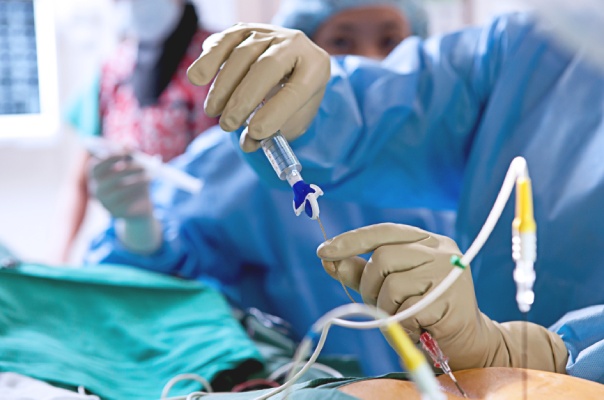
- Local anaesthesia with mild sedation is given. The patient lies face-down for the procedure.
- The physician uses live X-ray guidance to visualise the spine throughout the procedure.
- Contrast dye is injected to map the exact area affected by scar tissue.
- A thin catheter is inserted. It delivers a mixture of medication to reduce swelling and relieve pain.
- If needed, a small balloon may be used to create more space around the compressed nerve. Pulsed radiofrequency may also be applied to support nerve recovery.
Who May Benefit From Neuroplasty?
Neuroplasty (epidural adhesiolysis) may be suitable for patients with:
- Chronic lower back pain and leg pain
- Spinal stenosis
- Persistent pain following prior back or neck surgery
- A herniated disc that is not surgically correctable
- A preference to avoid open surgery
- Higher surgical risk that makes open surgery less suitable
How We Determine If Neuroplasty Is Right for You?
Not every patient with back or leg pain will benefit from neuroplasty. Scar tissue is only one possible cause of nerve compression, and other conditions can produce similar symptoms.
Before recommending neuroplasty, our pain specialists use the Painostic diagnostic approach to assess how the pain behaves, what is happening structurally, and how the nervous system is responding. This helps confirm whether scar tissue is genuinely driving the pain, and whether neuroplasty, or a different treatment in the Neurospan suite, is the better fit for that patient.
How Long Is Recovery After Neuroplasty?
Neuroplasty is a day-surgery procedure performed under local anaesthesia. Most patients go home the same day. It generally has a short recovery period, and many patients return to work or normal activities the next day.
Numbness in the legs from the anaesthesia may last up to 24 hours. Once it wears off, patients may notice a different type of ache as the original pain settles. The original pain itself may ease immediately, or take a few weeks to fully settle. This is often described as similar to recovering from a dental procedure. A short rehabilitation programme is typically recommended afterward, to strengthen the surrounding muscles. Medication (not painkillers) may also be used to help stabilise irritated nerves.
Is Neuroplasty Safe? What Are the Risks?
Serious complications are uncommon. The procedure is performed under continuous X-ray visualisation, which helps the physician stay within safe zones. There is less than a 0.5% chance of nerve injury, infection, or bleeding. As a minimally invasive procedure, it is generally associated with fewer risks and a shorter recovery than traditional open spinal surgery. Individual risk varies, and your pain specialist will review this with you beforehand.
How Long Does Pain Relief Last?
Many patients experience meaningful relief for two years or more. This is supported by published clinical research. A randomised controlled trial of 120 patients with persistent pain after back surgery found that 82% had significant improvement in pain and function two years after a course of percutaneous adhesiolysis, compared with the control group receiving epidural injections alone (Manchikanti et al., Journal of Pain Research, 2012). A separate placebo-controlled trial followed patients for 10 years and found that those who received the procedure maintained significantly better pain and disability scores than the control group throughout the follow-up period (Gerdesmeyer et al., Pain Physician, 2021).
Outcomes tend to be best when the catheter can pass through the narrowed area of the spinal canal. A 12-month study of over 400 patients with lumbar disc herniation reported good-to-excellent outcomes in 81.3% of patients at 1 month, settling to 71.7% at 12 months (Cho et al., Journal of the Korean Neurosurgical Society, 2019). The spine continues to change naturally over time, so new areas of pain can develop later, either at the same level or elsewhere in the spine. Neuroplasty is often carried out alongside nucleoplasty to support better long-term outcomes.
Frequently Asked Questions
References
- Manchikanti L, Singh V, Cash KA, Pampati V. Assessment of effectiveness of percutaneous adhesiolysis and caudal epidural injections in managing lumbar post surgery syndrome: a 2-year follow-up of randomized, controlled trial. Journal of Pain Research. 2012;5:597-608.
- Gerdesmeyer L, Noe C, Prehn-Kristensen A, et al. Long-term Efficacy of Percutaneous Epidural Neurolysis of Adhesions in Chronic Lumbar Radicular Pain: 10 Year Follow-up of a Randomized Controlled Trial. Pain Physician. 2021;24(5):359-367.
- Cho PG, Ji GY, Yoon YS, Shin DA. Clinical Effectiveness of Percutaneous Epidural Neuroplasty According to the Type of Single-Level Lumbar Disc Herniation: A 12-Month Follow-Up Study. Journal of Korean Neurosurgical Society. 2019;62(6):681-690.
Last Updated July 2026