
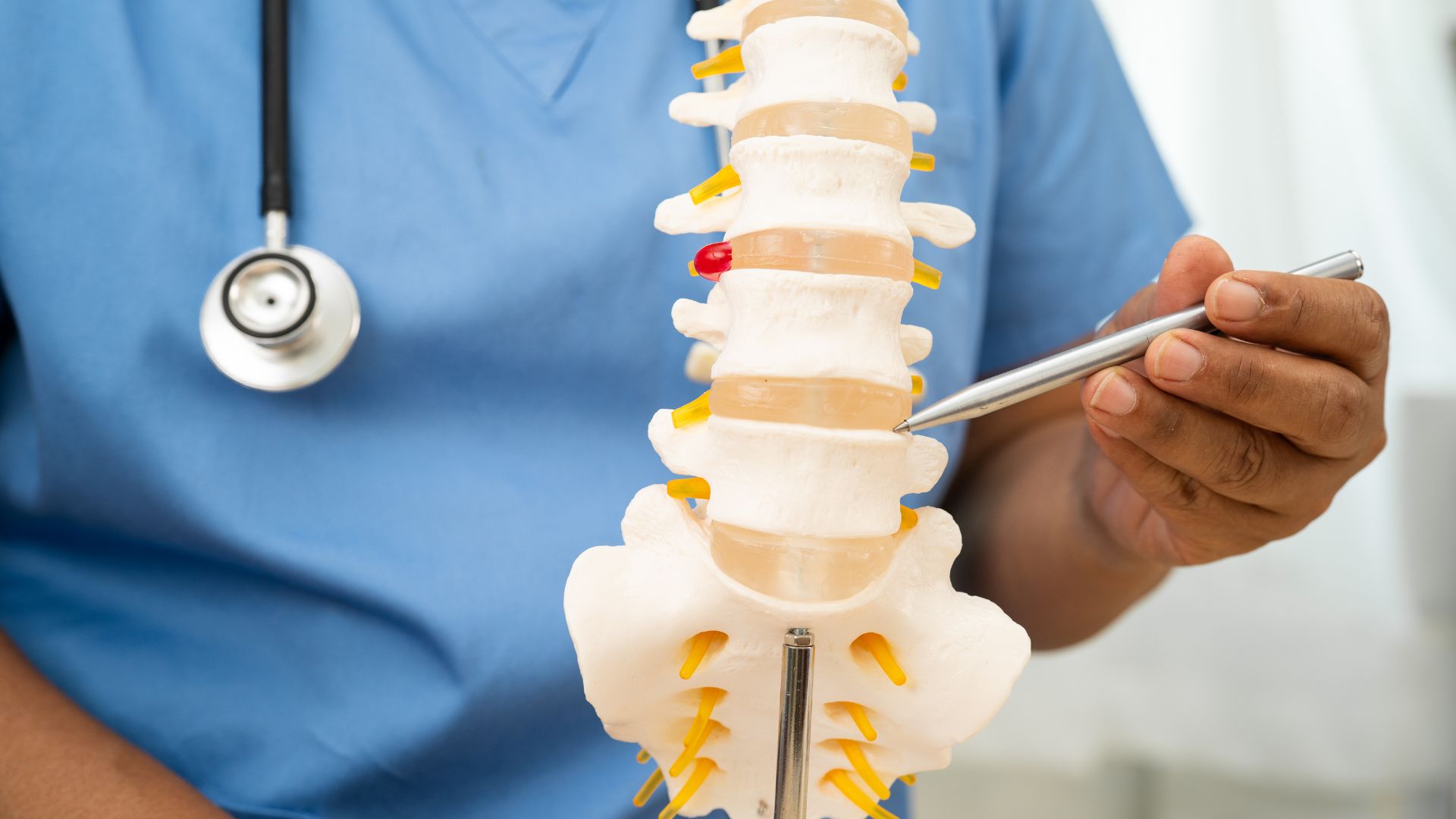
How a Pain Specialist Can Help With Your Slipped Disc / Herniated Disc Condition?
May 5, 2026
CONTENTS
Quick Answer:
A pain specialist finds the exact nerve causing your slipped disc pain and treats it using minimally invasive procedures. For most patients in Singapore, this means real relief without surgery.
You have a slipped disc. The MRI says so. You have rested, taken painkillers, maybe seen a doctor or two. But the pain is still there. Some days it is worse. Some days it travels down your leg. And you are starting to wonder — do I need surgery?
This is exactly when seeing a slipped disc specialist in Singapore matters most. Not because every slipped disc needs a procedure. But because a pain specialist can tell you clearly where your condition stands and what the right next step is, without jumping straight to surgery.
What Makes a Pain Specialist Different
When back or leg pain first appears, most people in Singapore see a GP. That is a sensible first step. A GP can check your symptoms, give you pain relief, and advise you on rest and movement.
A pain specialist goes further. They are trained to find the exact nerve or structure causing your pain. They also have access to targeted treatments that go beyond what medication or rest can achieve on their own.
An orthopaedic surgeon, by contrast, is focused on surgery. For cases that genuinely need an operation, that is the right person to see. But most slipped disc cases in Singapore do not need surgery. If you see an orthopaedic surgeon and the disc is not severe enough to operate on, you may leave with little guidance on what to do next.
A pain specialist fills that gap. They focus on treating your pain precisely, using the least invasive method that works for your specific situation.
How a Pain Specialist Diagnoses Your Slipped Disc
An MRI is a good starting point. It shows where the disc has slipped and which nerve is being pressed. But it does not explain everything.
It does not tell you why your pain feels as bad as it does. It does not show whether your nervous system has started to amplify the pain on its own. And it cannot tell you which treatment approach is right for you.
At Singapore Paincare, the diagnostic process follows the Painostic® methodology. This was developed by Dr. Bernard Lee Mun Kam, Founder and Consultant Pain Specialist. It works through three clear pathways.
Diagnostic Formulation
The specialist looks at both the physical source of your pain and how it is travelling through your body. This includes your MRI findings, but also considers other pain generators that a scan might miss. The goal is to build an accurate picture of exactly what is driving your symptoms.
Injection Roadmap
Once the pain source is confirmed, a personalised treatment plan is put together. This selects the right minimally invasive procedure for your case and combines it with physio or medication where needed.
Injection Technique
This is about precision — making sure the treatment reaches the exact spot in your spine that needs it, at the right depth, in the right way.
When the scan alone is not enough, a targeted nerve block can help. A small amount of anaesthetic is injected near the suspected nerve. If the pain eases, the source is confirmed. This kind of precise diagnostic step is part of what makes a pain specialist’s assessment different.
The Treatments a Pain Specialist Can Offer for Your Slipped Disc
Once the source of your pain is clear, the specialist chooses from a range of targeted procedures. These sit in the middle ground between rest-and-medication and full surgery. They are more direct than painkillers, but they do not carry the risks or recovery time of an operation.
For slipped disc treatment in Singapore, the relevant procedures from Singapore Paincare’s Neurospan suite include the following.
Epidural Analgesia
Sends a steroid and local anaesthetic directly to the inflamed nerve in your spine. This calms the swelling around the compressed nerve much more effectively than an oral tablet can. It is done as an outpatient procedure and works well for lower back disc herniations that cause leg pain.
Nucleoplasty
A needle-based procedure designed specifically for slipped discs. It uses controlled energy to shrink the part of the disc that is pressing on the nerve. There is no cut, no stitches, and most patients can return to light activities within days. [Understand more about Nucleoplasty]
Neuroplasty
Used when scar tissue has formed around a trapped nerve. This scar tissue, called adhesions, can develop after months of inflammation. It locks the nerve in place and keeps pain going even after the disc has settled. Neuroplasty uses a thin tube to break up the scar tissue and deliver anti-inflammatory medicine directly to the nerve. [Read more about Neuroplasty]
Pulsed Radiofrequency (PRF)
Uses a gentle signal to calm an overactive nerve. It does not damage the nerve. It just reduces how strongly the nerve sends pain signals. This works well for burning or electric nerve pain that has been going on for some time. [Read more about Pulsed Radiofrequency]
Peripheral Nerve Block
Injects a local anaesthetic around the specific nerve causing your pain. It can confirm where the pain is coming from and also give relief. It is often one of the first steps taken.
These procedures are part of a pain specialist’s specific toolkit and are what make the consultation different from a standard medical review.
A Pain Specialist’s Perspective
Many patients in Singapore wait six months to a year before seeing a pain specialist. By then, the nerve has been compressed for so long that the brain starts registering pain more intensely on its own — even when the disc problem has not gotten worse. This is called central sensitisation, and it makes treatment more complex. There is also a second pattern. Many patients feel stuck between two options: live with the pain or have surgery. But there is a whole range of procedures between those two points. They work best before the pain has been going on for years. A slipped disc that responds well to an Epidural Analgesia at three months may need Nucleoplasty by twelve months if nothing is done. Getting an accurate picture sooner keeps more options open.
When Should You See a Pain Specialist for Your Slipped Disc?
You do not need a referral. You can book directly with Singapore Paincare.
It is time to see a pain specialist if:
- Your back or leg pain has lasted more than four to six weeks and is not improving
- The pain is shooting, burning, or electric in quality
- You feel numbness or tingling in your leg, foot, arm, or hand
- You have noticed weakness in a limb
- Your MRI shows a slipped disc but you have only been offered painkillers so far
- You have been told surgery is the only option and want to explore alternatives
For a full overview of slipped disc treatment options in Singapore, visit the Singapore Paincare slipped disc treatment page.
If your pain travels down your leg, it may also be worth reading about how Singapore Paincare treats sciatica, which often goes hand in hand with a lumbar slipped disc.
Speak to a pain specialist to find out what treatment approach is right for you.
Frequently Asked Questions
I already have an MRI showing a slipped disc. Do I still need to see a pain specialist?
Yes, in most cases. An MRI shows the structure of the disc and which nerve is being pressed. But it does not explain the full picture — how severe your nerve involvement is, whether your nervous system has become sensitised, or which treatment is most likely to help. A pain specialist uses the Painostic methodology to assess all of this and shape the right treatment plan for you.
Can a pain specialist treat my slipped disc without surgery?
For most patients, yes. Singapore Paincare uses minimally invasive procedures like Nucleoplasty, Epidural Analgesia, and Neuroplasty to treat nerve compression directly without a surgical cut. Whether they are suitable for your case depends on the assessment, but the aim is always to find the least invasive approach that works.
What is the difference between a pain specialist and an orthopaedic surgeon for a slipped disc?
An orthopaedic surgeon specialises in surgery. A pain specialist specialises in non-surgical and minimally invasive treatments, and looks more closely at the nerve and pain processing side of your condition. If you want to explore all non-surgical options before deciding on surgery, a pain specialist is the right starting point.
How many sessions will treatment take?
It depends on your condition and how your body responds. Some patients get significant relief from a single procedure such as a Nucleoplasty or Epidural Analgesia. Others with more complex presentations need a combined approach over several sessions. Your pain specialist will give you a clear treatment plan after the initial assessment.
Could my slipped disc get better on its own without treatment?
For mild cases with little nerve involvement, improvement is possible with rest and time. But if you have clear nerve compression, weakness, numbness, or pain that has lasted more than six weeks, waiting is a risk. The longer nerve compression continues, the harder it can be to treat. A consultation gives you an accurate picture of where things stand without committing you to any procedure.
About Singapore Paincare
Singapore Paincare Medical Group is Singapore’s first SGX-listed pain management group, with clinics at Paragon and Novena. Founded by Dr. Bernard Lee Mun Kam, the Group uses the proprietary Painostic® diagnostic methodology to deliver personalised, minimally invasive pain treatment without surgery or long-term medication dependence.
Medical Disclaimer: This article is intended for general informational purposes only and does not constitute medical advice. Please consult a qualified healthcare professional for diagnosis and treatment tailored to your individual condition.