
How a Pain Specialist Can Help With Your Knee Pain in Singapore
May 25, 2026
CONTENTS
- What Makes a Pain Specialist Different for Knee Pain?
- How a Pain Specialist Diagnoses the Source of Your Knee Pain
- What a Pain Specialist Can Offer That Helps Your Knee Pain
- What Happens When You Cannot Avoid Surgery?
- Practical Steps You Can Take While Waiting for Your Assessment
- See a Pain Specialist for Knee Pain in Singapore
- Conclusion
- Frequently Asked Questions
Quick Answer:
A pain specialist for knee pain goes beyond painkillers and rest. They find the true source of your pain using a structured multi-dimensional assessment, then apply targeted, minimally invasive treatments matched to your diagnosis. This approach can help reduce pain, restore movement, and reduce reliance on long-term medication, without surgery. You do not need a referral to see a pain specialist in Singapore.
If you have been living with knee pain for weeks or months, chances are you have already tried the basics. Rest. Over-the-counter painkillers. Maybe a referral to physiotherapy. The pain eases a little, then comes back. You start adapting: taking the lift instead of the stairs at the MRT, skipping the morning walk, shifting your weight to the other side when you squat at the hawker centre.
What many patients in Singapore do not realise is that most of this adaptation is unnecessary. Knee pain that does not respond to basic treatment usually has a specific, identifiable cause. And when that cause is found and treated precisely, the outcome can be very different from months of managed discomfort.
This is where a pain specialist for knee pain comes in. A pain specialist is not a surgeon. They are a doctor trained in finding and treating the source of pain using targeted, minimally invasive techniques. This article explains exactly how a pain specialist approaches knee pain, what they can do that other clinicians may not, and what treatment options may be available to you.
What Makes a Pain Specialist Different for Knee Pain?
Most patients with knee pain first see a general practitioner, who may prescribe anti-inflammatory medication, order an X-ray, and refer them to physiotherapy. For many, this is enough. But for patients with persistent, recurrent, or complex knee pain, this pathway often reaches its limits quickly.
An orthopaedic surgeon specialises in the structural and surgical management of joint conditions. If your knee needs surgery, such as a ligament reconstruction or a knee replacement, an orthopaedic surgeon is the right referral.
A pain specialist sits in a distinct clinical space between these two. Their training is in chronic pain medicine, which means they are experts in diagnosing and treating pain as a condition in its own right, not just as a symptom of a structural problem. They understand that knee pain can come from the joint itself, from the soft tissues around it, from referred pathways in the spine or hip, or from a sensitised nervous system. They also understand how to distinguish between these causes, which determines the right treatment.
Singapore Paincare’s pain specialists use the Painostic® diagnostic methodology, developed by Founder and Consultant Pain Specialist Dr. Bernard Lee Mun Kam. Painostic® assesses pain across four dimensions: Pain Patterns, Pathology, Pain Perception, and Psychology. This is not a checklist. It is a structured clinical framework that ensures every dimension of a patient’s pain is considered before a treatment plan is built.
How a Pain Specialist Diagnoses the Source of Your Knee Pain
The first and most important thing a pain specialist does is diagnose accurately. This may sound obvious, but it is where many patients have been let down before they arrive at a specialist clinic.
Singapore research based on the National Health Surveillance Survey has estimated that symptomatic knee osteoarthritis affects approximately 11% of the general Singapore population, with prevalence rising sharply after age 40. But osteoarthritis is not the only cause, and it is not always the primary one. A patient can have mild osteoarthritis on a scan and severe pain, or significant arthritis and very little pain. The scan alone does not explain the patient in front of you.
A pain specialist takes a detailed pain history first. They ask about when the pain started, what makes it worse or better, how it behaves through the day, whether it disrupts sleep, and how it affects daily activities in Singapore’s context, whether that is managing stairs, sitting at a desk for eight hours, or kneeling during prayers.
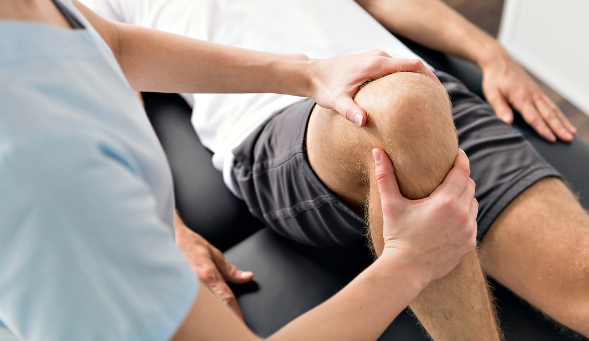
The physical examination assesses range of motion, ligament stability, muscle strength, and the alignment of the knee, hip, and lower spine together. This is important because knee pain is frequently driven by a problem above or below the joint. A stiff hip, a weak gluteal muscle, or a compressed nerve in the lower back can all generate or amplify knee pain.
Imaging such as X-rays and MRI scans is reviewed in context, not in isolation. Where the source of pain remains unclear, diagnostic injections offer a powerful tool. A small amount of local anaesthetic placed at a specific structure, such as the joint itself, a bursa, or a nerve, can confirm whether that structure is responsible for the pain. This level of precision is not available in a standard GP or physiotherapy assessment.
What a Pain Specialist Can Offer That Helps Your Knee Pain
Once the source of pain is clearly identified, a pain specialist can access a range of targeted, non-surgical treatments.
The key principle at Singapore Paincare is to start with the least invasive approach appropriate to your diagnosis, and to escalate only if the response requires it.
You can find the full treatment overview on the knee pain treatment Singapore page.
The following explains how each option works and which patients it is most suited for.
Guided Rehabilitation Support
A pain specialist does not simply send you back to physiotherapy with a referral letter. They work alongside physiotherapy as a co-ordinated part of your care, ensuring that the exercises you are doing are appropriate for your diagnosis and that you are not continuing activities that are aggravating the source of your pain. For many patients, the right rehabilitation programme after a correct diagnosis makes a significant difference to outcomes that physiotherapy alone could not achieve.
Anti-Inflammatory and Nerve-Stabilising Medication
Medication prescribed by a pain specialist is more targeted than a standard anti-inflammatory. Where the pain has a nerve-sensitisation component, which is common in patients who have had knee pain for more than three months, nerve-stabilising medications such as gabapentin or pregabalin may be added to reduce the amplified pain signals. This combination approach, matched to the specific pain mechanism, is often more effective than anti-inflammatories alone.
Coreflex Injections
Coreflex Injections deliver a combination of local anaesthetic, anti-inflammatory, and muscle relaxant directly to the affected soft tissue around the knee. This interrupts the localised pain-spasm cycle that keeps many patients trapped in persistent discomfort. Coreflex is particularly well-suited for patients with bursitis, tendinopathy, or soft tissue inflammation around the knee joint, conditions that often do not show clearly on scans but cause significant ongoing pain.
Intra-Articular Injections
For patients whose pain is generated inside the knee joint, anti-inflammatory medication and hyaluronic acid can be delivered directly into the joint space. Hyaluronic acid supplements the natural joint fluid, improving cushioning and reducing the friction that causes pain during movement. This approach is commonly used for knee osteoarthritis and is performed under imaging guidance at Singapore Paincare to ensure accurate placement.
Platelet-Rich Plasma (PRP) Therapy
Platelet-Rich Plasma (PRP) Therapy uses the patient’s own blood, processed to concentrate the growth factors naturally present in platelets, then re-injected at the site of injury. The growth factors support the body’s natural healing response. At Singapore Paincare, PRP is used for the non-surgical treatment of acute muscle and ligament injuries around the knee, with the goal of supporting tissue repair alongside pain relief.
Peripheral Nerve Block
When knee pain has a significant nerve component, a Peripheral Nerve Block may be both diagnostic and therapeutic. A local anaesthetic and anti-inflammatory are injected around the specific nerve or nerve bundle that is transmitting pain signals from the knee. When this relieves the pain, it confirms the nerve pathway as the primary driver. For patients with chronic neuropathic knee pain, or those who have had limited results from joint-based treatments, this approach opens a different treatment pathway.
Radiofrequency Ablation
For patients with persistent knee pain from osteoarthritis or chronic joint conditions who have not found lasting relief from injections alone, Radiofrequency Ablation (RFA) uses radiofrequency energy to interrupt the nerve signals transmitting pain from the knee joint. The small sensory nerves supplying the joint are targeted under imaging guidance, and the relief provided can extend well beyond what injections alone can achieve. RFA is suitable for patients who have had a positive response to a diagnostic nerve block confirming that the nerve pathway is the primary driver.
What Happens When You Cannot Avoid Surgery?
A pain specialist is not a substitute for surgery in cases where surgery is clearly needed. If your knee has a complete ligament tear, a severely displaced meniscus, or end-stage arthritis with significant bone-on-bone contact, an orthopaedic surgeon may be the right next step.
What a pain specialist can do in this context is help you get to that point with as much function and as little pain as possible, and in many cases reduce the degree of intervention needed. Patients who receive targeted minimally invasive treatment before surgery often recover faster and require less post-operative pain management.
Not every patient who is told they may need a knee replacement actually needs one immediately. A pain specialist assessment may identify treatable components that have not yet been addressed, and for some patients this can provide significant additional pain-free years before surgery becomes necessary. A pain specialist will tell you honestly when a surgical opinion is warranted and can refer you appropriately.
Practical Steps You Can Take While Waiting for Your Assessment
While you arrange a specialist assessment, there are supportive measures that help manage knee pain in day-to-day Singapore life. Strengthening the quadricep and hip muscles reduces the load on the joint. Swimming and cycling on a flat route are well-tolerated forms of exercise that maintain fitness without high-impact stress on the knee.
Applying a cold pack for fifteen minutes after activity can help settle acute swelling. Avoid prolonged kneeling, full squatting on hard floors, and sitting in low chairs for extended periods. Supportive footwear with cushioning makes a difference compared to flat slippers or sandals on Singapore’s hard surfaces.
Weight management is worth noting directly. Each kilogram of body weight generates roughly four kilograms of force on the knee joint during walking. For patients with knee osteoarthritis, even modest weight reduction can meaningfully reduce daily pain levels.
These measures support your recovery but they do not replace an accurate diagnosis or targeted treatment.
See a Pain Specialist for Knee Pain in Singapore
You do not need a referral to see a pain specialist at Singapore Paincare. You can book directly, which removes the delay that often comes from waiting for a GP letter before specialist access is granted.
If your knee pain has persisted for more than two to four weeks, is limiting your daily activities, or has not responded adequately to medication and physiotherapy, a specialist assessment is the appropriate next step. The sooner the source of pain is correctly identified, the wider the range of non-surgical options available to you.
Speak to a pain specialist for knee pain at Singapore Paincare today to book a consultation and take the first step toward a clearer diagnosis.
Conclusion
Living with knee pain in Singapore does not have to mean managing symptoms indefinitely. A pain specialist for knee pain brings a level of diagnostic precision and a range of targeted, non-surgical treatments that go well beyond what most patients have previously accessed. From accurate multi-dimensional assessment with the Painostic® methodology to treatments like Coreflex Injections, PRP Therapy, and Radiofrequency Ablation, the goal is always to find the root cause and address it directly.
If previous treatments have given you only partial or temporary relief, the missing piece is often an accurate diagnosis. Book a consultation with the pain management team at Singapore Paincare to find out what is actually driving your knee pain, and what can be done about it.
Frequently Asked Questions
How exactly can a pain specialist help my knee pain?
A pain specialist diagnoses the true source of your knee pain using a structured assessment that covers pain patterns, physical examination, imaging, and diagnostic injections where needed. Once the source is confirmed, they apply targeted treatments including corticosteroid and hyaluronic acid joint injections, Platelet-Rich Plasma (PRP) Therapy, Peripheral Nerve Blocks, or Radiofrequency Ablation, matched to your specific diagnosis. This precision-led approach can help reduce pain, improve mobility, and reduce reliance on long-term painkillers, without surgery.
Can a pain specialist treat knee pain without surgery?
Yes. Pain specialists specialise in non-surgical treatment. For most patients with knee pain, including osteoarthritis, meniscus pathology, tendinopathy, bursitis, and neuropathic knee pain, there are minimally invasive options that can reduce pain significantly without the recovery time, risks, or cost of surgery. The right non-surgical treatment depends on an accurate diagnosis, which is why the assessment is always the starting point.
Is a pain specialist the same as an orthopaedic surgeon for knee pain?
No. An orthopaedic surgeon focuses on surgical and structural management of joint conditions. A pain specialist focuses on diagnosing and treating pain using non-surgical, minimally invasive techniques. Many patients benefit from seeing a pain specialist first, particularly if they have not yet had a thorough assessment of all contributing factors, including referred pain from the spine and nervous system sensitisation. The two specialties complement each other, and a pain specialist will refer you for a surgical opinion when that is the most appropriate next step.
Why has my knee pain not improved even after physiotherapy and medication?
This usually points to one of two things. Either the underlying source of pain has not been accurately identified, meaning treatment has been directed at the wrong target, or the nervous system has become sensitised after prolonged pain, meaning the pain signal is being amplified even after the original cause is managed. A pain specialist assessment using the Painostic® methodology evaluates both possibilities so that treatment addresses the full picture.
How is knee pain assessed at Singapore Paincare?
Singapore Paincare uses the Painostic® diagnostic methodology, developed by Founder and Consultant Pain Specialist Dr. Bernard Lee Mun Kam. The assessment covers four dimensions: pain patterns, pathology, pain perception, and psychology. It begins with a detailed pain history and physical examination, followed by a review of imaging. Diagnostic injections may be used to confirm the pain source where needed. This multi-dimensional approach ensures that both structural and nerve-related components are identified before a treatment plan is built.
About Singapore Paincare
Singapore Paincare is a specialist pain management group listed on the Singapore Exchange (SGX). The group offers minimally invasive pain treatments guided by the proprietary Painostic® diagnostic methodology, developed by Founder and Consultant Pain Specialist Dr. Bernard Lee Mun Kam, across clinic locations at Paragon and Novena.
Medical Disclaimer: This article is intended for general informational purposes only and does not constitute medical advice. Please consult a qualified healthcare professional for diagnosis and treatment tailored to your individual condition.