
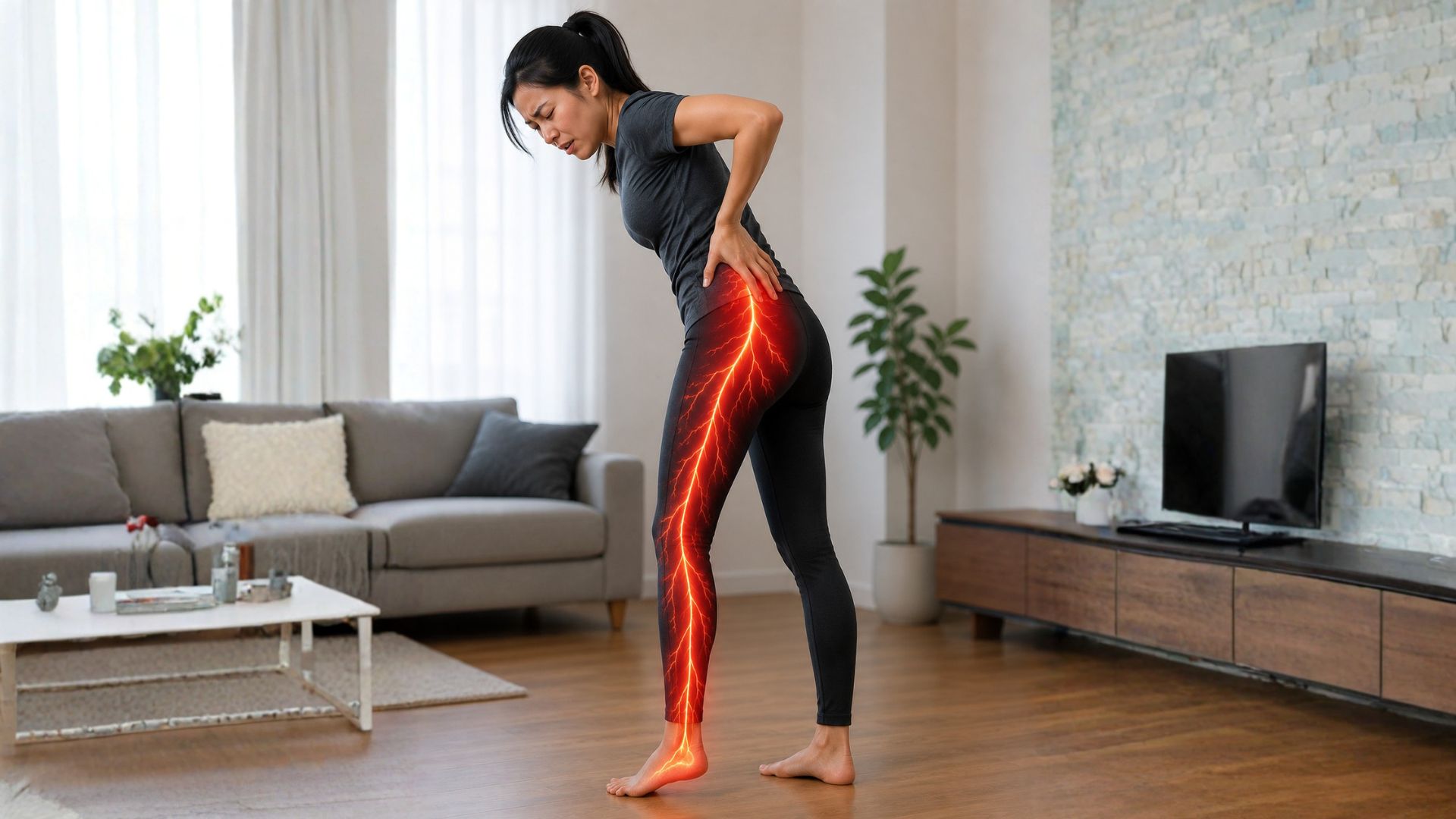
That Shooting Pain Down Your Leg: Is It Sciatica or Piriformis Syndrome?
June 10, 2026
CONTENTS
- Understanding the Sciatic Nerve and Why It Gets Irritated
- What Is Sciatica?
- What Is Piriformis Syndrome?
- How to Interpret Your Symptoms: Sciatica vs Piriformis Syndrome
- Symptoms That Accompany Sciatica and Piriformis Syndrome
- How Is Sciatica or Piriformis Syndrome Diagnosed?
- Sciatica and Piriformis Syndrome Treatment in Singapore: What Are Your Options?
- A Pain Specialist’s Perspective
- Managing Sciatica and Piriformis Pain Day to Day: Practical Tips
- When Should You See a Pain Specialist in Singapore?
- Conclusion
Quick Answer:
Sciatica and piriformis syndrome both cause shooting pain down the leg, but they are not the same condition and they do not respond to the same treatment. True sciatica starts in the lower back, where a slipped disc or bone spur compresses a spinal nerve root. Piriformis syndrome starts in the buttock, where a deep muscle called the piriformis tightens and pinches the sciatic nerve. Getting the diagnosis right is the essential first step toward lasting relief.
You sit down at your desk and a sharp, burning pain shoots from your buttock straight down the back of your leg. You stand up, hoping to shake it off, but the ache stays with you on the MRT ride home and makes it hard to get comfortable in bed. This kind of leg pain is one of the most common complaints seen by pain specialists in Singapore, and it almost always comes down to one of two diagnoses: sciatica or piriformis syndrome.
They look and feel almost identical. Both involve the sciatic nerve, both produce pain that travels down the leg, and both can leave you unable to sit for more than a few minutes without discomfort. But the causes are different, the anatomy involved is different, and the treatment that will actually resolve your pain is different too.
This article explains what sciatica and piriformis syndrome are, how a pain specialist tells them apart, and what treatment options are available in Singapore, from physiotherapy and targeted injections right through to minimally invasive nerve procedures.
Understanding the Sciatic Nerve and Why It Gets Irritated
The sciatic nerve is the longest nerve in the human body. It begins in the lower back, where five nerve roots from the lumbar and sacral spine join together, and it travels through the buttock, down the back of the thigh, and all the way to the foot. Because it runs such a long course, it can be compressed or irritated at more than one point along the way, which is precisely why sciatica and piriformis syndrome produce such similar symptoms.
Low back pain and related nerve pain are extremely common in Singapore. A 2022 cross-sectional study published in the journal Scientific Reports found that approximately 8.1% of adults in Singapore reported chronic low back pain, with 80.5% of them having sought treatment at a primary care or specialist clinic. A Singapore General Hospital study published via SingHealth’s HealthXchange found that 42% of office workers reported lower back pain, making it one of the three most common sites of work-related musculoskeletal pain in the country.
With Singapore’s workforce heavily concentrated in desk-bound roles, and with many commuters spending long periods seated on buses and MRT trains, the sciatic nerve is under near-constant pressure throughout the working day. Understanding where that pressure is coming from is what separates a diagnosis that resolves the problem from one that simply masks it.
What Is Sciatica?
Sciatica is not a diagnosis in itself. It is a symptom: pain, numbness, or weakness that follows the path of the sciatic nerve because one of the nerve roots in the lumbar spine is being compressed or irritated. Doctors sometimes call this lumbar radiculopathy, which is the clinical term for pain arising from a compressed spinal nerve root.
According to Singapore Paincare’s clinical data, approximately 70% of patients presenting with sciatica-type symptoms have a spinal source of nerve compression. The most common cause is a slipped disc, also known as a herniated disc, in the lower lumbar spine. When the soft inner material of a spinal disc pushes outward through a tear in its outer casing, it can press directly onto a nerve root, causing intense pain that radiates along the nerve’s entire path.
Other spinal causes include spinal stenosis, which is a narrowing of the spinal canal that squeezes the nerve roots passing through it, and spondylolisthesis, where one vertebra slips forward over the vertebra below, creating pressure on nearby nerves. Degenerative changes in the lumbar spine, including bone spurs and thickened ligaments, can produce the same effect.
The hallmark of true sciatica is that pain tends to start in the lower back and radiate down the leg in a specific dermatomal pattern, meaning it follows the path of a particular nerve root. Neurological signs, such as weakness in the leg, reduced reflexes, or altered sensation in a predictable area of the foot, often accompany the pain. These signs help a pain specialist identify which nerve root is affected and at what level of the spine.
What Is Piriformis Syndrome?
Piriformis syndrome is sometimes called pseudo-sciatica, and for good reason. It produces pain that feels almost identical to sciatica, yet the source is not in the spine at all.
The piriformis is a small, pear-shaped muscle that sits deep in the buttock. It connects the lower portion of the sacrum, the triangular bone at the base of the spine, to the upper part of the femur, or thigh bone, and its job is to help rotate the hip outward during walking and running. The sciatic nerve passes either just below the piriformis or, in a small proportion of people, directly through the muscle itself.
When the piriformis becomes tight, inflamed, or goes into spasm, it can compress the sciatic nerve where the two structures meet. The result is a deep, aching pain in the buttock that may radiate down the leg, mimicking the pattern of spinal sciatica. Singapore Paincare’s clinicians estimate that approximately 30% of patients presenting with sciatica-type pain have an extra-spinal source, with piriformis syndrome being one of the most common causes.
The condition is particularly common in people who spend long hours seated, which includes a large share of Singapore’s office-working population. Sitting causes the hip to flex and internally rotate, placing the piriformis under sustained stretch and making it more prone to tightening. It is also seen in runners and people who walk long distances on uneven surfaces, as well as in anyone who has experienced a fall or impact to the buttock area.
How to Interpret Your Symptoms: Sciatica vs Piriformis Syndrome
The two conditions share many symptoms, but understanding where your pain is most intense and what makes it worse can point toward which condition is more likely before you see a specialist.
True sciatica from a spinal source tends to produce pain that originates clearly in the lower back before radiating down the leg. You may notice that bending forward, sneezing, or coughing sharply intensifies the pain, because these actions increase pressure inside the spinal canal. The pain may follow a predictable strip down the leg, for example the outer calf and top of the foot if the fifth lumbar nerve root is involved, and you may notice weakness when trying to stand on your toes or flex your foot upward.
Piriformis syndrome, by contrast, tends to produce pain that is worst deep in the buttock rather than in the lower back. Sitting for prolonged periods, particularly on a hard surface or with one leg crossed over the other, typically aggravates it significantly. Climbing stairs, squatting, or rotating the hip inward can provoke a sharp, cramping pain in the buttock that may shoot down the back of the thigh. Many patients describe tenderness when pressing on a specific point in the middle of the buttock.
It is worth noting that these patterns overlap, and some patients have both conditions simultaneously. A compressed spinal nerve root and an irritated piriformis can coexist, particularly in patients with longstanding lumbar degeneration. This overlap is one of the reasons why self-diagnosis carries real risk. The wrong treatment applied to the wrong source of pain will not provide lasting relief.
Symptoms That Accompany Sciatica and Piriformis Syndrome
Both conditions can produce pain, tingling, numbness, and a feeling of weakness in the affected leg. The intensity ranges from a mild, persistent ache to a sharp electric shock that stops you mid-movement. Some patients describe a burning quality to the pain, particularly along the calf.
With sciatica from a spinal cause, it is common to notice that lying flat on your back with your legs straight makes the pain worse, while drawing your knees toward your chest provides some relief. Pain typically runs from the lower back through the buttock, down the back or outer side of the thigh, into the calf, and sometimes to the foot.
With piriformis syndrome, the pain is more localised to the buttock and upper thigh. Lying on the affected side is often uncomfortable. Unlike spinal sciatica, there are usually no changes in reflexes or objective muscle weakness when a physiotherapist or doctor tests specific nerve root functions, though there may be tenderness in the deep buttock tissue.
Seek urgent medical assessment if you experience any of the following:
- Loss of bladder or bowel control alongside leg pain
- Saddle area numbness (inner thighs and genitals)
- Rapid or progressive weakness in both legs
- Leg pain following a significant fall or road traffic accident
- Fever with spine pain
- Unintentional weight loss alongside persistent back or leg pain
These symptoms may indicate cauda equina syndrome or another serious spinal condition requiring immediate attention.
How Is Sciatica or Piriformis Syndrome Diagnosed?
Accurate diagnosis is the cornerstone of effective pain management, and it is exactly where Singapore Paincare’s Painostic methodology makes a clinical difference.
Painostic is the proprietary diagnostic framework developed by Singapore Paincare’s founder and consultant pain specialist Dr. Bernard Lee Mun Kam. It assesses pain across four dimensions: Pain Patterns, Pathology, Pain Perception, and Psychology. For a condition as clinically overlapping as sciatica and piriformis syndrome, this multi-dimensional approach matters enormously.
The assessment begins with a detailed pain history. Your specialist will ask about the precise location of your pain, what triggers or relieves it, how long you have had it, and how it has changed over time. These pain patterns often reveal whether the source is spinal or muscular before any imaging is reviewed.
A physical examination follows, including specific clinical tests designed to reproduce buttock and leg pain by placing the piriformis under stretch or load. Tests such as the FAIR test (flexion, adduction, and internal rotation of the hip) can help identify piriformis involvement, while straight-leg raise testing and dermatomal mapping help identify a spinal nerve root cause.
Imaging, typically an MRI of the lumbar spine, is used to identify disc herniations, spinal stenosis, or nerve root compression. An MRI showing a disc herniation does not automatically mean the disc is the cause of your leg pain, as imaging findings and clinical symptoms do not always correlate. This is another reason why clinical pattern analysis through Painostic formulation is so important.
In some cases, a diagnostic injection into the piriformis muscle under ultrasound guidance can both confirm the diagnosis and provide immediate therapeutic relief. If the injection reproduces and then settles your buttock pain, it confirms the piriformis as a meaningful pain generator.
Sciatica and Piriformis Syndrome Treatment in Singapore: What Are Your Options?
Treatment differs significantly depending on whether your pain is coming from the spine or from the piriformis muscle. A definitive Painostic assessment guides which pathway is appropriate for you. You can learn more about the full range of available treatments on the sciatica treatment Singapore page.
The general principle at Singapore Paincare is least-invasive first: start with the approach that carries the lowest risk and recovery burden, then progress to more targeted interventional procedures if needed.
Activity Modification and Rest
For both conditions, short-term activity modification helps reduce acute pain and inflammation. Avoiding prolonged sitting, adjusting workstation ergonomics, and taking regular standing breaks can reduce sustained pressure on the piriformis or on inflamed spinal nerve roots. Rest is not synonymous with complete immobility, however. Staying gently mobile, with guided stretching and walking, supports recovery better than bed rest.
Physiotherapy and Rehabilitation
Physiotherapy is a cornerstone of treatment for piriformis syndrome. A structured programme of piriformis stretching, hip strengthening, and gait correction can resolve many cases of piriformis-related leg pain over six to twelve weeks. For sciatica with a spinal cause, physiotherapy focused on core stabilisation and lumbar mobility supports the spine and reduces the mechanical load on compressed nerve roots. The intensity and approach of physiotherapy varies with each patient’s presentation, and Singapore Paincare’s allied health team tailors programmes to individual recovery goals.
Anti-Inflammatory Medication
Non-steroidal anti-inflammatory drugs (NSAIDs) such as celecoxib or diclofenac can reduce nerve inflammation and provide short-term pain relief. For neuropathic pain, nerve-stabilising medications such as gabapentin or pregabalin may help manage the burning, electric-shock quality of sciatic nerve pain. Medication is used to support function during rehabilitation, not as a long-term standalone solution.
Coreflex Injections
For piriformis syndrome that has not responded to stretching and physiotherapy alone, Coreflex Injections offer a targeted approach. Coreflex uses a combination of local anaesthetic, anti-inflammatory agent, and muscle relaxant, delivered directly into the piriformis muscle. The injection breaks the pain cycle by reducing muscle spasm and local inflammation, allowing the nerve to decompress and the surrounding tissue to begin healing. Many patients experience significant relief after a single treatment, and the procedure can be performed on an outpatient basis with minimal downtime.
Platelet-Rich Plasma (PRP) Therapy
Platelet-Rich Plasma (PRP) Therapy is a regenerative option for patients with chronic piriformis-related pain or underlying soft tissue injury to the muscle. PRP is prepared from the patient’s own blood: a small sample is processed to concentrate the platelets, which contain growth factors that promote tissue repair. When injected into the affected area, PRP stimulates healing through a controlled, low-grade biological response. It is particularly suitable for patients who have recurring piriformis syndrome or an underlying muscle strain contributing to the condition.
Peripheral Nerve Block
A Peripheral Nerve Block delivers a precise combination of local anaesthetic and anti-inflammatory medication around the sciatic nerve itself. This blocks pain signals from reaching the central nervous system and provides therapeutic relief by reducing nerve inflammation. It is used both diagnostically, to confirm the sciatic nerve as a pain generator, and therapeutically, as part of a broader treatment plan for patients with significant sciatica-related neuropathic pain.
Epidural Analgesia
For sciatica arising from spinal nerve root compression due to a slipped disc or spinal stenosis, Epidural Analgesia delivers steroid and local anaesthetic medication directly to the epidural space at the relevant spinal level. This targets the inflammation around the compressed nerve root, reduces swelling, and allows the nerve to recover. It is one of the most clinically established minimally invasive treatments for spinal sciatica and is performed as an outpatient procedure under image guidance.
Nucleoplasty
Nucleoplasty is a minimally invasive procedure indicated for sciatica caused by a herniated disc pressing on a nerve root. Using controlled plasma energy delivered through a fine needle, the procedure decompresses the disc by reducing the volume of herniated tissue, thereby relieving pressure on the nerve root. It is an outpatient procedure with a short recovery period, suitable for patients whose sciatica is confirmed to originate from a specific disc level and who have not responded to conservative treatment.
Neuroplasty
For patients with sciatica caused by spinal stenosis or scar tissue compressing a nerve root, Neuroplasty offers a targeted decompression approach. A fine catheter is guided into the epidural space and used to mechanically break down adhesions and free the trapped nerve. Anti-inflammatory and decongestant medication is delivered directly to the site, reducing swelling and restoring nerve mobility. It is particularly suited to patients with complex or recurrent spinal sciatica.
A Pain Specialist’s Perspective
One of the most common clinical errors I see in patients arriving at our clinic is the assumption that a positive MRI finding explains their leg pain. A patient may have a disc herniation visible on imaging at L4/5, which leads to a confident diagnosis of sciatica from the spine. Yet after nerve root injections and physiotherapy directed at that level, the pain persists.
When I re-examine these patients using the Painostic framework, paying close attention to the exact location of the pain, the pattern of aggravation, and the response to position changes, a significant proportion of them have piriformis syndrome as the primary or co-existing pain driver. The disc herniation was real, but it was not the source of the leg pain.
This pattern is particularly common in Singapore patients who are sedentary during the day and then exercise intensively on weekends, a lifestyle that both increases lumbar disc load and places the hip rotators under repetitive strain. It also appears frequently in middle-aged patients who have begun to notice hip stiffness from early degenerative changes, causing the piriformis to compensate for reduced hip mobility.
The clinical takeaway is this: when sciatica does not respond to treatment as expected, the piriformis should always be assessed as an alternative or contributing source. Conversely, if a patient with apparent piriformis syndrome has any neurological signs, such as altered reflexes or objective weakness, a spinal cause must be excluded before concluding that the muscle is solely responsible. Getting this distinction right at the outset avoids months of misdirected treatment and unnecessary suffering.
Managing Sciatica and Piriformis Pain Day to Day: Practical Tips
While awaiting specialist assessment or working through a treatment programme, there are practical steps that can help reduce pain and prevent flare-ups.
Ergonomic adjustment at the desk is one of the most effective changes available to Singapore’s office workers. Raise your chair so your hips are slightly above your knees, use a lumbar support cushion, and set a reminder to stand and walk for two to three minutes every forty-five minutes. This reduces sustained piriformis stretch and lowers the mechanical load on the lumbar discs.
Avoiding leg-crossing when seated relieves pressure on the piriformis. If you travel on the MRT and tend to sit for long commutes, shifting weight periodically and keeping both feet flat on the floor makes a meaningful difference. Sleeping on your back with a pillow under your knees, or on your side with a pillow between your knees, reduces overnight nerve compression.
Gentle stretching of the piriformis, such as lying on your back, crossing the affected ankle over the opposite knee, and drawing both legs toward your chest, is beneficial for piriformis syndrome. However, the stretch should be introduced gradually and not forced. If it reproduces your leg pain rather than easing it, stop and seek clinical guidance.
These are supportive measures, not substitutes for a proper diagnosis. Self-managing sciatica or piriformis pain without identifying the underlying cause may delay effective treatment and allow the condition to become more entrenched
When Should You See a Pain Specialist in Singapore?
You should seek professional assessment rather than waiting to see if the pain improves on its own if your leg pain has lasted more than four weeks, if it is getting progressively worse, or if it is affecting your ability to work, sleep, or carry out daily activities.
You do not need a referral to see a pain specialist at Singapore Paincare. If your pain is accompanied by any of the neurological red flags described earlier in this article, seek assessment urgently.
A formal pain assessment through the Painostic methodology gives you a clear clinical picture of what is causing your pain, a precise treatment roadmap, and a realistic timeline for recovery. Without an accurate diagnosis, the risk is months of treatment directed at the wrong source, and pain that becomes harder to resolve the longer it is left.
Speak to a pain specialist at Singapore Paincare to take the first step toward understanding whether your pain is coming from the spine, the piriformis, or both. Book a consultation with our pain management team at our Paragon or Novena clinics, no referral required.
Conclusion
Sciatica and piriformis syndrome are two of the most misunderstood pain conditions in Singapore. They share nearly identical symptoms, yet they are distinct conditions with different anatomical sources, different treatment pathways, and different prognoses. True sciatica, which comes from a compressed nerve root in the lumbar spine, requires a spinal-focused approach. Piriformis syndrome, which comes from a tight or inflamed deep buttock muscle, requires muscle-focused treatment. In some patients, both are present simultaneously.
Getting an accurate diagnosis through the Painostic framework, which looks at pain patterns, structural pathology, nerve sensitisation, and contributing lifestyle factors, is what makes it possible to target treatment precisely. Whether your pain needs a Coreflex Injection, Epidural Analgesia, Nucleoplasty, or a physiotherapy-led rehabilitation programme, the right approach starts with a clear diagnosis.
Book a consultation with our pain management team at Singapore Paincare. No referral is needed.
Read More: Sciatica | Piriformis Syndrome
FAQ
What is the difference between sciatica and piriformis syndrome?
Sciatica is leg pain caused by compression of a nerve root in the lumbar spine, most commonly from a slipped disc or spinal stenosis. Piriformis syndrome is leg pain caused by the piriformis muscle in the buttock compressing the sciatic nerve outside the spine. Both produce similar symptoms, including shooting pain down the leg, but the source is different and so is the treatment. An MRI and clinical assessment are needed to tell them apart accurately.
Can sciatica or piriformis syndrome go away on its own?
Mild cases of both conditions can improve over several weeks with rest, activity modification, and stretching. However, sciatica from a spinal cause that persists beyond four to six weeks, or that includes neurological signs such as weakness or altered reflexes, requires medical assessment. Piriformis syndrome that keeps returning despite stretching often has an underlying cause, such as hip stiffness or muscle imbalance, that needs to be identified and addressed. Waiting without diagnosis increases the risk that the condition becomes chronic and harder to treat.
What are the red flags in sciatica that require urgent care?
Seek urgent medical attention if your leg pain is accompanied by loss of bladder or bowel control, numbness in the saddle area (inner thighs and around the genitals), or rapidly worsening weakness in both legs. These symptoms may indicate cauda equina syndrome, a serious spinal emergency. Fever with back pain, pain following a significant fall, and unexplained weight loss alongside persistent back or leg pain also warrant prompt assessment.
What non-surgical treatments are available for sciatica in Singapore?
A range of minimally invasive options are available at Singapore Paincare. For piriformis syndrome, Coreflex Injections and Platelet-Rich Plasma (PRP) Therapy target the muscle directly. For spinal sciatica, Peripheral Nerve Block and Epidural Analgesia reduce nerve root inflammation, while Nucleoplasty and Neuroplasty decompress the affected disc or nerve root. All procedures are performed on an outpatient basis, and treatment is guided by the Painostic diagnostic framework to ensure precision targeting.
How is sciatica diagnosed at Singapore Paincare?
Singapore Paincare uses the Painostic methodology to assess sciatica and piriformis syndrome. This covers four dimensions: Pain Patterns, Pathology, Pain Perception, and Psychology. The process begins with a detailed pain history and physical examination, including specific clinical tests for piriformis involvement and spinal nerve root compression. An MRI of the lumbar spine is typically arranged, and in some cases a diagnostic injection into the piriformis or epidural space is performed to confirm the source of pain. This multi-dimensional approach ensures that treatment is directed at the true cause rather than at imaging findings alone.
About Singapore Paincare
Singapore Paincare is a specialist pain management group led by consultant pain specialists with over 20 years of clinical experience. The group operates from clinics at Paragon and Novena, offering minimally invasive pain treatments guided by the proprietary Painostic diagnostic methodology. No referral is needed to book a consultation.
Medical Disclaimer
This article is intended for general informational purposes only and does not constitute medical advice. Please consult a qualified healthcare professional for diagnosis and treatment tailored to your individual condition.