

Featured in U-Weekly: Dr. Bernard Lee Discusses Chronic Knee Pain
May 11, 2026
CONTENTS
Ten Years of Knee Pain — and One Consultation That Changed Everything
Imagine living with knee pain for a decade. No long walks. No stairs without discomfort. Restless nights because the ache won’t let you settle.
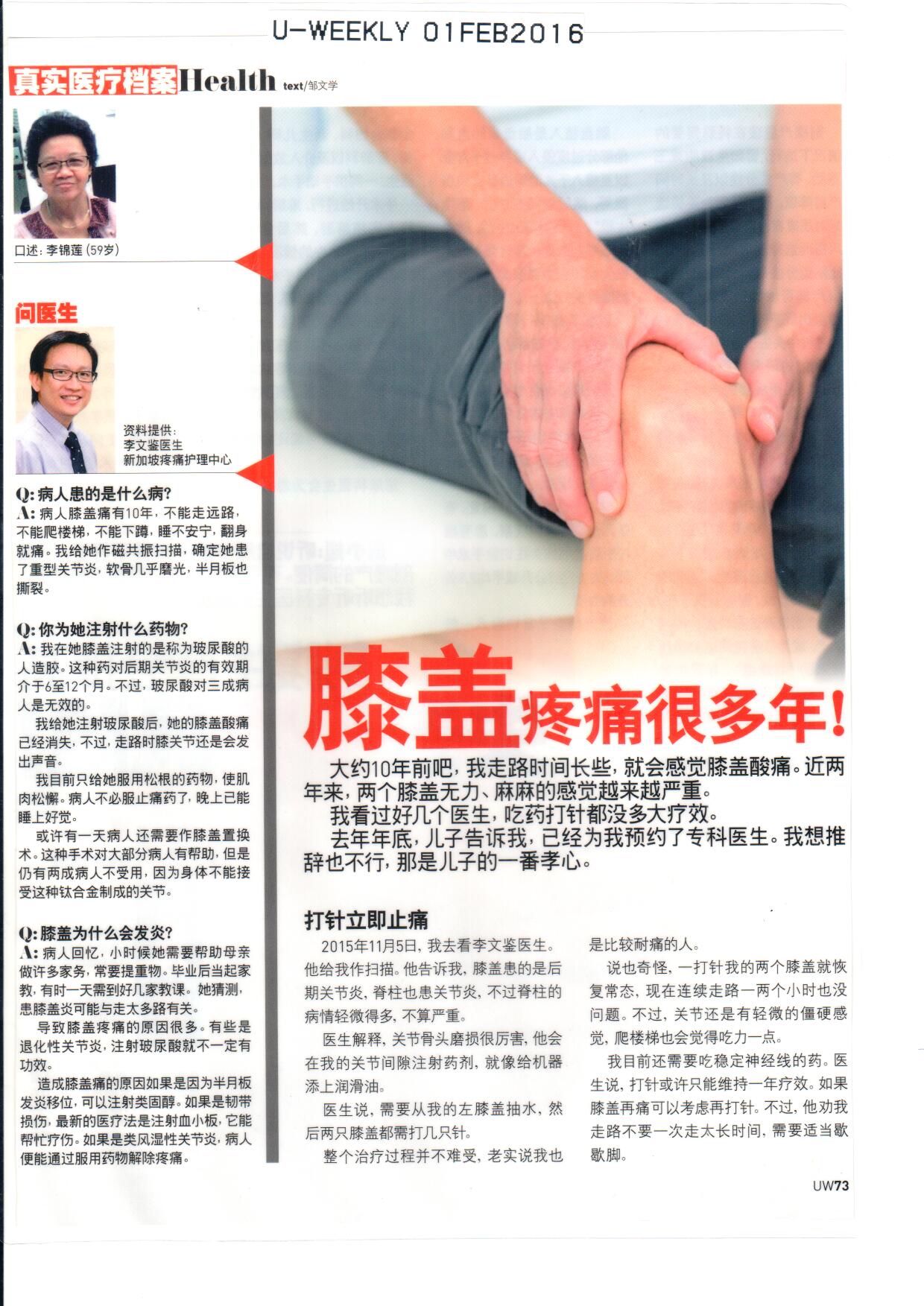
That was the reality for a 59-year-old Singapore woman whose story was featured in U-Weekly on 1 February 2016. Her case — and the doctor who treated her — caught the attention of one of Singapore’s most widely read Chinese-language lifestyle magazines.
The doctor they turned to was Dr. Bernard Lee Mun Kam (李文鉴医生), Consultant Pain Specialist and Founder of Singapore Paincare Center.
What Dr. Bernard Lee Shared
The patient had been living with bilateral knee pain since her forties. In the two years leading up to her consultation, the weakness and numbness in both knees had grown progressively worse. She had seen multiple doctors. She had taken medication and tried injections. Nothing had produced lasting relief.
Dr. Lee ordered an MRI scan. The findings were significant: severe joint inflammation, cartilage that had worn down almost completely, and a torn meniscus.
He explained that the joint surfaces had been grinding against each other — and that the joint needed lubrication, not just pain relief. He injected hyaluronic acid directly into both knees. Hyaluronic acid is a substance that acts like a lubricating fluid inside the joint. It is indicated for late-stage joint inflammation, and its effects can last between six to twelve months. Dr. Lee noted that it is not effective for approximately one in three patients — a candid acknowledgement of its limitations that reflects the clinical honesty Singapore Paincare is built on.
He also prescribed muscle relaxants to address the muscular component of her pain, allowing her to sleep through the night for the first time in years.
For her longer-term outlook, Dr. Lee discussed the possibility of knee replacement surgery — noting that while it helps most patients, roughly two in ten are unable to receive a titanium joint due to physiological compatibility. He made clear that this was a conversation for the future, not an immediate recommendation.
The patient’s response, as reported in U-Weekly, was striking. After a single treatment session, the pain in both knees subsided. She was walking for one to two hours without difficulty. There remained some mild stiffness and occasional effort on stairs — which Dr. Lee addressed by prescribing nerve-stabilising medication — but the transformation from where she had been was significant.
His advice was practical and grounded: keep walking, but do not overdo it. Rest when needed.
About Dr. Bernard Lee Mun Kam (李文鉴医生)
Dr. Bernard Lee Mun Kam is the Founder and CEO of Singapore Paincare Holdings Limited, listed on the Singapore Exchange (SGX) in 2020 — the first publicly listed pain management group in Singapore. He serves as Consultant Pain Specialist at Singapore Paincare Center.
Over more than 20 years of clinical practice, Dr. Lee has built his career around one principle: lasting pain relief requires finding the true source of pain, not just managing its symptoms.
Key career milestones:
- Established Chronic and Interventional Pain Management Service, Tan Tock Seng Hospital (2002–2007); Director, Pain Management Unit, Department of Anaesthesia
- Founded Singapore’s first Women’s Pain Centre, KK Women’s and Children’s Hospital (2009–2018)
- Developed the Painostic® diagnostic methodology — Singapore Paincare’s proprietary approach to multi-dimensional pain assessment
- Founded Singapore Paincare Academy, a training institute for allied health, TCM, physiotherapy, and medical professionals
Clinical specialties: Joint pain, knee pain, spine and back pain, shoulder pain, nerve pain, headache and facial pain, musculoskeletal pain, and cancer pain.
Dr. Lee conducts consultations at Singapore Paincare Center @ Paragon and Singapore Paincare Center @ Novena.
Frequently Asked Questions About Knee Pain
What causes chronic knee pain that lasts for years?
Chronic knee pain lasting several years is often caused by progressive joint degeneration — where cartilage wears down over time, leaving joint surfaces grinding against each other. Contributing factors can include a torn meniscus, ligament damage, rheumatoid arthritis, or past injuries. Identifying the underlying cause through imaging and clinical assessment is the first step toward effective treatment.
What is hyaluronic acid injection for knee pain, and how does it work?
Hyaluronic acid is a naturally occurring substance that lubricates healthy joints. When injected directly into a damaged or inflamed knee joint, it may reduce friction, improve mobility, and decrease pain. Effects typically last between six and twelve months. It is most commonly used for late-stage joint inflammation and is not suitable for every patient — a pain specialist can advise whether it is appropriate for your condition.
When should I see a pain specialist instead of a general doctor for knee pain?
If your knee pain has persisted for more than three months, is worsening over time, interferes with sleep or daily activities, or has not responded to medication or physiotherapy, consulting a pain specialist is advisable. A specialist can order the right imaging, identify the root cause, and discuss both non-surgical and minimally invasive treatment options.
Is knee replacement surgery the only solution for severe knee arthritis?
No. Knee replacement surgery is one option for severe arthritis, but it is not always the first recommendation. Minimally invasive treatments — including intra-articular injections, hyaluronic acid therapy, and other interventional procedures — may provide meaningful relief and help delay or avoid surgery for many patients. Your pain specialist can assess whether you are a candidate for these approaches before surgery is considered.
Can knee pain cause numbness or weakness in the legs?
Yes. Advanced knee joint inflammation can affect surrounding nerves and muscles, leading to sensations of numbness, weakness, or instability. If you are experiencing these symptoms alongside knee pain, it is important to seek a full clinical assessment — including an MRI — to rule out nerve involvement and determine the appropriate treatment pathway.
What does a consultation with a pain specialist for knee pain involve?
A consultation typically begins with a detailed pain history: how long you have had the pain, what aggravates it, how it affects your daily life. The specialist may order imaging such as an MRI or X-ray to assess the joint. A personalised treatment plan is then developed — which may include medications, injections, physiotherapy, or a combination of minimally invasive interventions tailored to your specific diagnosis.
Read the Original Feature
This article is based on the 真实医疗档案 (True Medical Case Files) column in U-Weekly, published 1 February 2016. The column was written by 邹文学. The original print feature is titled 膝盖疼痛很多年! (Knee Pain for Many Years!). Dr. Bernard Lee Mun Kam (李文鉴医生) is credited as the medical contributor, representing 新加坡疼痛护理中心 (Singapore Paincare Center).
Read the original article here
Speak to a Pain Specialist
If you have been living with knee pain — or any persistent joint pain — and have not found lasting relief, a consultation with a pain specialist may help identify options you have not yet explored.
Book a consultation with our pain management team.
Singapore Paincare Center @ Paragon 290 Orchard Road #18-03, Singapore 238859
Singapore Paincare Center @ Novena 38 Irrawaddy Road #07-33, Singapore 329563
Visit sgpaincare.com for current clinic hours and appointment booking.
No referral needed.
Medical Disclaimer
This article is intended for general informational purposes only and does not constitute medical advice. The clinical details referenced are drawn from a published media feature and are presented for informational and educational purposes. Please consult a qualified healthcare professional for diagnosis and treatment tailored to your individual condition.
Update May 2026