
Dr. Bernard Lee on Slipped Disc and Back Pain — Medical Insights Featured in U Weekly
August 31, 2026
CONTENTS
Back pain that keeps returning can be frustrating, especially when you are unsure what is causing it. For some people, the pain may be linked to a protruding or slipped disc in the spine. But finding a disc problem does not automatically tell you what treatment you need.
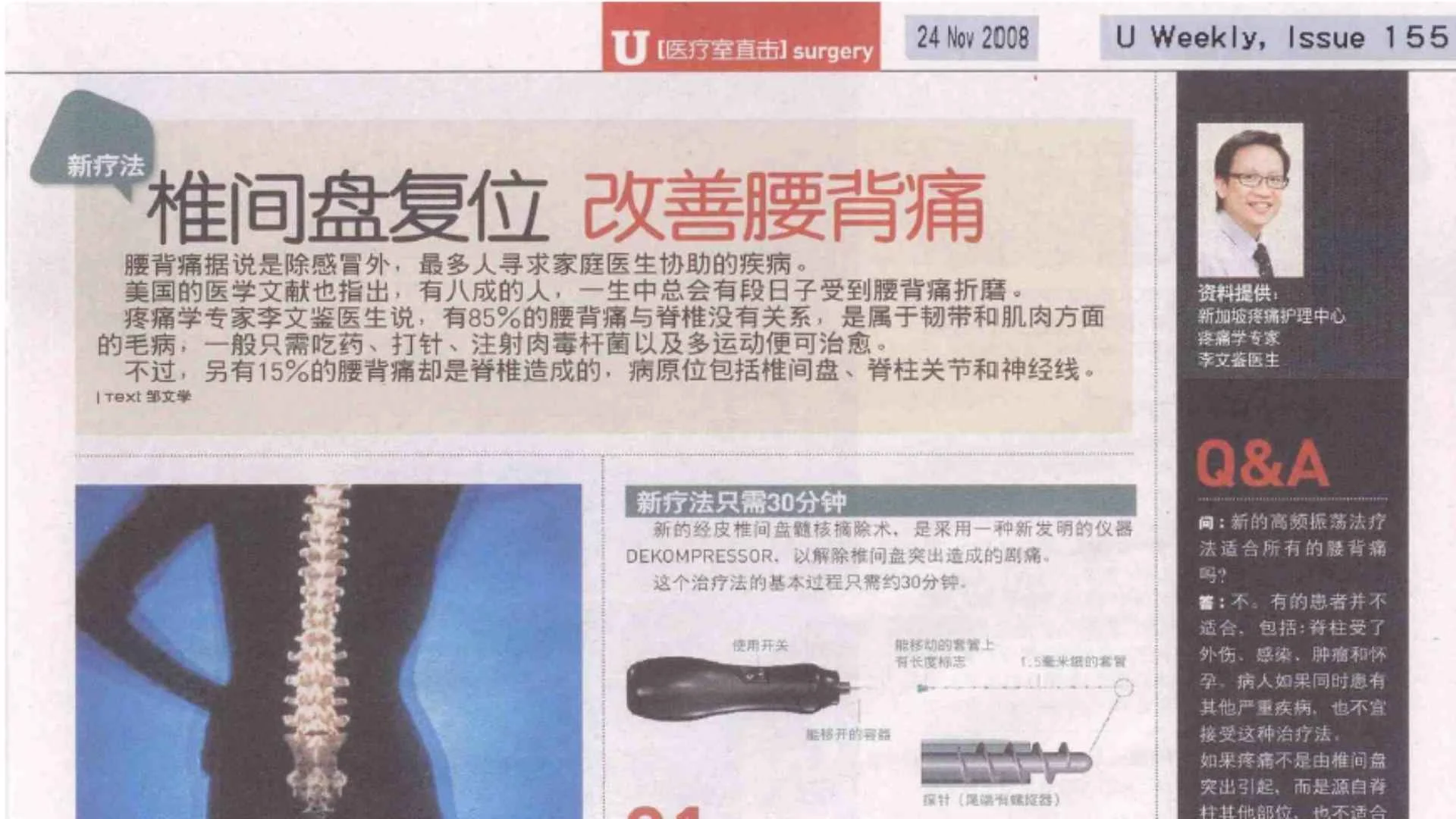
This was a topic explored in U Weekly on 24 November 2008. In Issue 155, the publication featured 《椎间盘复位 改善腰背痛》, with medical information provided by Dr. Bernard Lee Mun Kam (李文鉴医生) of Singapore Paincare Center.
The archived feature offers an early record of Dr. Lee sharing his expertise in back pain and minimally invasive pain management with the public. While the procedure discussed reflects medical practice at that time, several broader points raised in the article remain useful when understanding disc-related back pain today.
Can a Slipped Disc Cause Back Pain?
A spinal disc sits between the bones of the spine and helps absorb pressure. In the U Weekly feature, a protruding disc was discussed as one possible source of persistent lower back pain.
The article explained that when disc material protrudes, it may affect nearby nerves and contribute to pain. This helps explain why some people with disc problems may experience symptoms beyond a simple backache.
However, back pain can have many possible causes. A disc abnormality is only one possibility, which is why identifying the likely source of the symptoms matters before treatment is considered.
What Did Dr. Bernard Lee Share in U Weekly?
The 2008 U Weekly article focused on a minimally invasive disc decompression technique using the Dekompressor system.
The illustrated sequence in the original feature showed a small instrument being guided into the affected disc under X-ray imaging. The article described removing a small amount of disc material to reduce pressure within the disc.
The accompanying Q&A also addressed practical questions patients may have had at the time, including who might be suitable for the procedure, whether anaesthesia was required and the limitations of the treatment.
Importantly, the feature did not present the procedure as suitable for everyone.
The procedure described by U Weekly should be understood in its 2008 historical context. Medical technology and treatment approaches change over time, so the article should not be taken as a current recommendation for the Dekompressor procedure.
Does Every Slipped Disc Need a Procedure?
No. The U Weekly Q&A itself highlighted that suitability for the featured procedure depended on the patient’s individual condition.
That distinction is important for anyone reading about slipped disc treatment. Two people can have similar findings on a scan but experience very different symptoms. The location of the pain, whether a nerve is affected, physical examination findings and other clinical factors can all influence what treatment may be appropriate.
For this reason, a scan result alone should not be used to decide whether someone needs a procedure.
Why Finding the Source of Back Pain Matters
Persistent back pain can arise from different structures in and around the spine. Understanding the likely pain source helps a doctor determine whether symptoms are related to a disc, nerve, joint, muscle or another structure.
This diagnostic focus is also reflected in Dr. Bernard Lee Mun Kam’s work in pain management today.
Dr. Lee has more than 20 years of clinical experience in pain management. His institutional experience includes establishing the Chronic and Interventional Pain Management Service at Tan Tock Seng Hospital (TTSH) and founding the Women’s Pain Centre at KK Women’s and Children’s Hospital (KKH).
At Singapore Paincare Center, assessment may incorporate Painostic®, Singapore Paincare’s methodology for identifying the possible source and pathway of pain using the patient’s symptoms, clinical examination and relevant investigations.
This allows treatment options to be considered according to the individual patient’s findings rather than based only on the presence of a slipped disc.
When Should You See a Doctor for Back Pain?
Back pain often improves, but further assessment may be appropriate when symptoms persist, keep returning or begin to interfere with daily activities.
Medical assessment may also help when back pain is accompanied by symptoms suggesting that a nerve may be involved, such as pain travelling from the lower back into the leg.
The purpose of an assessment is to understand what may be causing the symptoms and determine whether further investigation or treatment should be considered.
A Look Back at Dr. Bernard Lee’s U Weekly Feature
The U Weekly article provides a useful snapshot of how minimally invasive approaches to disc-related back pain were being discussed with the Singapore public in 2008.
It also forms part of Dr. Bernard Lee’s media history in pain management. The feature appeared more than a decade ago, yet it documents his involvement in communicating about spinal pain and interventional pain procedures to a wider public audience.
Today, Dr. Lee is the founder of Singapore Paincare and a Consultant Pain Specialist at Singapore Paincare Center. His clinical interests include spinal and nerve-related pain, slipped discs, sciatica, joint pain and chronic pain conditions.
Singapore Paincare Center is part of Singapore Paincare Medical Group under Singapore Paincare Holdings Limited, which is listed on the Singapore Exchange.
Frequently Asked Questions
Can a slipped disc cause pain down the leg?
Yes. A slipped or protruding disc may irritate or affect a nearby spinal nerve. Depending on which nerve is involved, pain may travel from the lower back into the buttock or leg. However, leg pain can have other causes too, so an assessment is needed to identify the likely source.
Does a slipped disc always require surgery or a procedure?
No. Having a slipped disc does not automatically mean that surgery or another procedure is required. Treatment depends on the symptoms, examination findings, nerve involvement and other relevant investigations. Some people may be managed conservatively, while selected patients may require further treatment after clinical assessment.
What was the treatment discussed in Dr. Bernard Lee’s U Weekly feature?
The 24 November 2008 U Weekly feature discussed a minimally invasive disc decompression technique using the Dekompressor system. The article described removing a small amount of disc material through a small instrument. This reflects treatment discussed in 2008 and should not be interpreted as current medical advice or a treatment recommendation.
Is the Dekompressor procedure from the 2008 article still recommended today?
The archived U Weekly article only establishes that the Dekompressor procedure was discussed as a treatment option in 2008. It does not establish whether the same procedure is recommended for patients today. Current treatment decisions should be based on an up-to-date clinical assessment and available treatment options.
How does Dr. Bernard Lee assess back pain today?
Dr. Bernard Lee’s current pain management practice focuses on identifying the possible source of pain before considering treatment. At Singapore Paincare Center, assessment may incorporate Painostic®, which considers symptoms, clinical examination and relevant investigations to understand the likely pain source and help guide suitable treatment options.
About the Original U Weekly Feature
Publication: U Weekly
Issue: 155
Date: 24 November 2008
Original Article: 《椎间盘复位 改善腰背痛》
Media format: Feature with expert medical information and Q&A
Medical expert credited: Dr. Bernard Lee Mun Kam (李文鉴医生), Singapore Paincare Center
This article is intended for general informational purposes only and does not constitute medical advice. Please consult a qualified healthcare professional for diagnosis and treatment tailored to your individual condition.