
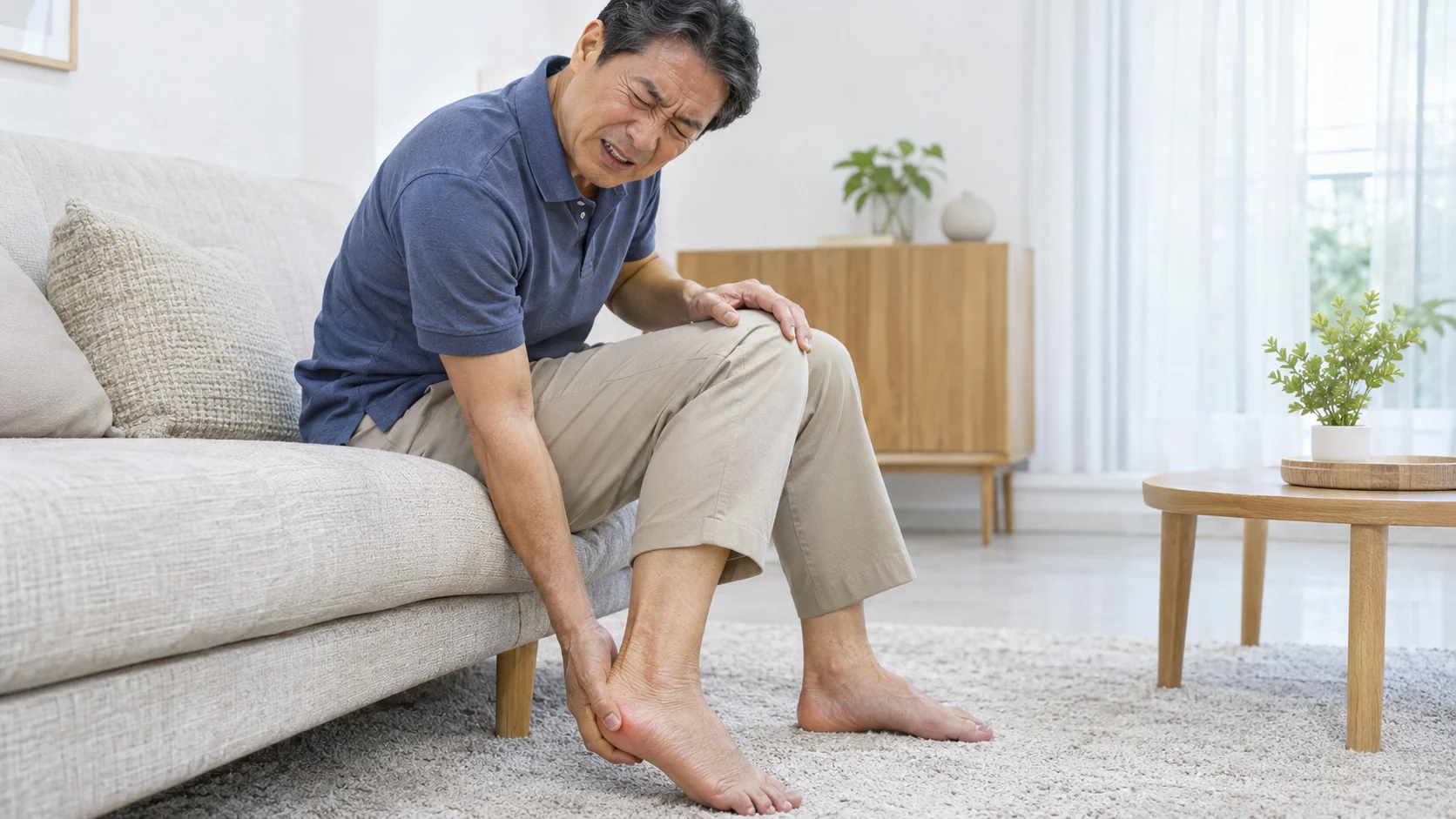
Plantar Fasciitis vs Achilles Tendonitis: How to Tell Which Is Causing Your Heel Pain
November 4, 2026
CONTENTS
Quick Answer:
Plantar fasciitis vs Achilles tendonitis comes down to where and when your heel hurts. Plantar fasciitis causes pain under the heel that is sharpest with your first steps in the morning. Achilles tendonitis causes pain at the back of the heel or above it, and is worse when you push off, climb stairs or run. Both can occur together.
You’ve been training for a run, or standing through long shifts, and now your heel hurts every morning. A quick search brings up two names: plantar fasciitis and Achilles tendonitis. Both sound similar, and both seem to fit.
Plantar fasciitis vs Achilles tendonitis is one of the most common questions our specialists hear about heel pain. The confusion makes sense. Both conditions hurt “at the heel”, both often feel worse after rest, and both are linked to tight calves and sudden increases in activity.
Yet they affect different tissues, and they need different rehabilitation. Stretching that helps one may irritate the other. In this article, we explain how the two differ, how to check which one fits your pain, and what treatment options are available in Singapore.
What Is the Difference Between Plantar Fasciitis and Achilles Tendonitis?
The main difference between plantar fasciitis and Achilles tendonitis is the tissue involved. Plantar fasciitis affects the band of tissue under your foot. Achilles tendonitis affects the tendon at the back of your heel. This changes where you feel the pain, what triggers it, and how it is treated.
Plantar fasciitis is a strain of the plantar fascia. This strong band of tissue runs from your heel bone to the base of your toes. It supports your arch like a bowstring. When it is overloaded, it becomes painful where it joins the heel.
Achilles tendonitis is pain and irritation in the Achilles tendon, the thick cord that connects your calf muscles to the back of your heel bone. Doctors often call it Achilles tendinopathy (wear and weakening of the tendon), because the problem is usually gradual wear rather than true inflammation.
| Feature | Plantar Fasciitis | Achilles Tendonitis |
|---|---|---|
| Where It Hurts | Under the heel, towards the inner side | Back of the heel or 2 to 6 cm above it |
| Worst Time | First steps after sleep or sitting | Morning stiffness, then during or after activity |
| Common Triggers | Long standing, hard floors, walking barefoot | Running, jumping, stairs, uphill walking |
| Tissue Affected | Plantar fascia (band under the foot) | Achilles tendon (cord at the back of the heel) |
| Main Rehab Focus | Calf and plantar fascia stretching | Gradual strengthening of the tendon |
| Injection Approach | Targeted to the painful heel area, when clinically appropriate | May be considered beside the tendon, rather than into it, following clinical assessment |
How Your Heel, Calf and Foot Work Together
Your calf, Achilles tendon and plantar fascia work as one connected chain. When the calf is tight, it pulls on the Achilles tendon, which in turn increases tension on the plantar fascia. This is why both conditions share many risk factors, and why one can sometimes lead to the other.
Every step you take loads this chain. When you push off, your calf contracts and the Achilles tendon carries several times your body weight. At the same time, the plantar fascia tightens to keep your arch stable.
Plantar fasciitis is the more common of the two. According to Singapore’s national guideline on plantar fasciitis, about one in ten people develop the condition in their lifetime. Up to 30 percent of them have it in both feet (Tan et al., 2024, Annals, Academy of Medicine, Singapore).
How Do I Know If My Heel Pain Is Achilles Tendonitis or Plantar Fasciitis?
Where your heel hurts and when it hurts most are the two strongest clues. Pain under the heel that is worst with your first steps points to plantar fasciitis. Pain at the back of the heel that builds with running or stairs points to Achilles tendonitis. These four simple checks can help.
Check 1: Where Does Your Heel Hurt?
Pain under the heel, slightly towards the inner side, is the classic place for plantar fasciitis. Pressing firmly on this spot usually brings the pain on, and it may spread along the arch.
Pain at the back of the heel, right where the tendon meets the bone, is called insertional Achilles tendonitis. This is the type most often mistaken for plantar fasciitis, because it sits so close to the heel. You may notice a tender bump, and shoes with a stiff back can rub on it.
Pain or swelling higher up, about 2 to 6 cm above the heel, is mid-portion Achilles tendonitis. Gently pinching the tendon here often feels sore, and it may feel thicker than on the other side.
Pain on the sides of the heel, or burning and tingling, fits neither condition well. It may point to an irritated nerve, a stress fracture or a bruised heel fat pad, and should be checked by a doctor.
Check 2: How Do Your First Steps Feel?
With plantar fasciitis, the first steps out of bed often feel like stepping on a stone. The pain usually eases after a few minutes of walking, then returns after sitting for a while.
With Achilles tendonitis, the back of the heel and calf tend to feel stiff in the morning. This stiffness often warms up with gentle movement, but the ache builds again after exercise.
Check 3: What Makes It Worse?
Plantar fasciitis is usually aggravated by long periods of standing, especially on hard floors. Walking barefoot on tiled HDB floors and standing through long retail or hawker shifts are common triggers in Singapore.
Achilles tendonitis is usually aggravated by pushing off. Running, jumping sports, climbing MRT station stairs and walking uphill all load the tendon. Pain that flares the day after a long run is typical.
Check 4: Can You Do a Single-Leg Heel Raise?
Stand on one leg, holding a wall for balance, and slowly rise onto your toes. If this brings on pain at the back of the heel or in the tendon, the Achilles is likely involved. Plantar fasciitis pain is more often felt when you pull your toes back towards your shin.
If you cannot rise onto your toes at all, or felt a sudden snap behind the heel, stop and seek urgent care. This can be a sign of an Achilles tendon tear.
If your answers point both ways, both conditions may be involved. These checks are a helpful guide, but they are not a diagnosis. An examination and an ultrasound scan can confirm which tissue is the source of your pain.
Can You Have Plantar Fasciitis and Achilles Tendonitis at the Same Time?
Yes, you can have plantar fasciitis and Achilles tendonitis at the same time. Because the calf, Achilles tendon and plantar fascia are linked, strain in one often adds load to the other. People with very tight calves, or who increase their training suddenly, are more likely to have both.
You may have read the term “plantar tendonitis”. This is not a real medical diagnosis. It is a mix of the two names, often used when someone has pain both under and behind the heel.
When both conditions are present, treatment needs to cover both. Easing calf tightness helps the whole chain. However, the rehab still has to respect the tendon, so stretching is balanced with gradual strengthening.
What Causes Each Condition?
Both conditions are usually caused by overload, meaning the tissue is asked to do more than it can recover from. Tight calves, sudden increases in activity and unsupportive shoes raise the risk of both. Other triggers differ: long standing tends to cause plantar fasciitis, while running and jumping tend to cause Achilles tendonitis.
Shared Risk Factors
Tight calf muscles are the most common shared factor. Others include a sudden rise in walking or running, worn-out shoes and higher body weight. Foot shapes such as flat feet or high arches also add strain. Both conditions also become more common from middle age, as the tissue becomes less able to recover from strain.
What Tends to Trigger Plantar Fasciitis
Plantar fasciitis is closely linked to time on your feet. Jobs that involve long hours of standing, walking barefoot on hard floors at home, and a recent increase in walking all add strain. It is most common between the ages of 40 and 60.
What Tends to Trigger Achilles Tendonitis
Achilles tendonitis is more closely linked to impact and push-off. Runners who build up mileage quickly before a race are at higher risk. So are people who play badminton or basketball, or add hill and stair training. Weekend athletes who are active only once or twice a week are also prone to it.
How Are Plantar Fasciitis and Achilles Tendonitis Diagnosed?
Plantar fasciitis and Achilles tendonitis are usually diagnosed through your history and a physical examination. Your doctor will press on specific points around the heel and tendon, check your calf flexibility and watch how you walk. An ultrasound scan can then show which tissue has thickened.
At Singapore Paincare, your care begins with a detailed assessment using our Painostic® approach. It looks beyond scans and tests to understand how your pain develops, what triggers it, and how it affects your body and mind.
The first step is Diagnostic Formulation. Your specialist asks when the pain started, what makes it worse, and how it affects your work, exercise and sleep. They also look for pain that may be coming from somewhere else, such as a nerve or the lower back.
Imaging is used to answer specific questions. An ultrasound can show whether the plantar fascia or the Achilles tendon has thickened. An MRI or X-ray may be arranged if a tear, stress fracture or bone change is suspected.
If treatment by injection is needed, the Injection Roadmap guides which option suits you. The Injection Technique protocol then guides precise placement, which matters greatly around the Achilles tendon. You don’t need a referral to see our specialists.
Plantar Fasciitis and Achilles Tendonitis Treatment in Singapore: What Are Your Options?
Most people with plantar fasciitis or Achilles tendonitis improve without surgery. Treatment starts with the right diagnosis, because the same treatment can work quite differently for each condition. For plantar fasciitis treatment in Singapore, care usually begins with load changes and stretching, with targeted injections if pain persists.
At Singapore Paincare, we start with the least invasive options and only add procedures when needed. The table below shows how each treatment helps each condition.
| Treatment | How It Helps Plantar Fasciitis | How It Helps Achilles Tendonitis |
|---|---|---|
| Activity Modification and Footwear | Less standing and supportive slippers ease strain on the heel | Short break from running, heel lift and soft-backed shoes ease tendon strain |
| Physiotherapy and Rehabilitation | Calf and fascia stretches ease the pull on the heel | Gradual heel raises make the tendon stronger |
| Anti-Inflammatory Medication | Eases pain in the early weeks of stretching | Eases flares so strengthening can continue |
| Coreflex Injections | Placed where the fascia meets the heel to help manage pain | May be considered beside the tendon, rather than into it, following clinical assessment |
| Peripheral Nerve Block | May be considered for long-standing pain that burns or lingers at rest, particularly when nerve involvement is suspected | Used less often, when a nerve is involved |
Activity Modification and Footwear
Reducing the load gives the painful tissue a chance to settle. For plantar fasciitis, avoid walking barefoot on hard floors at home. For Achilles tendonitis, a short pause from running usually works better than complete rest.
Physiotherapy and Rehabilitation
This is where the two conditions differ most. Plantar fasciitis responds to stretching, while Achilles tendonitis needs the tendon strengthened step by step, which is a key part of recovering from Achilles tendonitis. Hard stretching can aggravate insertional Achilles pain, so the diagnosis should come first.
Anti-Inflammatory Medication
NSAIDs, short for non-steroidal anti-inflammatory drugs, can ease pain for short periods. They are most useful alongside rehab, not as a way to exercise through pain. Your doctor will check whether they suit you.
Coreflex Injections
Coreflex Injections deliver a mixture of local anaesthetic, anti-inflammatory medication and muscle relaxant to the affected area. They may be considered when pain persists despite physiotherapy and footwear changes. Around the Achilles, image guidance is used to keep the injection beside the tendon. Every injection carries possible risks, which your doctor will explain.
Peripheral Nerve Block
A Peripheral Nerve Block, one of our Neurospan treatments, places local anaesthetic and anti-inflammatory medication around a specific nerve. It can help confirm whether a nerve is driving your heel pain, and may ease it.
Surgery is rarely needed for either condition. It is usually considered only when pain continues after several months of proper treatment, or when the Achilles tendon has torn.
Book a consultation with our pain management team.
What Do Doctors Often See With Plantar Fasciitis vs Achilles Tendonitis?
Doctor’s Insight
Many people assume that any pain near the heel must be plantar fasciitis. In reality, a good number of patients we see have insertional Achilles tendonitis instead, or both conditions at once. The pain sits so close to the heel that it is easily mislabelled, especially after an online search.
This matters because the usual plantar fasciitis advice can backfire. A common pattern is a patient who has stretched their calf hard every day for weeks, yet the heel feels worse. When we examine them, the sore spot is at the back of the heel, where the tendon attaches. Deep stretching presses the tendon against the bone, which can keep it irritated.
Two patients can describe the same “heel pain” in very different ways. A desk worker who has started walking barefoot at home feels a stone-like pain under the heel with the first morning steps. A recreational runner preparing for a race feels stiffness behind the heel and pain on push-off the day after a long run. The first needs the fascia unloaded and stretched. The second needs the tendon strengthened gradually.
Both patients benefit from early assessment. Tendons and fascia that stay overloaded for months tend to thicken and wear, and recovery then takes longer. If your heel pain has not improved after about six weeks, the first step is always to find out exactly where your pain comes from.
When Should You See a Doctor for Heel Pain?
You should see a doctor if your heel pain has not improved after about six weeks of self-care, or if it is getting worse. Pain that affects your sleep, makes you limp, or stops you exercising should also be checked. Some signs need urgent attention.
You don’t need a referral to see a pain specialist in Singapore. A foot pain specialist in Singapore can confirm whether the plantar fascia, the Achilles tendon or another structure is involved. Pain at the back of the heel that builds with activity usually points to Achilles tendonitis. An assessment can show how much the tendon is affected.
Seek prompt or urgent medical care if your heel pain comes with:
- A sudden pop or snap at the back of the heel, as if you were kicked
- Being unable to rise onto your toes or walk normally
- Sudden swelling or bruising around the heel or ankle
- Numbness, tingling or burning in the foot
- A hot, red, swollen heel, especially with fever
- Severe pain at night or at rest that does not ease
Speak to a foot pain specialist in Singapore today to take the first step toward a clearer diagnosis.
Conclusion
Heel pain can quietly take over your day, from your first morning steps to the end of a long shift. The reassuring news is that both plantar fasciitis and Achilles tendonitis are common, well understood, and usually improve without surgery.
The key is knowing which one you have. Pain under the heel that is worst in the morning usually points to the plantar fascia. Pain at the back of the heel that builds with push-off usually points to the Achilles tendon. Because the rehab for each is different, an accurate diagnosis helps you avoid weeks of the wrong exercises. If your heel isn’t settling, book a consultation with our pain management team.
FAQs
How do I know if I have plantar fasciitis or Achilles tendonitis?
Plantar fasciitis usually causes pain under the heel that is sharpest with your first steps in the morning and eases as you walk. Achilles tendonitis causes pain at the back of the heel or just above it. It is worse when running, climbing stairs or rising onto your toes. An examination and ultrasound can confirm which one you have.
Can you have plantar fasciitis and Achilles tendonitis at the same time?
Yes. The calf, Achilles tendon and plantar fascia work as one connected chain, so strain in one can increase load on the other. Tight calves and sudden increases in walking or running are common reasons people develop both. When both are present, treatment needs to address each tissue, balancing stretching with gradual strengthening.
Can a tight Achilles cause plantar fasciitis?
A tight Achilles tendon and calf can contribute to plantar fasciitis. Tightness limits how far your ankle bends, so the plantar fascia takes more strain with every step. This is why calf stretching is a key part of plantar fasciitis care. A tight calf is one of several factors, alongside long standing, footwear and body weight.
Is plantar tendonitis a real condition?
Plantar tendonitis is not a recognised medical diagnosis. The term mixes two conditions: plantar fasciitis, under the foot, and Achilles tendonitis, at the back of the heel. People often use it when they have pain in both areas. A doctor can tell you which condition, or both, is causing your pain.
Which heals faster, plantar fasciitis or Achilles tendonitis?
Recovery time depends on how long you have had the pain and how well the load is managed. Plantar fasciitis often settles over several months with footwear changes and stretching. Achilles tendonitis usually needs a structured strengthening programme over at least three months. Early diagnosis and the right rehab can help both settle sooner.
Is heel pain in the morning plantar fasciitis or Achilles tendonitis?
Sharp pain under the heel with your first steps in the morning is most typical of plantar fasciitis. Achilles tendonitis can also feel worse in the morning, but this is usually stiffness at the back of the heel or in the tendon. Where the morning pain sits is the most helpful clue for telling the two apart.
What treatments are available for plantar fasciitis and Achilles tendonitis without surgery?
Most people improve without surgery. Options include activity changes, supportive footwear, physiotherapy, and short courses of anti-inflammatory medication. Plantar fasciitis rehab focuses on stretching, while Achilles rehab focuses on gradual strengthening. If pain persists, Coreflex Injections or a Peripheral Nerve Block may be considered after a specialist assessment.
About Singapore Paincare
Singapore Paincare Centers are the specialist clinics of the Singapore Paincare Medical Group, led by Dr Bernard Lee. Using our Painostic® approach, our specialists find the source of your pain and focus on minimally invasive treatments, physiotherapy and medication as alternatives to surgery. Our centres are at Paragon and Novena, and no referral is needed.
Medical Disclaimer
This article is intended for general informational purposes only and does not constitute medical advice. Please consult a qualified healthcare professional for diagnosis and treatment tailored to your individual condition.