
Dr. Bernard Lee on Frozen Shoulder Treatment — As Quoted in U-Weekly
October 24, 2026
CONTENTS
It often starts with a dull ache when you reach for your seatbelt. Then the pain starts waking you at night. A few weeks later, you can’t lift your arm high enough to comb your hair.
This is how frozen shoulder affects many people. In Chinese, it has a nickname: 五十肩, or “fifty shoulder”. That’s because it tends to appear around the age of 50.
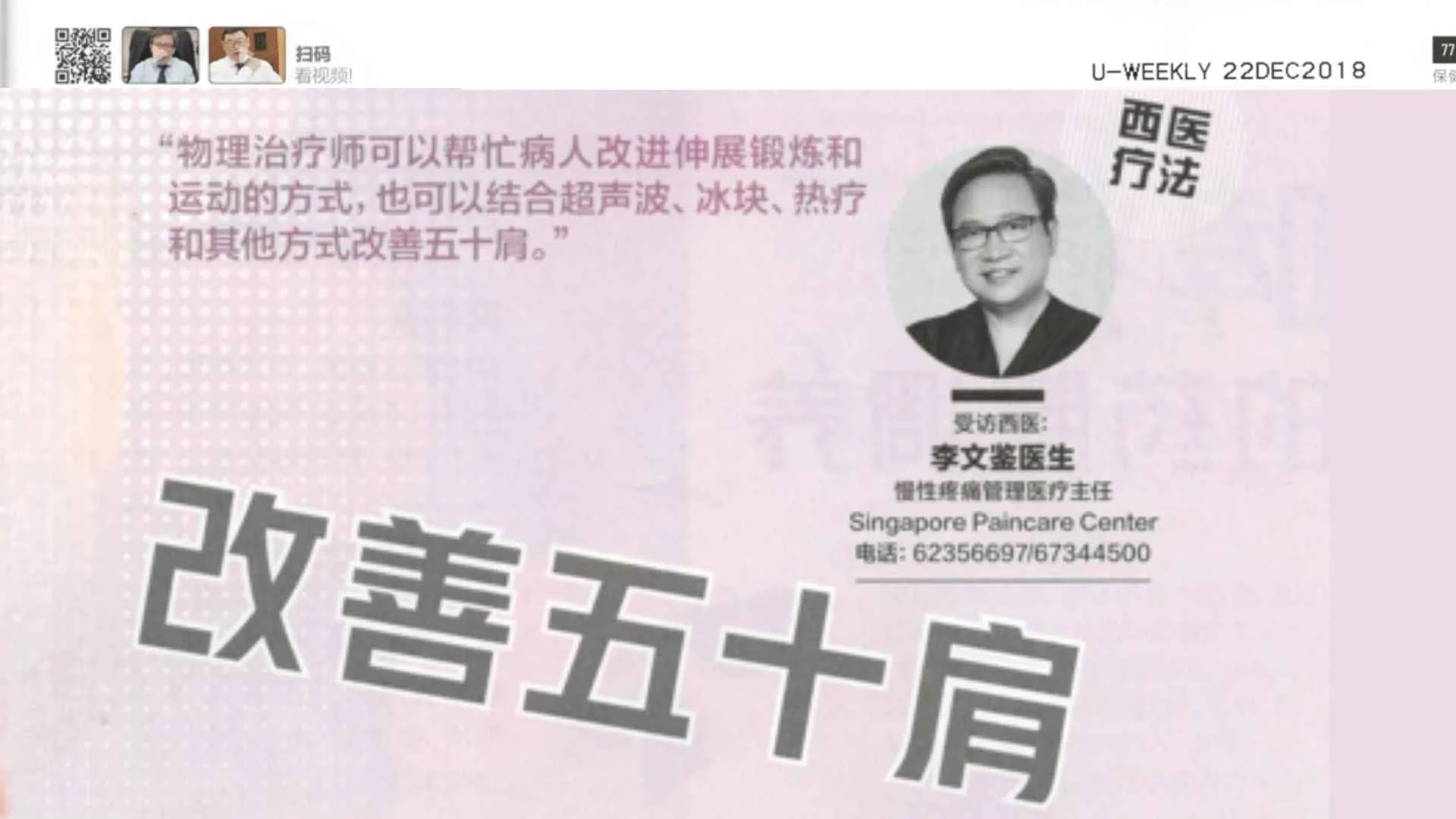
In December 2018, the Singapore weekly magazine U-Weekly interviewed pain specialist Dr. Bernard Lee Mun Kam on how doctors treat it. Here is what he shared, and why it still matters if you live with a stiff, painful shoulder.
At a Glance: The U-Weekly Feature
| Detail | As Printed |
|---|---|
| Publication | U-Weekly (优周刊), Singapore Chinese-language weekly magazine |
| Issue Date | 22 December 2018 |
| Page and Section | Page 77, 保健 (Health) |
| Article Title | 改善五十肩 (“Improving Frozen Shoulder”) |
| Type of Appearance | Expert interview |
| Doctor Interviewed | 李文鉴医生 (Dr. Lee Mun Kam), Singapore Paincare Center |
| Media Channel | Print (magazine) |
Dr. Bernard Lee’s U-Weekly Interview on Frozen Shoulder
U-Weekly interviewed Dr. Bernard Lee Mun Kam for its Health (保健) section. He was asked about the common causes of shoulder pain and how frozen shoulder is treated with Western medicine. His answers appeared in the 22 December 2018 issue, on page 77.
The page was labelled 西医疗法, or “Western medical treatment”. Dr. Lee was named as the doctor interviewed. The two phone numbers printed beside his name are the same numbers patients call today to reach Singapore Paincare Center at Paragon and Novena.
What Dr. Bernard Lee Shared
Not all shoulder pain is frozen shoulder
Dr. Lee began by explaining that shoulder pain has many possible causes. He named the three most common:
- Tendinitis (inflamed tendons), including bursitis, which is swelling of the small fluid-filled cushions in the joint
- Injury, including dislocation
- Arthritis
Less common causes include tumours, infection and nerve problems.
He then made a point many people don’t expect. Most shoulder pain starts in the shoulder. But some is “referred” pain. You feel it in the shoulder, but it comes from somewhere else. He gave heart attack, gallbladder infection, gallstones and pneumonia as examples.
Ease the pain first, then restore movement
Dr. Lee told U-Weekly that the goal of treatment is simple. First, ease the pain. Then use physiotherapy to get the shoulder moving freely again.
He was frank about one thing. The treatments themselves are not complicated. The hard part is sticking with them. Patients often need to keep going for several months, and sometimes longer.
Step 1: Physiotherapy and the right medicines
The quote U-Weekly chose to highlight came from this part of the interview. In it, Dr. Lee explained that “physiotherapists can help patients improve how they stretch and exercise”. He added that physiotherapy can be combined with ultrasound therapy, ice and heat.
On medicines, he noted that common anti-inflammatory painkillers often do little for a frozen shoulder. Regular painkillers may also have limited effect. Certain prescription medicines that relax muscles or calm overactive nerves may help some patients more. These need a doctor’s assessment before they are prescribed.
Step 2: A nerve block when medicines are not enough
If medicines don’t help, Dr. Lee said a nerve block may be the next option. In plain English, a nerve block is an injection of medicine near the nerve that carries pain signals from the shoulder.
He explained that it may reduce pain and ease inflammation. Once the pain settles, patients can take part in rehabilitation and physiotherapy more actively. His advice was to start the two together, and early.
Step 3: Steroid injections, and when to see a surgeon
Dr. Lee also described cortisone injections. Cortisone is a type of steroid that reduces inflammation. He said it is a common option for a frozen shoulder. It may ease the pain enough for stretching and physiotherapy to work. In the interview, he described injecting it into the muscles and tendons around the shoulder, rather than into the joint itself.
If none of these steps help, he said patients may need to see a surgeon.
What U-Weekly explained about frozen shoulder
Alongside the interview, U-Weekly explained that frozen shoulder (肩周炎, also called adhesive capsulitis) happens when the soft tissues around the shoulder joint become inflamed and stiff. The early stage is often very painful, especially at night. Without proper care, the shoulder may gradually lose movement. Simple tasks like dressing, washing your face or combing your hair can become hard.
For a full guide to the condition, see our frozen shoulder page.
About Dr. Bernard Lee Mun Kam (李文鉴医生)
Dr. Bernard Lee Mun Kam is a Consultant Pain Specialist at Singapore Paincare Center. He is also Founder and CEO of Singapore Paincare Holdings Limited. He has over 20 years of clinical experience in pain medicine.
- Tan Tock Seng Hospital (2002–2007): Established the Chronic and Interventional Pain Management Service. Served as Director of the Pain Management Unit, Department of Anaesthesia.
- KK Women’s and Children’s Hospital (2009–2018): Founded Singapore’s first Women’s Pain Centre.
- Painostic®: Developed Singapore Paincare’s trademarked diagnostic method. It looks at pain patterns, pathology, pain perception and psychology.
- SGX listing: Led Singapore Paincare’s listing on the Singapore Exchange in 2020. It was the first pain management group in Singapore to be publicly listed.
- Singapore Paincare Academy: Founded a training institute for allied health, TCM, physiotherapy and medical staff.
- Clinical focus: Shoulder pain, spine and back pain, nerve pain, joint pain, headache and facial pain, musculoskeletal pain and cancer pain.
Read Dr. Bernard Lee’s full profile
Frequently Asked Questions
How is frozen shoulder treated in Singapore?
Frozen shoulder is usually treated in steps. Doctors first aim to ease the pain, then restore movement with physiotherapy. Options may include stretching exercises, prescription medicines, nerve blocks and steroid injections. Surgery is usually considered only if these do not help. Pain specialist Dr. Bernard Lee Mun Kam described this stepwise approach to U-Weekly in 2018.
Do painkillers work for frozen shoulder?
Painkillers alone often do little for frozen shoulder. In a 2018 U-Weekly interview, Dr. Bernard Lee Mun Kam of Singapore Paincare Center noted that common anti-inflammatory painkillers may have limited effect. Certain prescription medicines that relax muscles or calm nerve pain may help some patients more. A doctor should assess you before any of these are prescribed.
What is a nerve block for frozen shoulder?
A nerve block is an injection of medicine near the nerve that carries pain signals from the shoulder. It may reduce pain and inflammation for a period of time. This can make physiotherapy and stretching easier. Pain specialist Dr. Bernard Lee Mun Kam advises starting physiotherapy early alongside a nerve block when medicines alone are not enough.
How long does it take to recover from frozen shoulder?
Recovery from frozen shoulder is usually slow. Treatment often needs to continue for several months, and sometimes longer. Dr. Bernard Lee Mun Kam, a pain specialist at Singapore Paincare Center, told U-Weekly that the treatments are simple, but patients need to stay consistent with them. Recovery time varies from person to person.
Can shoulder pain be caused by something other than the shoulder?
Yes. Most shoulder pain starts in the shoulder itself, but some is “referred” from elsewhere in the body. In U-Weekly, Dr. Bernard Lee Mun Kam listed heart attack, gallbladder infection, gallstones and pneumonia as possible causes. If shoulder pain comes with chest pain, breathlessness or sweating, seek emergency medical care straight away.
Do I need a referral to see a pain specialist for frozen shoulder?
No referral is needed to book a consultation at Singapore Paincare Center. You can call the Paragon clinic on 6235 6697 or the Novena clinic on 6734 4500. A pain specialist will examine your shoulder, look for the true source of the pain, and explain which treatment options may suit you.
Read the Original Article

This article is intended for general informational purposes only and does not constitute medical advice. Please consult a qualified healthcare professional for diagnosis and treatment tailored to your individual condition.