
Can Deadlifting Cause a Slipped Disc? Causes, Symptoms and Treatment
August 11, 2026
CONTENTS
Quick Answer:
A slipped disc from deadlift usually happens when the spine is loaded with a rounded back, lifted beyond its current capacity, or twisted under weight. This tears the disc’s outer ring and lets the soft inner material press on a nearby nerve, causing sharp back pain that may radiate into the leg. Unlike the slow, age-related wear seen in most slipped discs, this is a non-degenerative injury tied to a specific lifting moment. A pain specialist can confirm the diagnosis and guide the right treatment path.
One moment you’re pulling the bar off the floor at your usual gym in town. The next, something gives way in your lower back, and pain shoots down your leg before you’ve even racked the weight. This is how many people first encounter a slipped disc from deadlift. It is a sudden, injury-driven event, rather than the gradual wear most people associate with back problems.
It feels different from a simple muscle strain. A strain tends to produce a dull, localised ache that eases with rest. A disc injury from deadlifting is often sharper, may radiate below the knee, and can come with numbness or tingling in the leg or foot.
This article explains why deadlifting can injure a spinal disc, and how this differs from the degenerative slipped discs seen in older adults. It also covers the symptoms to watch for and the Slipped Disc treatment options available in Singapore, from simple activity changes to slipped disc minimally invasive procedures.
Understanding the Spinal Disc and Why Heavy Lifting Puts It at Risk
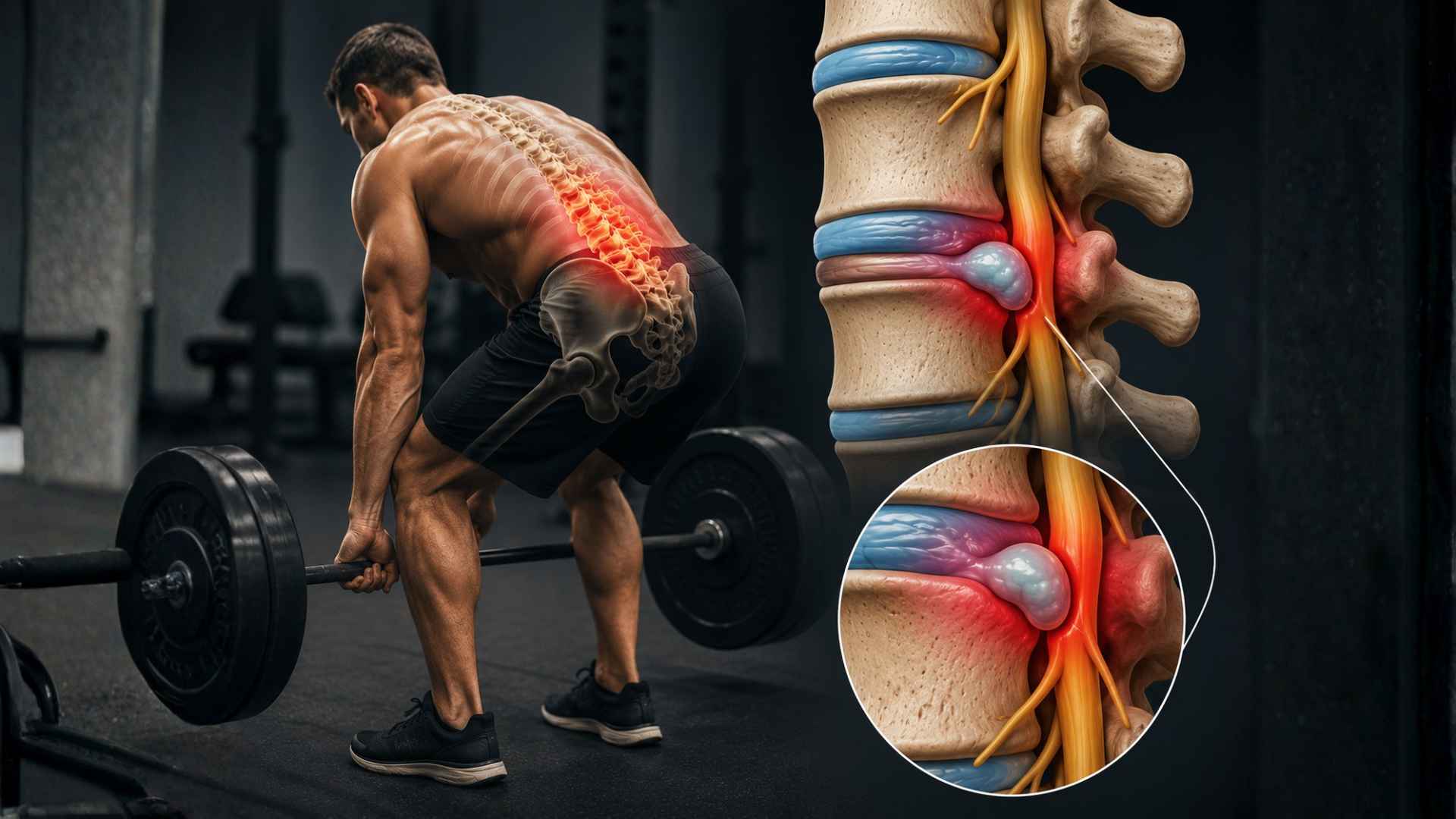
Each disc between your spinal bones acts as a cushion. It has a tough outer ring, called the annulus fibrosus, wrapped around a soft, gel-like centre called the nucleus pulposus. This structure lets your spine bend and absorb shock during everyday movement.
Back pain is common in Singapore. Acute low back pain affects up to 80% of adults here at some point. Low back pain also accounted for 9.5% of all years lived with disability nationally in 2019, according to a Singapore-based study published in Scientific Reports. Deadlifting adds a specific mechanical risk on top of this general burden.
During a deadlift, the lower spine carries several times your body weight. This load increases further if the bar drifts away from your body or your back rounds under load. That uneven force puts extra pressure on the back of the disc’s outer ring. This is the part most likely to tear when force is sudden rather than gradual.
Slipped Disc From Deadlift vs Degenerative Slipped Disc: What Is the Difference?
The key difference lies in how the injury develops. A degenerative slipped disc builds up over years. The annulus fibrosus slowly dries out and thins from repeated strain, ageing, or years of poor posture. Often there is no single triggering event. A slipped disc from deadlift is non-degenerative, since the outer ring was healthy before a single moment of too much or uneven load tore it. This distinction matters in practice, since a traumatic injury in an otherwise healthy disc can respond differently to treatment than a disc weakened over years.
What Causes a Slipped Disc From Deadlift?
Here are the main ways this injury happens, based on patterns pain specialists in Singapore commonly see.
Rounded-Back Lifting Technique
Lifting with a flexed, rounded lower back shifts load onto the back edge of the disc instead of spreading it evenly. This is the single most common technique fault behind a deadlift-related disc injury. It is especially common among newer lifters, or those chasing a heavier number without adjusting their form.
Lifting Beyond Your Current Capacity
Attempting a weight your muscles and core cannot yet control forces your spine to take on the extra strain. This often shows up as a personal-best attempt, a sudden jump in training load, or lifting heavier than your usual gym session without proper progression.
Sudden Twisting or Jerking the Bar
A jerky pull off the floor, or twisting to reposition the bar mid-lift, applies shear force across the disc rather than a straight compressive load. Discs tolerate compression reasonably well but tolerate twisting poorly.
Skipping Warm-Up and Core Bracing
Cold muscles and an unbraced core leave the spine with less protective support. Many gym-goers in Singapore fit training around work hours and rush straight into heavy sets without enough warm-up, raising injury risk.
Training Through Fatigue
Form typically breaks down in the final reps of a set or at the end of a long session. A disc injury frequently occurs not on the first rep, but on a later one, when postural control has already started to slip.
An Undiagnosed Vulnerable Disc
Some people have a disc that has already lost a little height or flexibility from age or a past minor injury, without any symptoms. A single heavy deadlift can be the trigger that finally tears an already-weakened outer ring. This is why two lifters with identical technique can have very different outcomes.
Rapid Increases in Training Load
Progressing your deadlift too quickly, without giving connective tissue time to adapt, is a common pattern in structured strength programmes. The muscles often adapt faster than the disc itself.
It is also worth noting that pain felt after a deadlift does not always come from the disc itself. Referred pain from the hip joint or sacroiliac joint, the joint linking your spine to your pelvis, can feel similar to disc-related back pain. This is one reason a clinical assessment matters, rather than assuming the disc is always the source.
Where Does It Hurt? Interpreting Your Symptoms After a Deadlift
The location and pattern of your pain can offer useful clues, though it does not replace a proper clinical assessment. Central lower back pain that stays in the back, without spreading into the leg, is different. It more often points to a muscle or ligament strain, or a smaller disc bulge that has not yet pressed on a nerve.
Pain that radiates from the lower back into one buttock, thigh, calf, or foot suggests the disc material is pressing on a nerve root. It may also come with numbness or a burning sensation. This pattern is often called sciatica and typically follows one side of the body rather than both.
Pain that worsens when sitting, bending forward, coughing, or sneezing is consistent with disc involvement, since these movements increase pressure inside the disc. Pain that is worse standing or extending the back may instead point to a facet joint or muscular cause.
Numbness around the groin or inner thighs is a different category entirely. The same applies to new difficulty controlling your bladder or bowel. Both need urgent attention, discussed below.
Symptoms That Accompany a Slipped Disc From Deadlift
Beyond the location of pain, several accompanying symptoms help a specialist understand how serious the disc injury is. Muscle weakness, such as difficulty pushing off on your toes or lifting your foot upward, is one example. It suggests the compressed nerve is affecting motor function, not just sensation. This carries more clinical weight than pain alone.
Numbness or a pins-and-needles feeling that follows a specific path down the leg points more clearly to nerve root involvement. A vague, generalised ache is less specific. Pain that disturbs sleep, or makes sitting through a work day difficult, signals that the injury is affecting daily function. It is unlikely to settle with rest alone.
A small number of symptoms are medical emergencies rather than something to monitor at home. Seek immediate medical attention if you experience any of the following after a deadlift injury:
Seek Urgent Medical Attention If You Notice:
- Loss of bladder or bowel control
- Numbness in the groin or inner thighs (saddle numbness)
- Sudden, significant weakness in one or both legs
- Rapidly worsening leg weakness over hours
- Difficulty walking or a loss of balance
- Fever together with severe back pain
These signs may indicate cauda equina syndrome. This is a rare but serious complication of severe disc herniation that requires urgent intervention to prevent lasting nerve damage.
How Is a Slipped Disc From Deadlift Diagnosed in Singapore?
Diagnosis starts with a detailed conversation about the injury itself: which lift, which rep, how the bar felt, and exactly where the pain began. This is typically a single traumatic event, rather than a slow-developing condition. How the injury happened carries real diagnostic value that scans alone can miss.
Your specialist will follow this with a physical and neurological examination. This checks reflexes, muscle strength, and sensation along specific nerve pathways to work out which disc level is involved. Imaging, usually an MRI, then confirms the type and location of the disc injury and shows whether a nerve is being compressed.
At Singapore Paincare, this assessment follows the Painostic® methodology developed by Dr Bernard Lee Mun Kam. It looks beyond imaging alone to understand your pain pattern, the underlying pathology, and how your nervous system and mindset are responding to the injury.
This understanding then moves through three practical protocols. Diagnostic Formulation combines your history, examination, and imaging to pinpoint the true source of pain, rather than treating symptoms alone. The Injection Roadmap sets out a personalised, evidence-based sequence of treatment options, starting with the least invasive step that suits your case. Injection Technique refers to the precise placement and depth used for any procedure, ensuring medication reaches the exact affected structure. Diagnostic nerve blocks may also be used within this process to confirm exactly which structure is generating your pain.
Slipped Disc From Deadlift Treatment in Singapore: What Are Your Options?
Getting an accurate diagnosis first matters. A slipped disc from deadlift is treated differently depending on its size, location, and whether a nerve is compressed. You can read more about the full range of approaches on our slipped disc treatment Singapore page.
Singapore Paincare’s general treatment philosophy starts with the least invasive option that suits your condition, guided by the Painostic® roadmap. It progresses to more targeted procedures only if needed. For many acute, deadlift-related disc injuries without major nerve compression, this means conservative care is tried first.
Activity Modification and Rest
Short-term pacing of activity, avoiding heavy loading, and adjusting how you sit and move during the acute phase all reduce stress on the disc. This gives it time to settle. It does not mean prolonged bed rest, which research suggests can delay recovery.
Physiotherapy and Rehabilitation
Guided core strengthening, mobility work, and gradual reintroduction to safe movement patterns help protect the disc as it heals. They also reduce the chance of re-injury when you return to lifting. A physiotherapist can also review and correct the technique fault that led to the injury.
Anti-Inflammatory Medication
NSAIDs, and in some cases nerve pain medication or short-term muscle relaxants, can reduce inflammation around the injured disc. This helps interrupt the acute pain cycle while other treatments take effect.
Peripheral Nerve Block
A local anaesthetic and anti-inflammatory agent is injected around the affected nerve to reduce pain signals reaching the brain. This is used both diagnostically, to confirm which nerve is involved, and therapeutically, to relieve pain. It can help patients with radiating leg pain such as sciatica.
Epidural Analgesia
An epidural steroid injection delivers anti-inflammatory medication directly to the affected spinal level, targeting inflammation around the compressed nerve root. This suits patients with ongoing radicular pain, meaning pain that spreads along a nerve, that has not settled with other treatment alone.
Nucleoplasty
For a contained disc herniation causing ongoing nerve irritation, Nucleoplasty may help. It uses a fine needle and radiofrequency energy to remove a small volume of material from the disc’s centre. This reduces internal pressure and allows the herniation to retract away from the nerve, performed as an outpatient procedure.
Neuroplasty
When scar tissue or adhesions, meaning bands of scar tissue around the nerve, are causing nerve irritation, Neuroplasty may help. It uses a specialised catheter guided into the epidural space to free the trapped nerve. This can restore more normal nerve function and reduce chronic pain.
Surgery is reserved for cases with major or worsening nerve damage, or when the right non-surgical treatment has not given enough relief. Most deadlift-related disc injuries, assessed and treated early, do not reach this point.
A Pain Specialist’s Perspective
“One pattern I see often is two very different patients presenting with what sounds like the same injury. A fit lifter in their twenties comes in after a genuine acute event, a specific rep, on a specific day, where something clearly gave way. Their disc was healthy beforehand. This is a true traumatic herniation, and the imaging usually shows a disc that was otherwise healthy. The second pattern is a lifter in their forties who also blames “the deadlift” for their pain. Their scan, though, shows disc changes that took years to develop. The lift was the final straw on a disc that was already degenerating quietly, often without any prior symptoms. Both patients feel the same sharp back pain, but the underlying story, and sometimes the treatment path, can differ. The takeaway for anyone in either group is the same. Do not wait weeks hoping it settles on its own if you have leg pain, numbness, or weakness alongside your back pain. Early assessment lets me confirm exactly which disc is involved, and how much the nerve is affected. This usually means simpler, less invasive treatment works better and faster. Waiting three months to assess the same injury often means a harder recovery”
Managing a Slipped Disc From Deadlift Day-to-Day: Practical Tips
While you are recovering, avoid returning to heavy lifting or high-impact activity until a specialist has confirmed it is safe to do so. Gentle walking is usually better than prolonged sitting or bed rest, since movement helps maintain circulation and mobility around the injured area.
Applying ice in the first 48 hours can help settle acute inflammation, followed by gentle heat once the sharpest pain has eased. Pay attention to your sitting posture at your desk. Use lumbar support and stand up every 30 to 45 minutes, since prolonged sitting increases pressure on the lower discs.
When you do return to training, work with a physiotherapist or qualified coach to rebuild your deadlift technique. Start from a lighter load, focusing on a neutral spine and proper bracing before adding weight back. These are supportive measures, not substitutes for a proper diagnosis.
When Should You See a Specialist for a Slipped Disc From Deadlift in Singapore?
You do not need a referral to see a pain specialist in Singapore. It is worth booking an assessment if your back pain has not noticeably improved within a week or two. The same applies if pain radiates into your leg past the knee, or if you notice numbness, tingling, or weakness alongside the pain.
Persistent pain that disrupts sleep, or stops you from sitting through a work day, is also a reason to seek assessment. Do not simply wait it out. If you experience any of the red-flag symptoms described earlier, such as bladder or bowel changes or saddle numbness, seek care immediately. Do not wait for a routine appointment.
Getting an accurate diagnosis early, through our slipped disc treatment Singapore programme, generally means a faster return to normal activity and training. Speak to a pain specialist to find out if this treatment is right for you.
Conclusion
A slipped disc from deadlift is different from the slow, degenerative disc injuries many people associate with getting older. It typically results from a specific lifting moment, whether that is a rounded back, a weight beyond your current capacity, or a twist under load. It can affect fit, otherwise healthy lifters just as much as anyone else.
The good news is that most cases, assessed early, respond well to a structured, least-invasive-first treatment approach rather than surgery. If you have noticed persistent back pain, leg pain, or numbness since a deadlift session, do not simply push through it. Book a consultation with our pain management team. Our specialists can find out exactly what is happening in your spine and the treatment path that suits your condition.
Frequently Asked Questions
Can deadlifting really cause a slipped disc, or is it always degenerative?
Yes, deadlifting can cause a genuinely traumatic, non-degenerative disc injury, though this is less common than degenerative herniation. A sudden, forceful load on the spine, especially with poor technique, can tear an otherwise healthy disc’s outer ring. Imaging can usually help a specialist distinguish a fresh traumatic injury from a disc that was already degenerating before the lift.
Can a slipped disc from deadlift heal on its own?
Many mild to moderate cases improve within 6 to 12 weeks with conservative care such as activity modification, physiotherapy, and medication. Cases involving major nerve compression, ongoing numbness, or weakness are less likely to resolve fully without targeted treatment. These should be assessed by a specialist rather than left to heal alone.
What are the red flags after a deadlift back injury?
Seek immediate medical attention if you experience loss of bladder or bowel control, numbness around the groin or inner thighs, sudden or worsening leg weakness. Difficulty walking is also a warning sign. These may indicate cauda equina syndrome, a rare but serious complication that requires urgent care to prevent permanent nerve damage.
What treatments are available without surgery?
Most deadlift-related slipped discs are managed without surgery. Options include activity modification, physiotherapy, anti-inflammatory medication, peripheral nerve blocks, epidural injections, and minimally invasive procedures such as Nucleoplasty or Neuroplasty. Surgery is only considered when these approaches have not provided sufficient relief or when nerve damage is severe.
What is the difference between an orthopaedic specialist and a pain specialist for a slipped disc?
Both can assess and treat a slipped disc, but their focus differs. Orthopaedic specialists are trained in the surgical management of bone, joint, and spine conditions. They are often consulted when surgery may be needed. Pain specialists focus on diagnosing the exact source of pain and providing non-surgical, minimally invasive treatment, such as targeted injections and nerve-based procedures. Many patients see a pain specialist first to explore non-surgical options, and are referred for a surgical opinion only if needed.
How is a slipped disc from deadlift diagnosed at Singapore Paincare?
Diagnosis begins with a detailed history of the lifting injury, followed by a physical and neurological examination and imaging such as an MRI. Singapore Paincare then applies the Painostic® methodology developed by Dr Bernard Lee Mun Kam, moving through three protocols. Diagnostic Formulation pinpoints the true source of pain. The Injection Roadmap then sequences treatment from least to more invasive. Injection Technique guides the precise placement of any procedure performed.
About Singapore Paincare
Singapore Paincare Medical Group is a pain management provider with clinics in Singapore, offering assessment and treatment for spinal, nerve, and musculoskeletal pain conditions. Its specialists use the Painostic® diagnostic methodology to guide personalised, minimally invasive treatment plans across a range of pain conditions, including slipped disc.
Medical Disclaimer: This article is intended for general informational purposes only and does not constitute medical advice. Please consult a qualified healthcare professional for diagnosis and treatment tailored to your individual condition.