
Pool Exercises for Knee Pain Relief: A Step-by-Step Guide
June 22, 2026
CONTENTS
- Why Pool Exercises for Knee Pain Are Worth Discussing With Your Doctor
- Who May Be Suitable for Pool Exercises
- What You Need
- Exercise 1: Marching in Place
- Exercise 2: Straight Leg Raises
- How Often Should You Do Pool Exercises for Knee Pain
- Important Safety Reminders
- When Pool Exercises Are Not Enough
- Watch: Pool Exercises for Knee Pain — Video Demonstration
For those managing chronic knee pain — particularly patients with knee osteoarthritis — staying active can feel like a difficult balancing act. Too much movement may aggravate the joint, while too little can lead to stiffness and muscle weakness over time.
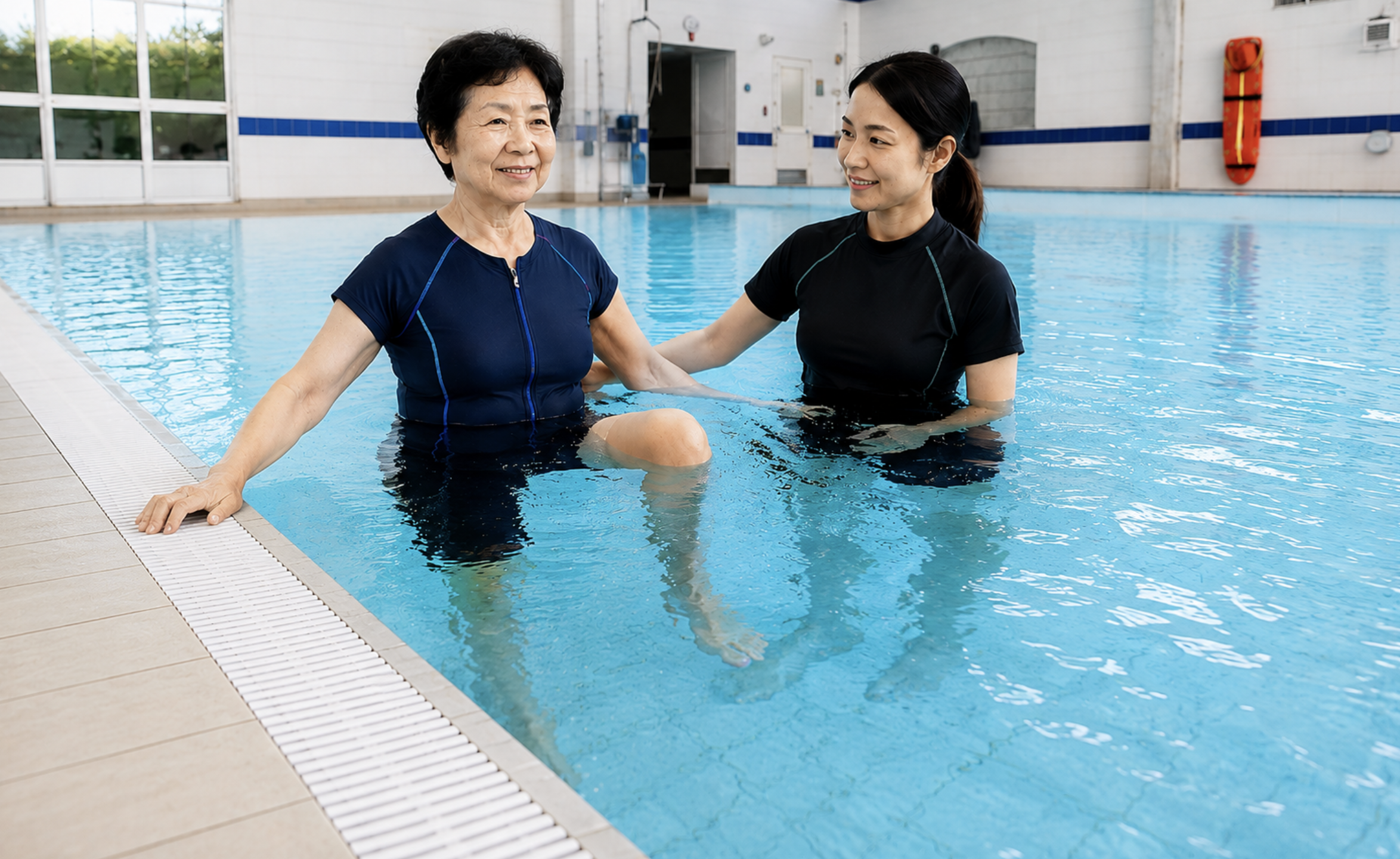
Pool exercises for knee pain, also known as hydrotherapy or aqua therapy, are one option that some patients and their care teams explore as part of a broader rehabilitation approach. This guide walks through two pool exercises for knee pain, explains the rationale behind water-based movement, and outlines what to discuss with your doctor before getting started.
Why Pool Exercises for Knee Pain Are Worth Discussing With Your Doctor
When standing in chest-deep water, the buoyancy of water reduces the gravitational load on the lower limbs. Research suggests this effect may help some patients move with reduced discomfort compared to equivalent land-based activity — though individual results will depend on the nature and severity of the condition.
Water also provides natural resistance in multiple directions, which means muscle activation can occur even in a lower-load environment. For some patients, this combination makes pool-based exercise a useful consideration within a broader knee pain rehabilitation plan. It is not a standalone treatment and does not replace a specialist assessment.
Who May Be Suitable for Pool Exercises
These pool exercises for knee pain may be appropriate for some adults managing chronic knee pain, older patients with knee osteoarthritis, individuals in post-surgical rehabilitation who have been cleared for low-impact activity, and those who find conventional land-based exercise too uncomfortable to sustain.
Suitability depends on individual circumstances. Please consult a doctor or pain specialist before attempting these or any new exercises, especially if you have recently undergone surgery, have a cardiovascular condition, or are experiencing significant joint swelling.
What You Need
You will need access to a swimming pool where the water reaches chest height when standing. No specialist equipment is required. Any public or residential swimming pool in Singapore is generally suitable.
Exercise 1: Marching in Place
Enter the pool and stand with water at chest level. March in place, lifting each knee to approximately 90 degrees. Maintain an upright posture throughout, with eyes looking straight ahead. Avoid leaning forward or to either side.
Perform 100 repetitions per set, then rest for 5 minutes. Repeat for a total of 5 sets, amounting to 500 repetitions per session.
If sharp joint pain — as distinct from general muscle effort — occurs during the exercise, stop and rest. Discuss any pain responses with your doctor before continuing.
Exercise 2: Straight Leg Raises
The quadriceps — the muscle group along the front of the thigh — play an important role in supporting the knee joint. This exercise involves these muscles.
Standing upright in chest-deep water, lift one leg forward with the knee fully extended. Lower it in a controlled manner, then alternate to the other leg. Keep the standing leg slightly unlocked, and stand near the pool wall if balance support is needed.
Perform 100 repetitions per set, rest for 5 minutes, and repeat for 5 sets total.
How Often Should You Do Pool Exercises for Knee Pain
As a general reference, some patients find it manageable to attempt pool exercises for knee pain on alternate days, allowing rest days in between. How often to exercise, and whether this programme is appropriate at all, should be guided by a treating doctor or specialist.
Important Safety Reminders
Always consult a doctor or specialist before starting any new exercise programme, particularly if you have an existing knee condition or have recently undergone surgery. Do not exercise alone in the pool. Stop immediately if sharp joint pain, dizziness, or shortness of breath occurs. These exercises are not a replacement for a personalised treatment plan from a qualified specialist.
When Pool Exercises Are Not Enough
Pool exercises for knee pain may support rehabilitation for some patients, but they are not a substitute for a proper clinical evaluation. If knee pain is persistent, worsening, or affecting daily function, understanding the underlying cause is an important first step.
At Singapore Paincare, pain specialists conduct detailed assessments using the Painostic® approach to better understand each patient’s pain experience. A personalised treatment plan is then developed — which may or may not include aqua therapy depending on what the assessment reveals. Learn more about knee pain treatment at Singapore Paincare.
Watch: Pool Exercises for Knee Pain — Video Demonstration
Get in Touch
To speak with one of our pain specialists, or to find out more about how we approach knee pain assessment and care, please reach out via WhatsApp or complete the form below.
📞 WhatsApp: 8777 9500
📍 Paragon Medical Centre #18-03
📍 Mount Elizabeth Novena Specialist Centre #07-33
🌐 www.sgpaincare.com
This article is intended for general educational purposes only and does not constitute medical advice. Individual responses to exercise vary. Always consult a qualified healthcare professional before beginning any new exercise programme, particularly if you have an existing medical condition or have recently undergone surgery.