
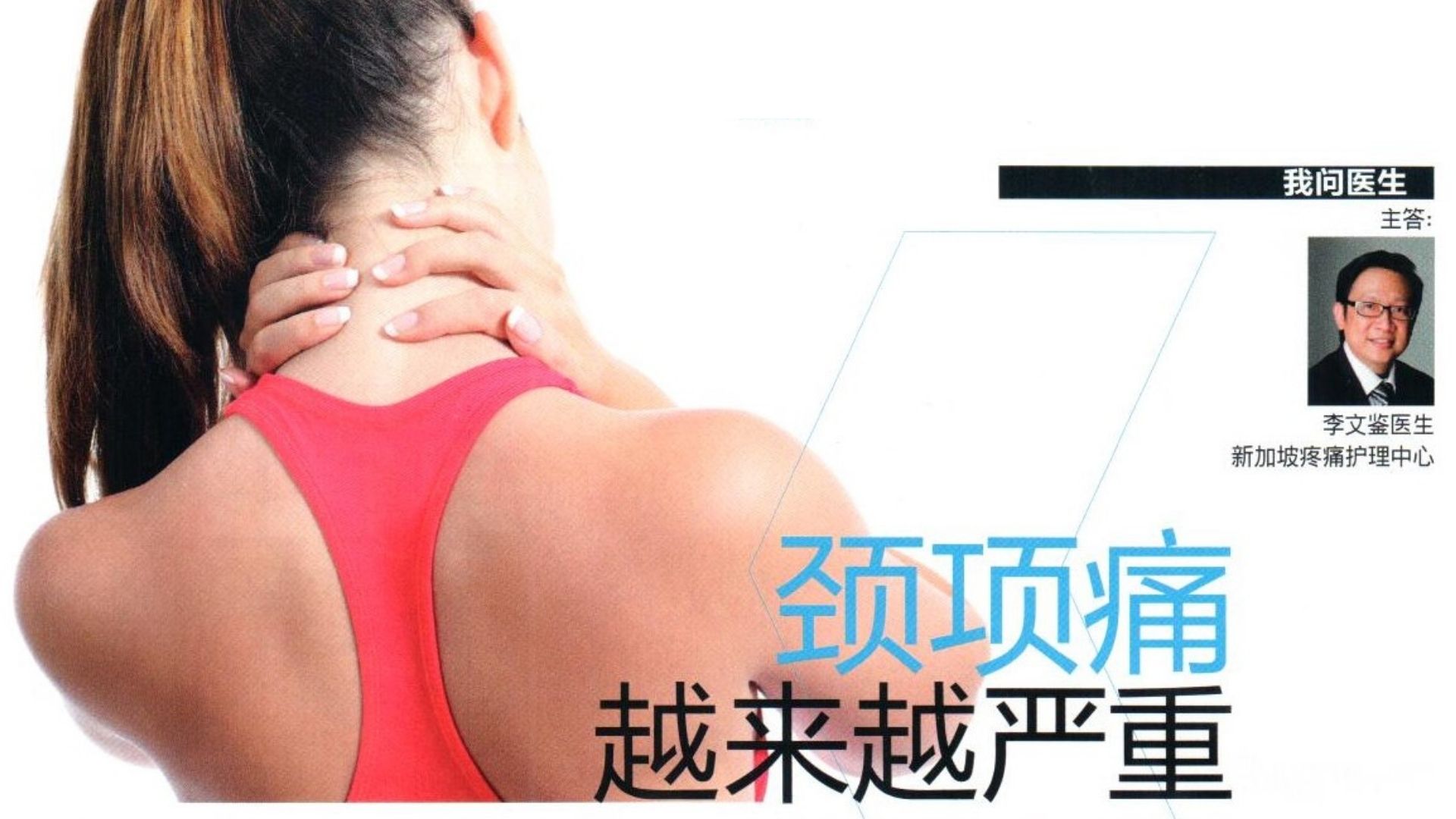
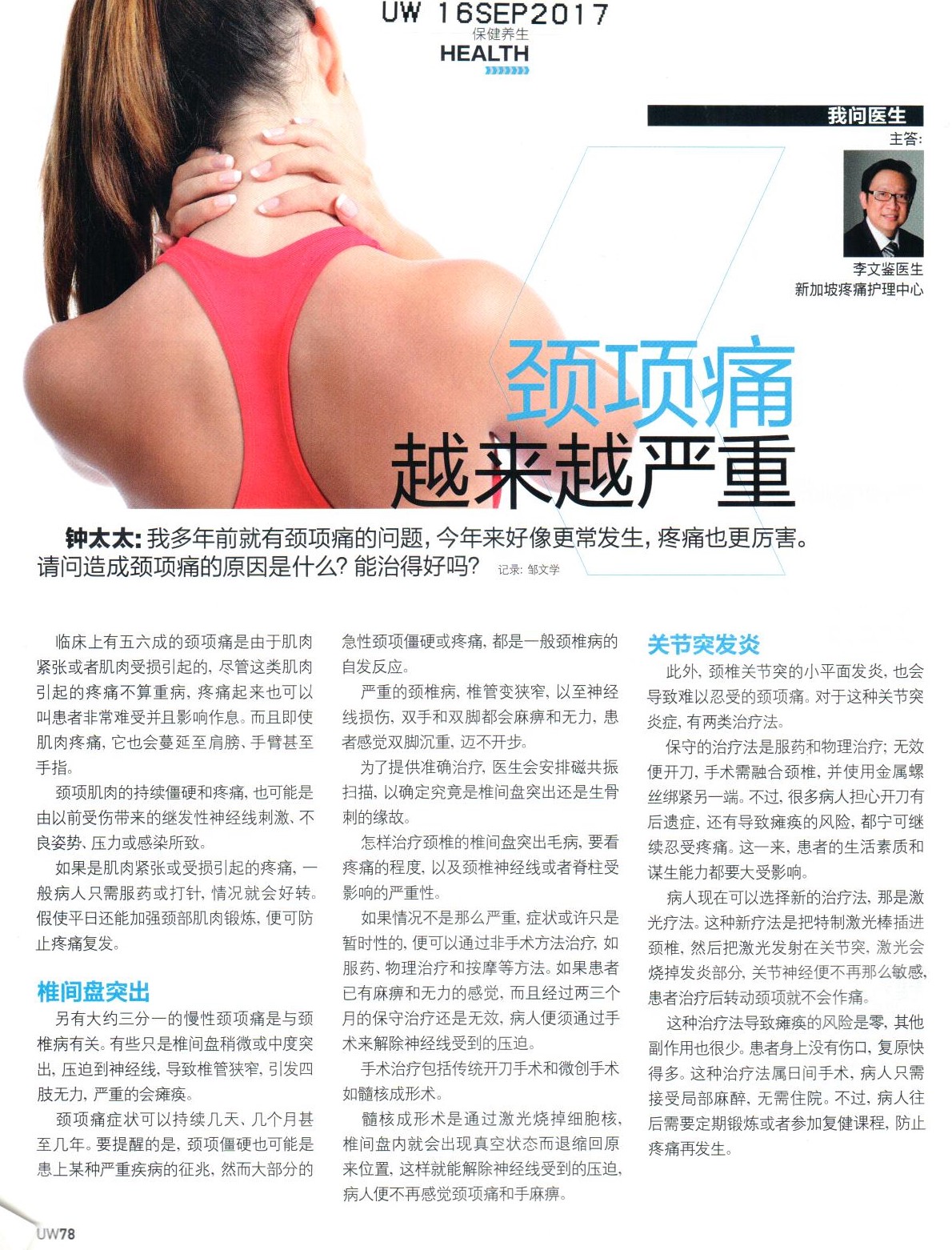
Dr. Bernard Lee on Neck Pain — As Quoted in Lianhe Wanbao’s 我问医生
May 28, 2026
CONTENTS
When Neck Pain Stops Being Something You Can Ignore
You’ve had neck pain for years. Some weeks it’s manageable. Other weeks, it locks up your shoulder. Lately it’s been spreading down your arm — or your fingers feel numb when you wake up.
This is the point most people reach before they ask a doctor: why is this getting worse, and is there something that can actually fix it?
That is exactly what Madam Zhong (钟太太) asked in the pages of Lianhe Wanbao. Her question — about neck pain that had been worsening over years — was answered by Dr. Bernard Lee Mun Kam (李文鉴医生) of Singapore Paincare Center.
His answer covered the three most common sources of persistent neck pain, when surgery is and isn’t necessary, and what minimally invasive options are now available to patients who don’t want to go under the knife.
About the Column: 我问医生 (I Ask the Doctor), Lianhe Wanbao
我问医生 is a reader Q&A column in Lianhe Wanbao (联合晚报), Singapore’s Chinese-language evening newspaper. Readers submit real medical questions; the column connects them with named specialist doctors who answer publicly, in their own words, under their own byline.
Dr. Bernard Lee Mun Kam was quoted as the responding specialist in the 16 September 2017 issue — published in the 保健养生 (Health & Wellness) section, page UW78. He was identified by name and clinic: 李文鉴医生,新加坡疼痛护理中心.
What Dr. Bernard Lee Explained
Most Neck Pain Starts in the Muscles — But That’s Not the Whole Story
Dr. Bernard Lee noted that roughly five to six out of ten cases of neck pain originate from muscle tension or muscle injury. This type of pain is not classified as serious disease. It can radiate to the shoulders, arms, and even the fingers — making it feel more severe than it is.
Persistent muscle tightness, he explained, can also arise from old nerve irritation, poor posture, pressure, or infection. When the source is purely muscular, medication and physical therapy are usually sufficient, and strengthening exercises can help prevent recurrence.
This distinction matters. Many patients assume arm tingling or hand numbness means something has gone structurally wrong. In many cases, it hasn’t.
When the Disc Is Involved
About one in three cases of chronic neck pain involves the cervical spine — specifically, a slipped or herniated disc pressing on nerve roots. This can cause spinal canal narrowing (椎管狭窄), weakness in the hands and legs, and in more severe cases, difficulty walking.
Dr. Bernard Lee described the importance of MRI in distinguishing disc herniation from bone spurs before selecting a treatment path. He noted that when numbness and weakness are already present, and three months of conservative treatment have not helped, surgical decompression may be needed to relieve nerve pressure.
For patients where the condition is less severe, he described nucleoplasty (髓核成形术) — a minimally invasive procedure in which a laser is used to reduce disc volume. As the disc shrinks, it pulls away from the nerve it was pressing on. Patients can experience relief from neck pain and hand numbness without open surgery.
Facet Joint Inflammation: A Treatable, Often Missed Cause
Dr. Bernard Lee also addressed facet joint inflammation (关节突发炎) — a less widely known but significant source of severe neck pain. Small joint inflammation at the cervical facets can cause pain that is difficult to tolerate.
He explained two treatment approaches. The conservative route involves medication and physiotherapy. When that fails, a newer option is available: a specialised laser probe is inserted into the cervical spine, and laser energy is applied directly to the inflamed joint. This sensitises the nerve locally, so that rotating the neck no longer triggers pain.
The risk of paralysis with this approach is zero, he noted. It is performed as a day procedure. No hospital admission is required. Recovery is quick — though patients need to keep up with exercises afterwards to prevent recurrence.
About Dr. Bernard Lee Mun Kam (李文鉴医生)
Dr. Bernard Lee Mun Kam is the Founder and CEO of Singapore Paincare Holdings Limited, and a Consultant Pain Specialist at Singapore Paincare Center.
He has over 20 years of clinical experience in pain management. Between 2002 and 2007, he established the Chronic and Interventional Pain Management Service at Tan Tock Seng Hospital, where he served as Director of the Pain Management Unit within the Department of Anaesthesia. From 2009 to 2018, he founded Singapore’s first Women’s Pain Centre at KK Women’s and Children’s Hospital.
Dr. Bernard Lee developed the Painostic® diagnostic methodology — a proprietary, trademarked framework that evaluates pain across four dimensions: patterns, pathology, perception, and psychology. It is the clinical foundation behind every assessment and treatment plan at Singapore Paincare.
He led the SGX listing of Singapore Paincare Holdings Limited in 2020 — making it the first publicly listed pain management group in Singapore.
His clinical specialties include spine and back pain, neck pain, shoulder pain, nerve pain, headache and facial pain, and musculoskeletal conditions.
Frequently Asked Questions About Neck Pain
Why has my neck pain been getting worse over the years?
Neck pain can worsen over time for several reasons — including cumulative disc wear, progressive muscle tightness, or undiagnosed facet joint inflammation. In some cases, what began as muscle tension gradually involves the cervical disc or spinal joints. A specialist assessment can identify which structure is responsible and guide appropriate treatment.
Is neck pain that spreads to the arm a sign of a slipped disc?
Not always. Around half of neck pain with arm radiation originates from muscle tension, not disc herniation. However, if you also experience hand numbness or weakness, this warrants further evaluation. An MRI can differentiate between disc-related nerve compression and a purely muscular cause.
What is nucleoplasty and is it suitable for neck pain caused by a slipped disc?
Nucleoplasty (髓核成形术) is a minimally invasive procedure where a laser reduces disc volume, allowing it to retract away from the nerve it was pressing on. It is performed as a day procedure without open surgery. Suitability depends on the severity of disc herniation and whether conservative treatment has already been tried. A pain specialist can advise on your specific case.
What causes facet joint pain in the neck, and how is it treated?
Facet joints are small joints at the back of the cervical spine. When inflamed, they can cause intense, localised neck pain. Conservative treatment includes medication and physiotherapy. When this fails, a minimally invasive laser procedure may be used to desensitise the affected joint — relieving pain when moving the neck without requiring surgery or hospitalisation.
When should I see a pain specialist for neck pain rather than a GP?
Consider seeing a pain specialist if your neck pain has persisted for more than three months, is getting progressively worse, is accompanied by numbness or weakness in the hands or arms, or has not responded to medication and physiotherapy. A specialist can perform a detailed assessment, arrange appropriate imaging, and advise on targeted treatment options.
Can neck pain be treated without surgery?
Many cases of neck pain — including those caused by disc herniation and facet joint inflammation — can now be managed without open surgery. Minimally invasive procedures such as nucleoplasty and targeted laser treatments are performed as day procedures with no hospital admission, low risk of complications, and faster recovery than traditional surgery.
Read the Original Article
This Q&A was published in Lianhe Wanbao (联合晚报), 我问医生 column, 16 September 2017, page UW78. The article is in Mandarin Chinese. Read the original article here
Speak to a Pain Specialist
If your neck pain is worsening or not responding to treatment, a specialist assessment can help identify the cause and explore your options.
Book a consultation with our pain management team.
This article is intended for general informational purposes only and does not constitute medical advice. Please consult a qualified healthcare professional for diagnosis and treatment tailored to your individual condition.