
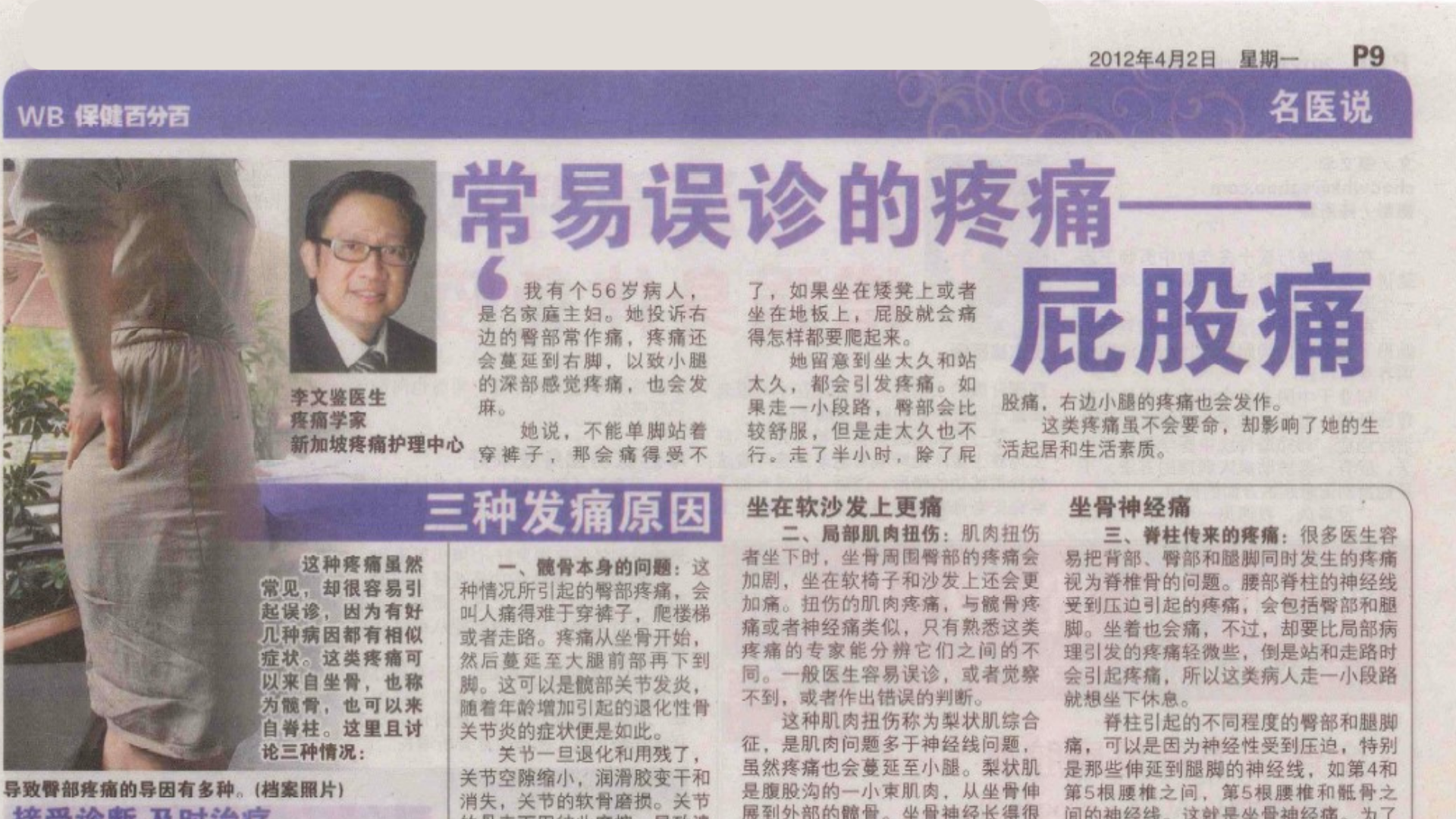
Dr. Bernard Lee on Buttock Pain — As Featured in Wan Bao’s 名医说 (Expert Doctor Speaks)
June 15, 2026
CONTENTS
Buttock Pain Is Common But Rarely Diagnosed Correctly the First Time
You sit down and your buttock hurts. You stand up and walk, and the pain follows you. Go far enough, and it travels down the back of your leg. You rest — and it is still there.
This is not an unusual story. Buttock pain is one of the most frequently misdiagnosed conditions seen in pain clinics across Singapore. Patients cycle through general practitioners, physiotherapists, and orthopaedic consultants before someone identifies the real source. The reason it gets missed so often is that several very different conditions produce almost identical symptoms — and each one requires a different treatment approach.
Dr. Bernard Lee Mun Kam (李文鉴医生), Consultant Pain Specialist and founder of Singapore Paincare Center, has spent over two decades untangling exactly these kinds of cases. In April 2012, Wan Bao (联合晚报) — a Singapore Press Holdings Chinese-language evening newspaper — featured Dr. Lee in its 名医说 (Expert Doctor Speaks) column within the WB 保健百分百 health section. The article, titled 常易误诊的疼痛——屁股痛 (Pain That Is Easily Misdiagnosed — Buttock Pain), gave Dr. Lee a platform to walk readers through three distinct causes of buttock pain and explain why getting the diagnosis right matters more than the treatment itself.
About This Feature: 名医说 (Expert Doctor Speaks) in Lianhe Wan Bao
名医说 — which translates literally as “Expert Doctor Speaks” — is a specialist health column published in 联合晚报 (Wan Bao), a Chinese-language evening newspaper under the Singapore Press Holdings group. The column gives named medical specialists a direct platform to educate Chinese-reading Singaporeans on clinical topics drawn from real patient experience.
Being featured in 名医说 is not a general interview. The column positions the doctor as the authoritative voice — the expert explaining a clinical situation to the public in plain terms. Dr. Bernard Lee Mun Kam appeared in this column on 2 April 2012, Page 9. He was credited as 疼痛学家,新加坡疼痛护理中心 — Pain Specialist, Singapore Paincare Center.
This appearance in a Singapore Press Holdings publication is a meaningful third-party signal. It reflects the clinical standing Dr. Lee held even before Singapore Paincare became the first pain management group to list on the Singapore Exchange (SGX) in 2020.
What Dr. Bernard Lee Explained: Three Sources of Buttock Pain
The clinical scenario Dr. Lee described in 名医说 is one that many Singaporeans would recognise. A 56-year-old homemaker presented with pain on one side of the buttock. The pain spread to the right leg, causing deep aching and numbness in the calf. She could not stand on one leg to put on trousers. Sitting too long made it worse. So did standing too long. Walking a short distance provided some relief — but if she walked for half an hour, both the buttock and the lower leg would flare.
This is a patient presentation that looks deceptively simple. It is not. Dr. Lee used this case to walk through three anatomically distinct sources of gluteal pain — each of which can produce a near-identical symptom picture to an untrained eye.
1. The Coccyx and Sacroiliac Joint (髋骨本身的问题)
The first source Dr. Lee discussed is pain originating from the bone itself — specifically the sacroiliac joint and surrounding structures. This type of buttock pain typically starts at the coccyx (the tailbone) and radiates forward toward the front of the thigh. As the sacroiliac joint degenerates with age, the joint space narrows, synovial fluid decreases, and the cartilage on the joint surface deteriorates. This is what produces deep, aching buttock pain that worsens on soft surfaces — a sofa or a mattress — because there is no firm support for an already unstable joint.
The treatment principle for sacroiliac joint-related pain is reducing joint inflammation. Standard oral painkillers that act at the surface of a joint tend to be ineffective. What works is delivering medication precisely to the deeper structures of the affected joint itself.
2. Piriformis Syndrome (梨状肌综合征 — Pain from Muscle Tension)
The second source is piriformis syndrome — and it is the one most frequently confused with the conditions around it. The piriformis is a small but important muscle that runs from the sacrum to the outer hip bone, deep in the gluteal region. It sits very close to the sciatic nerve. In roughly ten percent of people, the sciatic nerve actually passes through the piriformis muscle fibres directly.
When the piriformis becomes tight, contracted, or goes into spasm — from prolonged sitting, poor posture, overuse, or compromised biomechanics — it compresses the sciatic nerve running alongside or through it. The result is buttock pain with sciatic radiation: aching, numbness, or tingling that travels down the back of the leg to the calf and foot. This mimics sciatica caused by a slipped disc so closely that many clinicians miss it.
Dr. Lee explained that piriformis syndrome is most commonly caused by muscle contraction, nerve compression, and overuse of the gluteal muscles — compounded by poor posture and suboptimal physical conditioning. The implications for treatment are significant: this is a muscular and nerve-compression problem, not a spinal one. Treating it as a disc problem leads to the wrong outcome.
3. Spine-Referred Pain and Sciatica (脊柱传来的疼痛)
The third source is genuine spinal referred pain — what most people mean when they say “sciatica.” When the nerve roots at the lumbar spine are compressed, typically between the L4 and L5 vertebrae, or between L5 and S1 (the fifth lumbar and first sacral vertebrae), the pain radiates from the lower back through the buttock and down the leg.
Dr. Lee noted that many doctors reflexively attribute simultaneous back, buttock, and leg pain to a spinal problem. But the diagnostic key is in the pattern. Spine-referred pain tends to cause more significant symptoms during standing and walking, rather than sitting — which is the opposite of what sacroiliac joint pain produces. A person with true lumbar nerve compression often finds that sitting relieves their symptoms because it reduces the compressive load on the nerve root. They walk a short distance, need to rest, then can walk again.
If all three components are present — buttock pain, leg radiation, and worsening with exertion — Dr. Lee indicated this points to a more severe nerve compression, with a less favourable prognosis if left untreated.
Seek Diagnosis. Then Treat. (接受诊断 及时治疗)
Dr. Lee closed his 名医说 column with a direct message to readers: understanding why the pain occurs is only the first step. The important thing is to seek an accurate diagnosis promptly — and then treat it.
Because the causes differ, the treatment approaches differ too. Some patients may need only medication or physiotherapy. Others may require minimally invasive procedures. A small number of cases are best addressed through open surgery. No single pathway fits every presentation — which is why the diagnosis must come before the treatment plan, not after it.
About Dr. Bernard Lee Mun Kam (李文鉴医生)
Dr. Bernard Lee Mun Kam is the Founder and CEO of Singapore Paincare Holdings Limited and Consultant Pain Specialist at Singapore Paincare Center. He has over 20 years of clinical experience in pain management.
Dr. Lee established the Chronic and Interventional Pain Management Service at Tan Tock Seng Hospital between 2002 and 2007, serving as Director of the Pain Management Unit within the Department of Anaesthesia. He later founded Singapore’s first Women’s Pain Centre at KK Women’s and Children’s Hospital, where he practised from 2009 to 2018.
He developed the Painostic® diagnostic methodology — a proprietary, trademarked framework for multi-dimensional pain assessment — and founded the Singapore Paincare Academy to train allied health professionals in evidence-based pain management.
In 2020, Dr. Lee led Singapore Paincare to become the first pain management group to list on the Singapore Exchange (SGX), a milestone that reflects the group’s institutional accountability and clinical governance standards.
His clinical specialties include spine and back pain, sciatica, piriformis syndrome, nerve pain, shoulder pain, joint pain, headache and facial pain, musculoskeletal conditions, and cancer pain.
Dr. Lee’s April 2012 feature in 联合晚报’s 名医说 column predates the SGX listing by eight years — reflecting a career-long commitment to public health education and clinical transparency that long preceded Singapore Paincare’s institutional growth.
Read the Original Article
The original 名医说 column by Dr. Bernard Lee Mun Kam — 常易误诊的疼痛——屁股痛 — was published in 联合晚报 (Wan Bao) on 2 April 2012, Page 9, WB 保健百分百 health section.
Speak to a Pain Specialist
Buttock pain that has not resolved — or that keeps coming back — is worth investigating properly. Speak to a pain specialist to find out if this treatment is right for you.
Frequently Asked Questions About Buttock Pain
What causes pain in the buttock that spreads down the leg?
Buttock pain that radiates down the leg can come from three distinct sources: the sacroiliac joint, the piriformis muscle compressing the sciatic nerve (piriformis syndrome), or a compressed nerve root in the lumbar spine. Each cause produces similar symptoms but requires a different treatment approach. An accurate diagnosis is essential before any treatment begins.
How is piriformis syndrome different from sciatica?
Both conditions cause buttock pain with leg radiation — which is why they are so often confused. Sciatica originates from nerve compression at the lumbar spine, usually between the L4–L5 or L5–S1 vertebrae. Piriformis syndrome is caused by the piriformis muscle — deep in the buttock — compressing the sciatic nerve as it passes nearby. The source is muscular, not spinal. Treatment differs significantly between the two.
Why does sitting make my buttock pain worse?
Pain that worsens when sitting on soft surfaces like a sofa or mattress is often associated with sacroiliac joint dysfunction. The joint loses stability and cartilage over time, and soft seating reduces the support available to an already compromised joint. Piriformis syndrome can also be aggravated by prolonged sitting, because sustained hip flexion increases tension in the piriformis muscle.
When should I see a pain specialist for buttock pain?
You should consult a pain specialist if your buttock pain has lasted more than four to six weeks, if it is radiating into the leg, or if it is interfering with daily activities like sitting, walking, or sleeping. Buttock pain that is misdiagnosed and treated incorrectly can worsen over time — particularly if nerve compression is present and goes unaddressed.
Can buttock pain be treated without surgery?
In many cases, yes. Depending on the confirmed source of pain, treatment options may include physiotherapy, targeted injections, nerve blocks, or minimally invasive procedures. Surgery is indicated in a minority of cases. Accurate diagnosis of the specific pain source — sacroiliac joint, piriformis, or lumbar spine — determines which approach is appropriate.
What is piriformis syndrome and how is it treated?
Piriformis syndrome occurs when the piriformis muscle in the deep buttock becomes tight or goes into spasm, compressing the nearby sciatic nerve. It is caused by factors including prolonged sitting, poor posture, overuse, and muscle imbalance. Treatment typically involves physiotherapy to stretch and strengthen the piriformis, and in some cases, targeted muscle injections or nerve blocks to relieve compression and reduce spasm.