
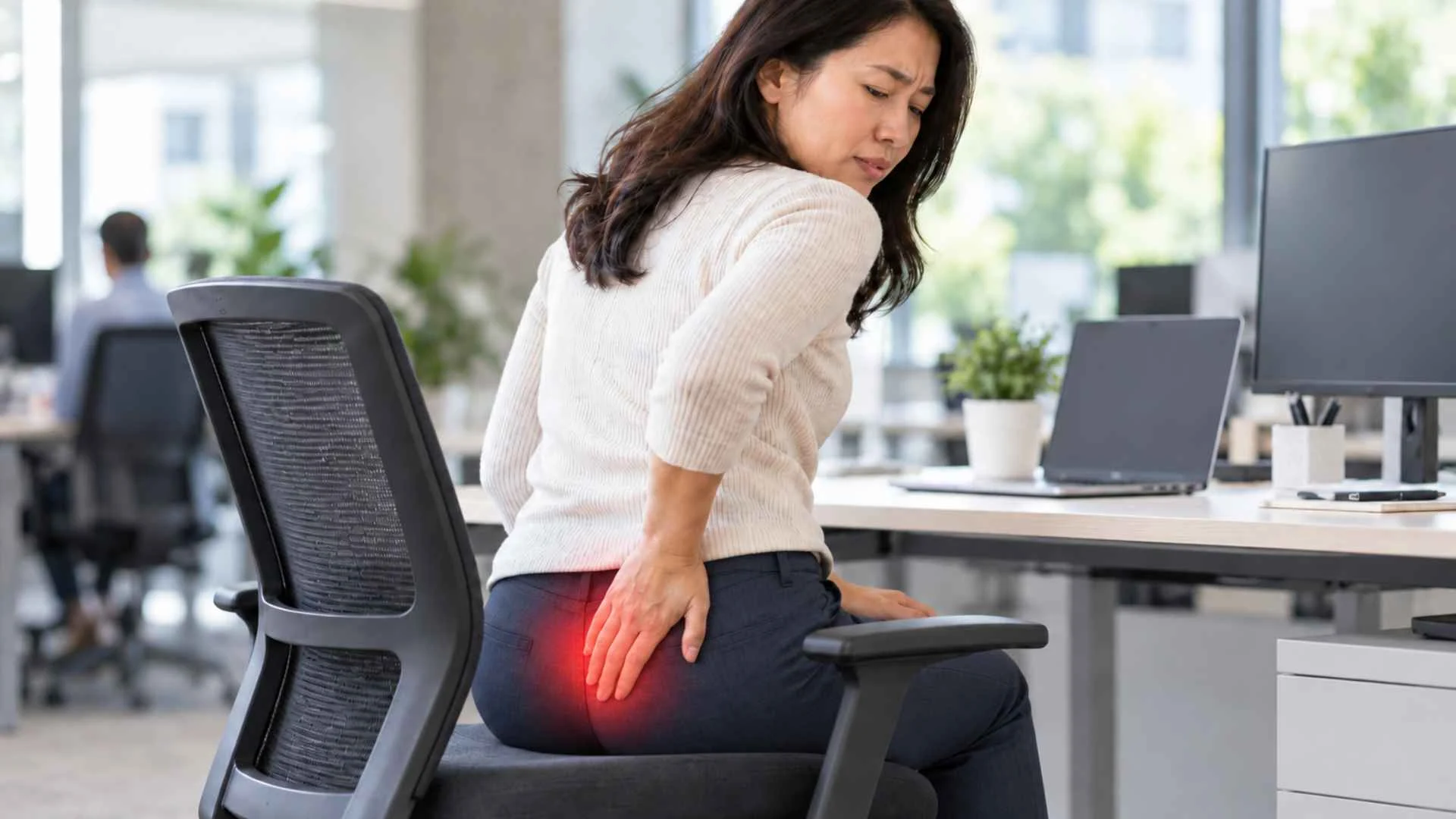
Tailbone Pain When Sitting: Causes, Relief, and When to Get Help in Singapore
September 28, 2026
CONTENTS
Quick Answer:
Tailbone pain when sitting is known medically as coccydynia. It means the coccyx, the small bone at the very bottom of your spine, or the tissues around it have become irritated or inflamed. Common causes include a fall onto your bottom, childbirth, long hours on hard seats, and a tailbone that moves too much or too little. Most people improve with simple measures such as a coccyx cushion, medication, and physiotherapy. If the pain lasts beyond a few weeks, targeted injection treatments may help settle it.
You sit down at your desk, and there it is again. A sharp, bruised ache right at the bottom of your spine. By lunch at the hawker centre, the hard round stool feels impossible. You find yourself perching on one buttock, or leaning forward just to get through a meeting.
If this sounds familiar, you are dealing with tailbone pain when sitting. It is more common than most people realise, and it is usually treatable.
This kind of pain behaves differently from general lower back pain. It sits lower, in a small spot you can often point to with one finger. It is usually worst when you lean back, and it often flares as you stand up from a chair.
This article explains why your tailbone hurts when you sit and what the pattern of your pain can tell you. It also covers the warning signs that need prompt attention, and the treatment options available to you in Singapore.
Understanding Your Tailbone and Why Sitting Makes It Hurt
Your tailbone, or coccyx, is a small, triangle-shaped bone made of three to five tiny segments. It sits at the base of your spine, just below the sacrum, which is the flat bone between your hips. It looks like a leftover, but it does real work. Several pelvic floor muscles, ligaments, and part of your buttock muscle all attach to it.
When you sit, your weight rests on three points: your two sitting bones and your tailbone. Lean back, slump into a sofa, or sit on a hard surface, and more of that weight shifts onto the coccyx. Normally, the tailbone flexes forward slightly to absorb the load. If it is bruised, inflamed, or moving abnormally, every sit-down presses on a sore spot.
This matters in Singapore, where many of us spend long hours seated. In a study of 2,867 Singapore adults, 47.7 percent reported seven or more hours of sedentary time a day (Lau et al., 2021, BMC Public Health). Add a daily commute and hard hawker seating, and your tailbone takes a lot of load.
What Causes Tailbone Pain When Sitting?
Doctors call persistent tailbone pain coccydynia. It is about five times more common in women than in men. This is partly because the wider female pelvis leaves the tailbone more exposed when sitting (Bain, Mabrouk and Foye, StatPearls). Several different problems can lead to the same painful spot.
A Fall Onto Your Bottom
Slipping on a wet floor and landing hard on your backside is one of the most common triggers. The fall can bruise the tailbone, sprain the ligaments around it, or, less often, fracture it. The pain can linger for weeks or months after the bruising has faded. A bruised and a fractured tailbone can feel very similar, so an X-ray helps tell them apart.
Pregnancy and Childbirth
In late pregnancy, hormones loosen the ligaments around your pelvis, and this can make the tailbone sore even before delivery. During delivery, the baby’s head pushes the coccyx backwards, which can strain the ligaments or shift the joint. Many mothers notice tailbone pain in the weeks after birth, and for some it does not settle on its own.
Prolonged Sitting on Hard or Narrow Seats
You do not need a fall or injury to develop tailbone pain. Hours of sitting, especially slumped back on a hard chair, can cause repeated small strains. Over time, these build into constant irritation. Long desk days, cycling, and hard, backless stools are common culprits.
An Unstable or Stiff Coccyx
Some tailbones move too much when you sit, which doctors call hypermobility. Others barely move at all, which is called hypomobility. Either way, the joint takes more stress than it should. This is one of the more common hidden causes, and it often only shows up on special sitting and standing X-rays.
Weight Changes
A higher body weight increases the pressure through your tailbone when you sit. Rapid weight loss can also trigger pain, because you lose some of the fat padding that cushions the bone. If you have recently lost a lot of weight, this is worth mentioning to your doctor.
Tight Pelvic Floor Muscles
The muscles of your pelvic floor attach directly to the coccyx. When they stay tense or go into spasm, they tug on the bone and cause a deep, aching pain. This often overlaps with other causes and can keep pain going after the original injury has healed.
Pain Referred From Elsewhere
Sometimes the problem is not the tailbone at all. Pain from the lower spine, the sacroiliac joint, or piriformis syndrome, where a buttock muscle irritates the sciatic nerve, can feel like tailbone pain. The next section explains how to tell them apart.
Less Common but Important Causes
Rarely, tailbone pain comes from an infection, a tumour, or a pilonidal cyst. This is a small pocket in the skin near the top of the buttock crease that can become infected. These are uncommon. However, they are the reason persistent pain should be properly checked rather than ignored.
How Can You Tell If Pain When Sitting Is Coming From Your Tailbone?
The two main clues are where the pain sits and when it strikes. True tailbone pain is usually felt in one small spot at the very bottom of the spine. It is worst when you sit, lean back, or get up from a chair. These clues never replace a clinical assessment, but they help you describe your symptoms clearly to your doctor.
Pain at the tip of the tailbone usually comes from the coccyx itself, especially if pressing on the spot reproduces it. Pain when sitting down and getting up is one of the most typical patterns. If it hurts most as you rise from a chair, this can point to an unstable coccyx. The bone shifts as your weight comes off it.
Deep pain towards the rectum that worsens with bowel movements often involves the pelvic floor muscles, which attach to the coccyx. Pain above the tailbone, over the flat sacrum or to one side of the buttock, more likely comes from the sacroiliac joint or piriformis muscle. Pain felt in the tailbone and hips together can point the same way.
Pain that spreads down the back of your leg, with tingling or numbness, suggests a nerve from the lower spine rather than the tailbone. Lower back and tailbone pain can also occur together, which is why your spine is checked as part of the assessment.
Symptoms That Accompany Tailbone Pain
Tailbone pain when sitting rarely comes alone. Most people describe a dull, bruised ache that turns sharp when they lean back or sit on a firm surface. Sitting on one buttock, or leaning forward, usually eases it, which is itself a strong clue.
You may also notice pain during bowel movements, or discomfort during intimacy. These symptoms often involve the pelvic floor muscles and ligaments that attach to the coccyx.
Pain that stays the same whether you sit, stand, or lie down behaves differently. So does pain that wakes you at night. These patterns are less typical of simple coccydynia and deserve a closer look.
A burning, tingling, or electric feeling around the tailbone or between your legs is also worth mentioning to your doctor. It can mean a nerve, rather than the bone or joint, is involved.
See a doctor promptly if your tailbone pain comes with:
- Fever, chills, or redness and swelling over the tailbone
- A painful lump or discharge near the top of the buttock crease
- Unexplained weight loss or a history of cancer
- Severe pain at night that does not change with position
- New numbness around the groin, or bladder or bowel control problems
- Pain that began after a major fall or accident and is getting worse
How Is Tailbone Pain Diagnosed?
Getting the cause right matters, because treatment for an unstable coccyx differs from treatment for a tight pelvic floor or a spinal problem.
At Singapore Paincare, assessment starts with your story. When did the pain begin? Was there a fall, a pregnancy, or a change in weight? Is it worse sitting down, standing up, or during bowel movements?
A physical examination follows. Your doctor will press gently around the tailbone and nearby structures to find the exact source of tenderness. They will also check your lower back, hips, and sacroiliac joints to rule out referred pain.
Imaging helps confirm the cause. A standard X-ray often looks normal, because it shows the coccyx in only one position. Dynamic X-rays, taken while you sit and then stand, show whether your coccyx moves too much or too little. An MRI may be used if an infection, cyst, or other cause needs to be ruled out.
If the picture is still unclear, a diagnostic nerve block can help confirm whether the tailbone is the pain source by briefly switching it off.
This combined approach reflects the Painostic® methodology. It looks at four pillars: your pain patterns, what examination and scans show, how sensitive your nerves have become, and how pain affects your mood.
Tailbone Pain When Sitting Treatment in Singapore: What Are Your Options?
Your treatment is planned around what is causing your pain. That is why a clear diagnosis comes first. Our coccydynia treatment for tailbone pain follows this same principle.
The good news is that most people improve without surgery. Around nine in ten cases settle with simple, non-surgical care (StatPearls). At Singapore Paincare, we start with the simplest options. If the pain does not settle, we may move on to targeted treatments from our Neurospan suite.
Coccygeal Cushions and Activity Modification
Simple changes can take pressure off a sore tailbone. A coccygeal cushion, such as a wedge with a cutout or a donut cushion, eases the load when you sit. Leaning slightly forward, standing up every 20 to 30 minutes, and avoiding activities that make the pain worse can calm a flare. For many people, these steps are the first thing that helps.
Physiotherapy and Rehabilitation
A physiotherapist can teach you stretches, strengthening exercises, and ways to relax your pelvic floor. They can also help you change your posture to ease strain on the tailbone. For some patients, gentle hands-on work helps loosen tight muscles that attach to the tailbone. Physiotherapy often works best alongside other treatments.
Anti-Inflammatory Medication
NSAIDs, short for non-steroidal anti-inflammatory drugs, can ease pain and swelling around the tailbone. They are usually taken for short periods during a flare. Anti-inflammatory creams rubbed onto the skin are another option and tend to cause fewer side effects. Your doctor will check which is right for you, as tablets do not suit everyone.
Neurospan Radiofrequency Injections
Neurospan Radiofrequency Injections are day procedures that use imaging to guide a fine needle to the nerves carrying pain signals from the tailbone. Treatment often starts with a nerve block around the ganglion impar, a small cluster of nerves just in front of the tailbone. If the block helps, gentle pulses of radiofrequency energy may then be used to calm these nerves for longer. This option is usually considered when pain persists despite cushions, physiotherapy, and medication.
Surgery is kept for the few people whose pain does not respond to these treatments. It removes part of the tailbone (partial coccygectomy) or all of it (total coccygectomy). Most patients do not need it. If your pain also involves your lower back, your plan may treat your spine at the same time.
A Pain Specialist’s Perspective
One pattern we see often in Singapore is tailbone pain that has been treated as a simple bruise for months. The patient, frequently a woman after childbirth or someone after a fall, has had a normal X-ray and been told to rest. Yet every time they sit down or stand up, the pain returns.
In many of these patients, only a single standard X-ray was taken. One image cannot show how the coccyx moves when you put your weight on it. When we repeat the X-rays with the patient sitting and then standing, some tailbones tip too far or shift out of line. That instability explains why the pain is triggered by movement rather than by the sitting itself.
A second group looks similar but behaves differently. Their tailbone moves normally, yet they have constant, deep pain driven by tight pelvic floor muscles and a sensitised nervous system. This means the nerves have become more reactive to signals they would normally ignore.
The first group may respond well to targeted injections and procedures. The second often needs muscle relaxation work, physiotherapy, and nerve-calming medication as the foundation.
The takeaway is that a normal scan does not mean your pain is imagined. Once pain has lasted beyond about two months, it is less likely to settle on its own. By then, many people sit on one side, which strains the hips and lower back and can make the nerves more sensitive. An early, accurate assessment can make treatment simpler.
Managing Tailbone Pain Day-to-Day: How to Sit, Sleep, and Move
How you sit makes a real difference. Use a coccygeal cushion, such as a wedge with a cutout or a donut cushion, to take pressure off your tailbone. Sit up tall or lean slightly forward, so your weight rests on your sitting bones. Avoid slumping on soft sofas, which rolls your pelvis back onto the tailbone.
Set a reminder to stand and walk every 20 to 30 minutes during long desk days. In the car or a Grab ride, bring your cushion and avoid reclining the backrest too far. At the hawker centre, choose a seat with a backrest when you can, rather than a hard round stool. When you get up, lean forward and push up with your legs instead of rocking back.
At night, many people find lying on their side more comfortable, with a pillow between the knees. If lying on your back hurts, a pillow under your knees may ease it.
Gentle movement, such as walking or swimming, usually helps more than complete rest. Gentle stretches for the buttocks, hips, and lower back, such as a knee-to-chest stretch, may ease muscle tension around the coccyx. A physiotherapist can show you which exercises suit you. For sit-ups or floor exercises, use a thick mat and avoid rolling back onto your tailbone.
A cold pack in the first few days after a fall, or a warm compress for ongoing muscle tension, may ease discomfort. Keeping your bowel movements soft also helps, because straining and constipation put pressure on the pelvic floor and tailbone. Drink enough water and include fibre in your meals. If you cycle, a split or cutout saddle can reduce pressure.
These are supportive measures, not substitutes for a proper diagnosis.
When Should You See a Specialist for Tailbone Pain When Sitting in Singapore?
Most tailbone pain improves within a few weeks to a few months. As a general guide, see a pain specialist if your pain has lasted more than four to six weeks. The same applies if it stops you from working, driving, or sleeping comfortably. It is also worth getting assessed if simple measures like a cushion and medication have not helped.
You do not need a referral to see a pain specialist in Singapore. Our team can assess your tailbone, arrange dynamic X-rays if needed, and explain the treatment options for coccydynia that fit your situation. If you have any of the warning signs listed earlier, seek medical care promptly.
Find out more about your options. Consult a specialist today.
Conclusion
Tailbone pain when sitting can make ordinary days feel exhausting, from your commute to your lunch break. The reassuring part is that a cause can usually be found, and even when it cannot, the pain can still be treated. Most people improve with the right plan. For some, a cushion and physiotherapy are enough, while others need a targeted treatment such as Neurospan Radiofrequency Injections.
The key is not to accept months of sitting on one side as your new normal. Book a consultation with our pain management team. A clear diagnosis is the first step toward sitting comfortably again.
Read More: Tailbone pain (coccydynia)
FAQs
What does tailbone pain when sitting usually mean?
Tailbone pain when sitting usually means the coccyx, or the ligaments and muscles around it, has become irritated or inflamed. Doctors call this coccydynia. It often follows a fall, childbirth, long hours on hard seats, or a tailbone that moves too much or too little. Less often, pain is referred from the lower back or buttock muscles. A doctor can confirm the cause with an examination and, if needed, sitting and standing X-rays.
Can tailbone pain go away on its own?
Yes, many cases improve within a few weeks, especially after a minor fall. Using a coccyx cushion, avoiding hard seats, and taking short breaks from sitting can help. However, pain that lasts more than four to six weeks is less likely to settle without treatment. At that point, a specialist assessment can find the cause and guide targeted care, so the pain does not become long-term.
Why does my tailbone hurt when I sit down and get up?
Pain when you sit down and stand up is one of the most typical signs of coccydynia. As you sit, your weight shifts onto the tailbone and it bends slightly forward. As you stand, it moves back again. If the joint is inflamed, or the coccyx moves too much, these small movements hurt. Sitting and standing X-rays can show whether an unstable coccyx is the cause, which helps guide treatment.
How long does tailbone pain last?
Most tailbone pain improves within a few weeks to a few months, especially with a cushion, activity changes, and medication. A bruised tailbone usually settles faster than a fracture or a strained joint. Pain lasting more than about two months is considered long-term and is less likely to go away on its own. At that stage, a specialist assessment can find the cause and guide targeted treatment.
What are the red flags for tailbone pain?
Seek prompt medical care if your tailbone pain comes with fever, redness, or swelling. The same applies to a lump or discharge near the buttock crease, or unexplained weight loss. Severe night pain that does not change with position also needs checking. New numbness around the groin, or loss of bladder or bowel control, needs urgent attention. These signs are uncommon but may point to infection, a cyst, or a nerve problem.
What treatments are available for tailbone pain without surgery?
Most tailbone pain is treated without surgery. Options include a coccygeal cushion, activity changes, physiotherapy, and anti-inflammatory medication as tablets or topical cream. If pain persists, Neurospan Radiofrequency Injections may help. These target the nerves carrying pain signals from the tailbone, often starting with a nerve block. Surgery to remove the coccyx is kept for the small number of cases that do not respond.
How is tailbone pain diagnosed at Singapore Paincare?
Diagnosis starts with a detailed history of how your pain began and what triggers it. A physical examination then pinpoints the tender spot and rules out the lower back, hips, and sacroiliac joints. Dynamic X-rays, taken sitting and standing, show whether the coccyx moves abnormally. MRI or a diagnostic nerve block may be added. This follows the Painostic® methodology, which also considers nerve sensitivity and how the pain is affecting your mood and daily life.
About Singapore Paincare
Singapore Paincare Medical Group runs pain clinics across Singapore, including Singapore Paincare Center at Paragon and Novena. Its doctors use the Painostic® method to find the source of pain. Treatment options include minimally invasive procedures, physiotherapy, and medication as alternatives to surgery. No referral is needed.
Medical Disclaimer
This article is intended for general informational purposes only and does not constitute medical advice. Please consult a qualified healthcare professional for diagnosis and treatment tailored to your individual condition.