
Dr. Bernard Lee on Chronic Back Pain and Slipped Disc: As Featured in Lianhe Wanbao
August 31, 2026
CONTENTS
Back pain can start as an occasional ache, then slowly become something that affects work, sleep, sitting, standing and everyday movement. When it keeps returning for months or years, the bigger question is often not how to dull the pain, but what is causing it.
That was the situation described in a 2010 Lianhe Wanbao feature involving a 38-year-old application engineer who had lived with back pain for seven years. The report also cited his treating pain specialist, Dr. Bernard Lee Mun Kam (李文鉴医生), who identified a slipped disc pressing on a nerve as the source of his symptoms.
The case is more than 15 years old, so the treatment described in the newspaper should be read in its historical context. What remains useful today is the clinical lesson: persistent back pain, especially when numbness or other nerve symptoms appear, deserves a proper assessment of the underlying cause.
The 2010 Lianhe Wanbao Feature
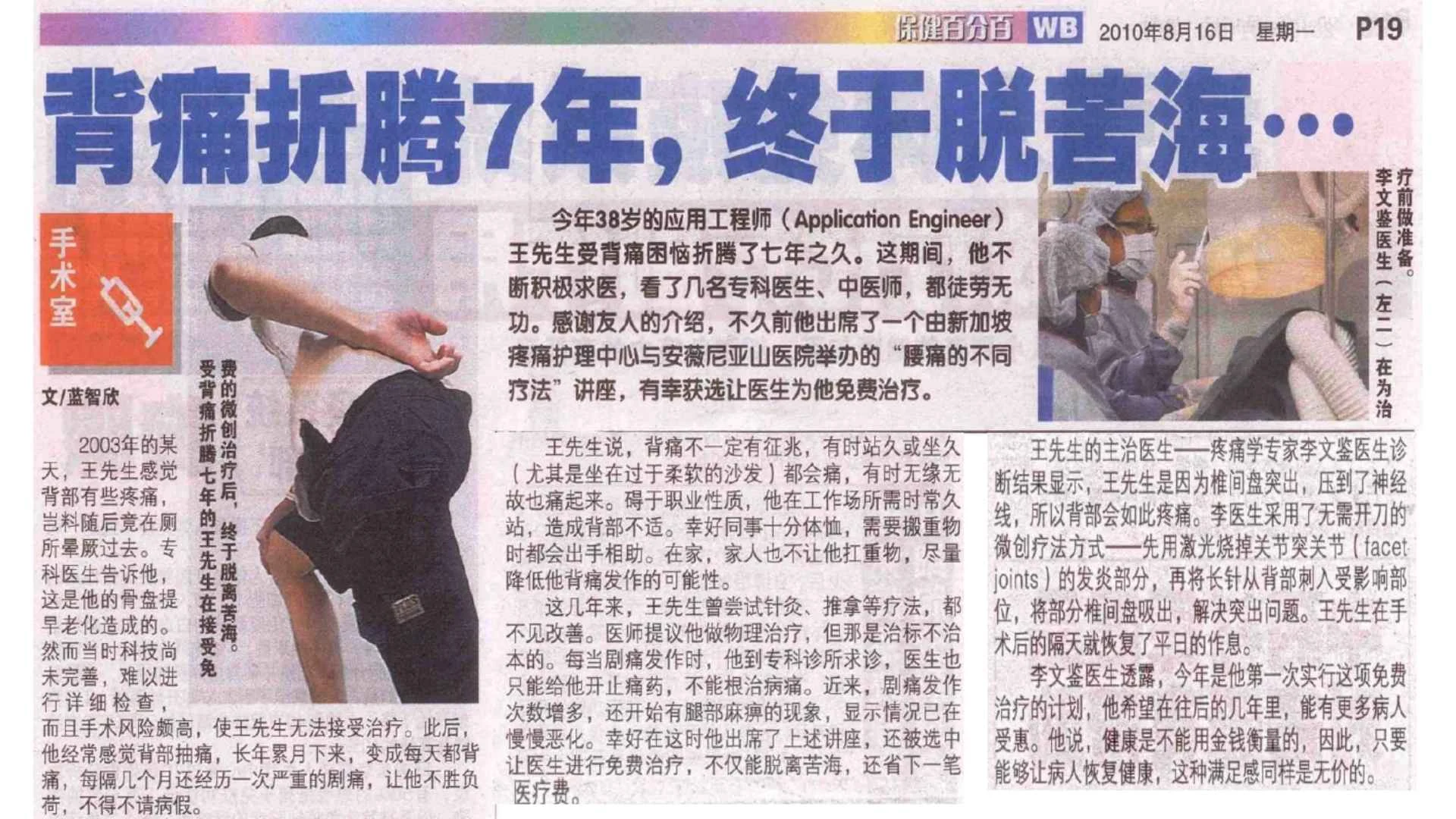
On 16 August 2010, Lianhe Wanbao (联合晚报) published the article 《背痛折腾7年,终于脱苦海…》 in its 《保健百分百》 section on page P19.
Written by newspaper journalist 蓝智欣, the feature followed a patient referred to as Mr Wang, an application engineer who had experienced recurring back pain since 2003. The article cited Dr. Bernard Lee Mun Kam (李文鉴医生) as his treating pain specialist.
According to the report, Mr Wang had sought help from several specialists and traditional Chinese medicine practitioners over the years. His pain became more frequent, affected prolonged standing and sitting, and eventually included numbness in the leg. The newspaper reported that Dr. Lee diagnosed a herniated or slipped disc pressing on a nerve.
This was a newspaper-reported patient case from 2010. It should not be treated as proof that the same diagnosis or treatment will apply to another person with back pain.
What Can Seven Years of Back Pain Tell Us?
One useful point from the feature is how chronic back pain can gradually interfere with normal life.
Mr Wang told the newspaper that long periods of standing could aggravate his back. Sitting for too long, particularly on a very soft sofa, could also trigger pain. At work, colleagues sometimes helped him with heavy lifting. At home, his family tried to reduce activities that might set off another episode.
These details matter because back pain is often assessed through more than a scan alone. A doctor will usually want to know what brings the pain on, what makes it better or worse, whether it travels into the leg, and whether there is numbness or weakness.
Pain patterns do not diagnose the condition by themselves, but they can help guide the next step.
Can a Slipped Disc Cause Back Pain and Leg Numbness?
Yes. A slipped disc, also called a herniated disc, happens when part of a spinal disc bulges or pushes out from its normal position. If it irritates or compresses a nearby nerve, symptoms can extend beyond the back.
Possible symptoms include:
- Lower back pain
- Pain that travels into the buttock or leg
- Tingling or pins and needles
- Numbness in part of the leg or foot
- Muscle weakness
- Pain that becomes worse with certain positions or movements
The 2010 article is notable because the patient’s symptoms had changed over time. The report described increasingly frequent severe pain followed by leg numbness. That combination prompted further assessment and a diagnosis involving nerve compression.
Not every slipped disc causes symptoms, and not every episode of back pain comes from a disc. Muscles, joints, spinal nerves and other structures can also be involved.
Why Does Finding the Source of Back Pain Matter?
Back pain is a symptom, not a diagnosis.
Two people may both say, “My lower back hurts,” yet the underlying cause can be very different. One may have muscular pain. Another may have pain from the small joints of the spine. Someone else may have a disc problem irritating a nerve.
That is why treatment should follow diagnosis.
Today, Dr. Bernard Lee uses the Painostic® diagnostic approach at Singapore Paincare Center. It considers the patient’s history, examination findings, pain pattern and relevant investigations before treatment options are discussed. The aim is to identify the likely pain generator rather than rely on symptoms alone.
For persistent or complex back pain, imaging such as an MRI may be considered when the clinical assessment suggests it is needed. A scan should be interpreted together with the patient’s symptoms and examination, because disc changes can sometimes be seen even in people who have little or no pain.
What Treatment Did the 2010 Article Describe?
The Lianhe Wanbao report described a minimally invasive treatment selected for Mr Wang at that time. It said the procedure involved treating an inflamed area around the facet joints and inserting a needle through the back to remove some disc material from the affected area.
The article reported that this was intended to address both the painful spinal joint area and the disc protrusion identified in his case.
This description reflects the treatment reported in 2010. It should not be interpreted as a current treatment recommendation or as the right procedure for another patient. Techniques, equipment, clinical criteria and treatment pathways can change over time.
Current treatment for a slipped disc or chronic back pain depends on the diagnosis, severity of symptoms and whether there are signs of nerve involvement. Options may range from medication and rehabilitation to targeted minimally invasive procedures or surgery in selected cases.
Does Every Slipped Disc Need a Procedure?
No.
Many people with a slipped disc can improve without a procedure, particularly when there is no progressive weakness or other serious nerve problem. A treatment plan may include appropriate activity modification, medication and physiotherapy or rehabilitation.
A procedure may be considered when symptoms remain significant despite conservative care, when pain continues to limit function, or when the clinical findings suggest that a specific pain source can be targeted.
Surgery may be needed in selected cases, especially when there is severe or progressive nerve compression. The decision depends on the individual diagnosis rather than the scan result alone.
When Should Back Pain Be Assessed More Urgently?
Most back pain is not an emergency. However, some symptoms need prompt medical attention.
Seek urgent medical assessment if back pain is accompanied by:
- New loss of bladder or bowel control
- Numbness around the groin or inner thighs
- Sudden or worsening weakness in the legs
- Major difficulty with balance or walking
- Rapidly worsening neurological symptoms
For non-emergency symptoms, it is also reasonable to seek medical review when back pain keeps returning, lasts for weeks, interferes with work or sleep, or starts to include persistent tingling, numbness or weakness.
Dr. Bernard Lee’s Experience in Pain Management
Dr. Bernard Lee Mun Kam (李文鉴医生) is the Founder of Singapore Paincare Center and Chief Executive Officer of Singapore Paincare Holdings Limited. He has more than 20 years of clinical experience in chronic and interventional pain management.
Before Singapore Paincare, Dr. Lee established the Chronic and Interventional Pain Management Service at Tan Tock Seng Hospital. He later founded Singapore’s first Women’s Pain Centre at KK Women’s and Children’s Hospital.
He holds a Master of Medicine in Anaesthesiology and is a Fellow of the Faculty of Pain Medicine, Australian and New Zealand College of Anaesthetists. He also developed the Painostic® diagnostic methodology used at Singapore Paincare Center.
Singapore Paincare Holdings Limited was listed on the Singapore Exchange in 2020.
The 2010 Lianhe Wanbao clipping provides a historical record of Dr. Lee being cited in public coverage of chronic back pain, slipped disc and interventional pain management more than a decade ago. His current role and credentials above are based on current Singapore Paincare information, not on the old clipping alone.
Frequently Asked Questions
Can chronic back pain be caused by a slipped disc?
Yes. A slipped or herniated disc can cause chronic back pain when displaced disc material irritates nearby tissues or presses on a spinal nerve. Some people also develop pain, tingling, numbness or weakness in the leg. However, chronic back pain has many possible causes, so an assessment is needed before assuming the disc is responsible.
Does leg numbness with back pain mean a nerve is compressed?
Leg numbness can occur when a spinal nerve is irritated or compressed, including from a slipped disc, but it is not the only possible cause. The location of numbness, whether pain travels down the leg, and whether weakness is present all help with diagnosis. Worsening numbness or weakness should be assessed promptly.
Do I need an MRI for chronic back pain?
Not everyone with back pain needs an MRI. A doctor usually starts with your symptoms, medical history and physical examination. Imaging may be considered when pain persists, nerve symptoms are present, there are concerning clinical signs, or the result would change treatment. MRI findings should always be interpreted together with the clinical assessment.
Does every slipped disc need surgery?
No. Many slipped discs can be managed without surgery. Treatment may include medication, appropriate activity changes and rehabilitation. Targeted procedures may be considered for selected patients whose symptoms remain significant. Surgery is generally reserved for specific situations, such as severe or progressive nerve compression, based on a specialist assessment.
When should I see a pain specialist for back pain?
Consider a specialist assessment when back pain keeps returning, lasts for several weeks, interferes with work, sleep or daily activity, or begins to cause persistent leg pain, tingling, numbness or weakness. Urgent assessment is needed for bladder or bowel changes, groin numbness or sudden worsening leg weakness.
Original Lianhe Wanbao Article
Publication: Lianhe Wanbao (联合晚报)
Section: 《保健百分百》
Article: 《背痛折腾7年,终于脱苦海…》
Date: 16 August 2010
Page: P19
Byline: 蓝智欣
Media type: Newspaper feature / patient case report citing Dr. Bernard Lee Mun Kam
This article is intended for general informational purposes only and does not constitute medical advice. Please consult a qualified healthcare professional for diagnosis and treatment tailored to your individual condition.