
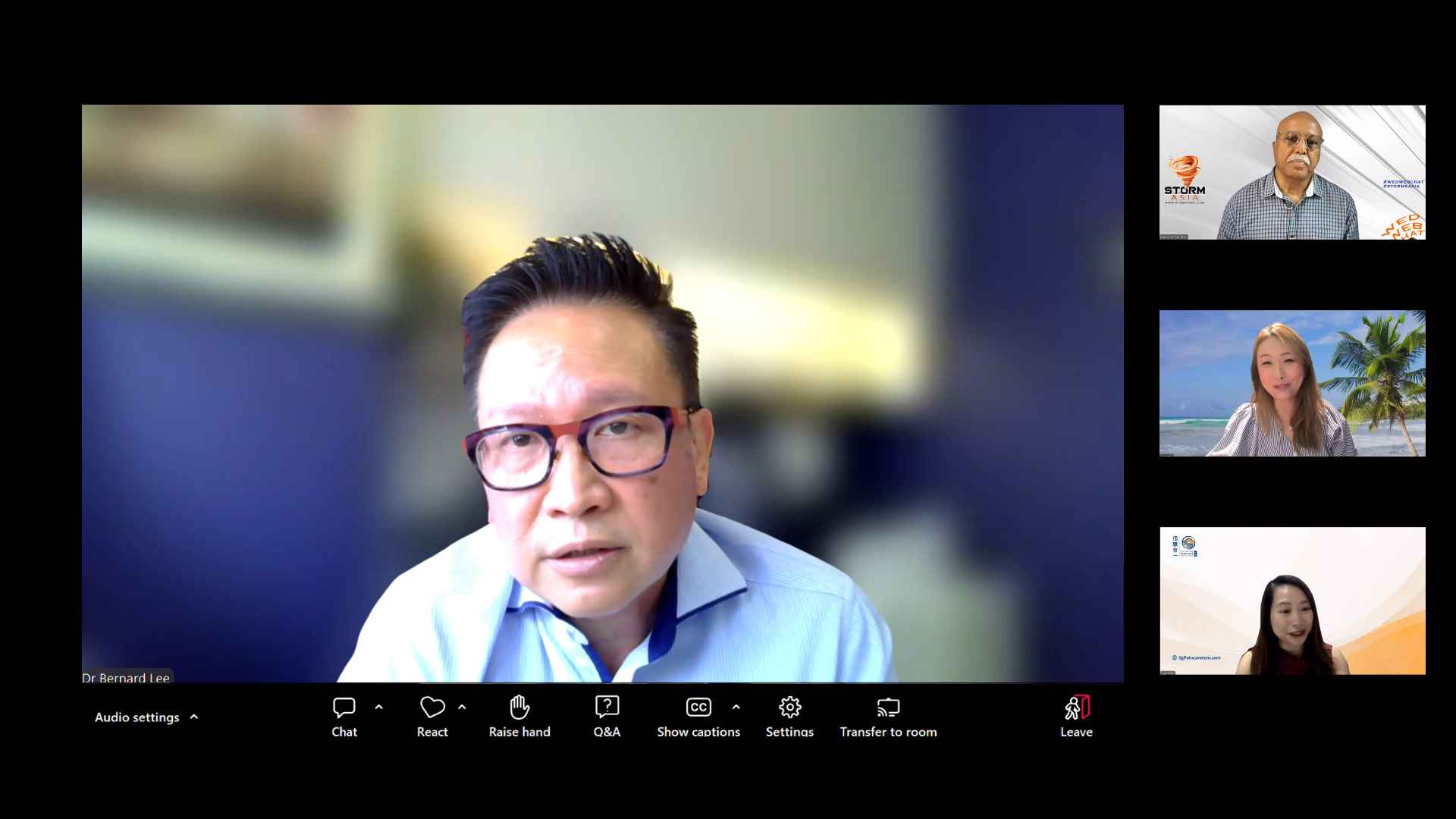
Dr. Bernard Lee on Chronic Pain Management — As Quoted in Storm Asia’s Web Chat
July 1, 2026
When Pain Won’t Go Away, Who Do You Ask?
A sprained ankle heals in weeks. A stubbed toe stops hurting in days. But what happens when the pain doesn’t leave — when it outlasts the injury that caused it, or shows up with no clear cause at all?
That was the question at the centre of a live Web Chat session hosted by Storm Asia, where Dr. Bernard Lee Mun Kam, Founder and CEO of Singapore Paincare Holdings Limited, joined a panel to unpack how persistent pain is diagnosed — and why the pain you feel doesn’t always match what’s actually wrong.
Also on the panel was Physician Sue Wan of Singapore Paincare TCM Wellness, offering a Traditional Chinese Medicine perspective as a complement to Dr. Lee’s interventional approach — a conversation that reflected how the two disciplines increasingly work side by side in patient care.
About the Web Chat
Storm Asia’s Web Chat is a recurring live session on storm-asia.com where guests join a moderated discussion, take audience questions in real time, and share professional perspectives on topics of public interest. This session, hosted by Mr Kanan, focused on pain — how it works as a warning signal, why it sometimes persists long after healing, and how patients can decide when to seek help.
Dr. Bernard Lee was invited onto the panel as a consultant pain specialist to field questions on diagnosis and treatment. (Session date: 1 July 2026. Watch the full session here: https://youtu.be/1Kuq4ONqnZE..)
What Dr. Bernard Lee Shared
Pain Is Not a Straight Line
Dr. Lee opened by reframing what pain actually is: an alarm system, meant to protect us by signalling that something needs attention — rest, treatment, or a fix. For a simple injury, that alarm is reliable. You break a bone, you feel pain, you fix the bone, the pain goes away.
But past a certain point — six weeks to three months of persistent pain — that straight-line relationship breaks down. The pain can outlast the problem it was meant to signal, or persist even after the original cause has been treated. Understanding why that happens, Dr. Lee explained, is the real work of a pain specialist.
Three Categories, Three Different Problems
A key part of the session was Dr. Lee walking through how pain specialists categorise pain into three broad groups:
- Mechanical pain — caused by a physical, identifiable problem: a torn muscle, a slipped disc, a damaged joint. Fixing the underlying structure typically resolves the pain.
- Nerve (neuropathic) pain — caused by injury or dysfunction in the nervous system itself, even when nothing looks structurally wrong. Diabetic neuropathy and post-stroke pain are examples.
- Nociplastic pain — the hardest category to treat, where pain persists even after the original generator is gone, or without ever matching a clear structural cause. Dr. Lee used phantom limb pain as an illustration: amputees can continue to feel pain in a limb that no longer exists, because the nervous system’s pain signalling has become sensitised independent of the original injury.
This distinction matters because treatment for one category rarely works for another — a diagnosis that misreads which category a patient falls into can lead to years of ineffective treatment.
The Painostic® Approach
Dr. Lee also touched on the diagnostic framework he developed at Singapore Paincare — Painostic®. Rather than relying on a scan or an X-ray in isolation, the approach evaluates both the mechanical and functional dimensions of a patient’s pain, aiming to match what a patient reports feeling against what’s actually happening in the body. He compared it to a mechanic diagnosing a rattling car — sometimes the source of the noise isn’t obvious, and getting the diagnosis right the first time prevents years of chasing the wrong fix.
Severity of Pain Doesn’t Always Predict Severity of Cause
One point Dr. Lee returned to more than once: how much pain a patient feels is not a reliable measure of how serious the underlying problem is. A simple muscle strain can produce debilitating back pain that stops someone from getting out of bed, while a genuinely serious condition can sometimes present with comparatively mild discomfort. Getting this wrong in either direction — dismissing severe pain as “nothing,” or over-treating a minor strain as if it were catastrophic — is where patients can lose years to the wrong care pathway.
Where TCM Fits In
Responding to a question about complementary approaches, Physician Sue Wan of Singapore Paincare TCM Wellness explained how Traditional Chinese Medicine is increasingly used alongside conventional pain treatment, particularly in the rehabilitation phase after a procedure or surgery. Where physiotherapy is an active form of rehabilitation, she described TCM modalities — such as acupuncture — as working through a different mechanism: supporting circulation and, in TCM terms, addressing blocked energy flow. Dr. Lee affirmed this complementary role, noting that TCM sits alongside physiotherapy, chiropractic, and other allied approaches as part of a broader toolkit for functional pain conditions.
About Dr. Bernard Lee Mun Kam (李文鉴医生)
Dr. Bernard Lee Mun Kam is the Founder and CEO of Singapore Paincare Holdings Limited — the first publicly listed pain management group in Singapore (SGX-listed, 2020) — and a Consultant Pain Specialist at Singapore Paincare Center.
- Experience: Over 20 years in interventional pain management
- Institutional history: Established the Chronic and Interventional Pain Management Service at Tan Tock Seng Hospital (2002–2007), where he served as Director of the Pain Management Unit, Department of Anaesthesia; founded Singapore’s first Women’s Pain Centre at KK Women’s and Children’s Hospital (2009–2018)
- Proprietary methodology: Developer of Painostic®, Singapore Paincare’s trademarked, multi-dimensional pain diagnosis framework
- Academy: Founder of Singapore Paincare Academy, training allied health, TCM, and physiotherapy staff
- Clinical specialties: Chronic pain, orthopaedic pain, spine and back pain, shoulder pain, nerve pain, headache and facial pain, joint pain, musculoskeletal pain, cancer pain
Frequently Asked Questions
What does it mean when pain lasts longer than the injury that caused it?
This is often called persistent or chronic pain, generally defined as pain lasting beyond six weeks to three months. It can mean the nervous system continues to send pain signals even after tissue has healed. A pain specialist can help identify whether this is happening and what may help.
What are the three main types of pain doctors look for?
Pain specialists broadly categorise pain as mechanical (caused by a physical problem like a torn muscle), neuropathic (caused by nerve injury or dysfunction), or nociplastic (where pain persists without matching an obvious structural cause). Each category typically needs a different treatment approach.
Does more severe pain always mean a more serious underlying condition?
Not necessarily. A simple muscle strain can cause severe, debilitating pain, while some serious conditions present with comparatively mild discomfort. This is why an accurate diagnosis — not just the intensity of pain — should guide treatment decisions.
Can Traditional Chinese Medicine be used alongside Western pain treatment?
Yes, TCM is increasingly used as a complementary approach, particularly during rehabilitation after a procedure. Modalities like acupuncture may help support circulation, working alongside physiotherapy and conventional pain management rather than replacing it.
When should I see a pain specialist rather than wait for pain to go away?
If pain persists beyond six weeks to three months, it’s unlikely to resolve on its own. A pain specialist can help determine the underlying cause and the most appropriate treatment path, rather than continuing to self-manage with painkillers alone.
Link to Original Session
Storm Asia Web Chat, hosted on storm-asia.com. Session date: 1 July 2026. (Watch the full session here: https://youtu.be/1Kuq4ONqnZE.)
Next Steps
Speak to a pain specialist to find out if this treatment is right for you.
Singapore Paincare Center @ Paragon 290 Orchard Road #18-03, Singapore 238859
Singapore Paincare Center @ Novena 38 Irrawaddy Road #07-33, Singapore 329563
This article is intended for general informational purposes only and does not constitute medical advice. Please consult a qualified healthcare professional for diagnosis and treatment tailored to your individual condition.