
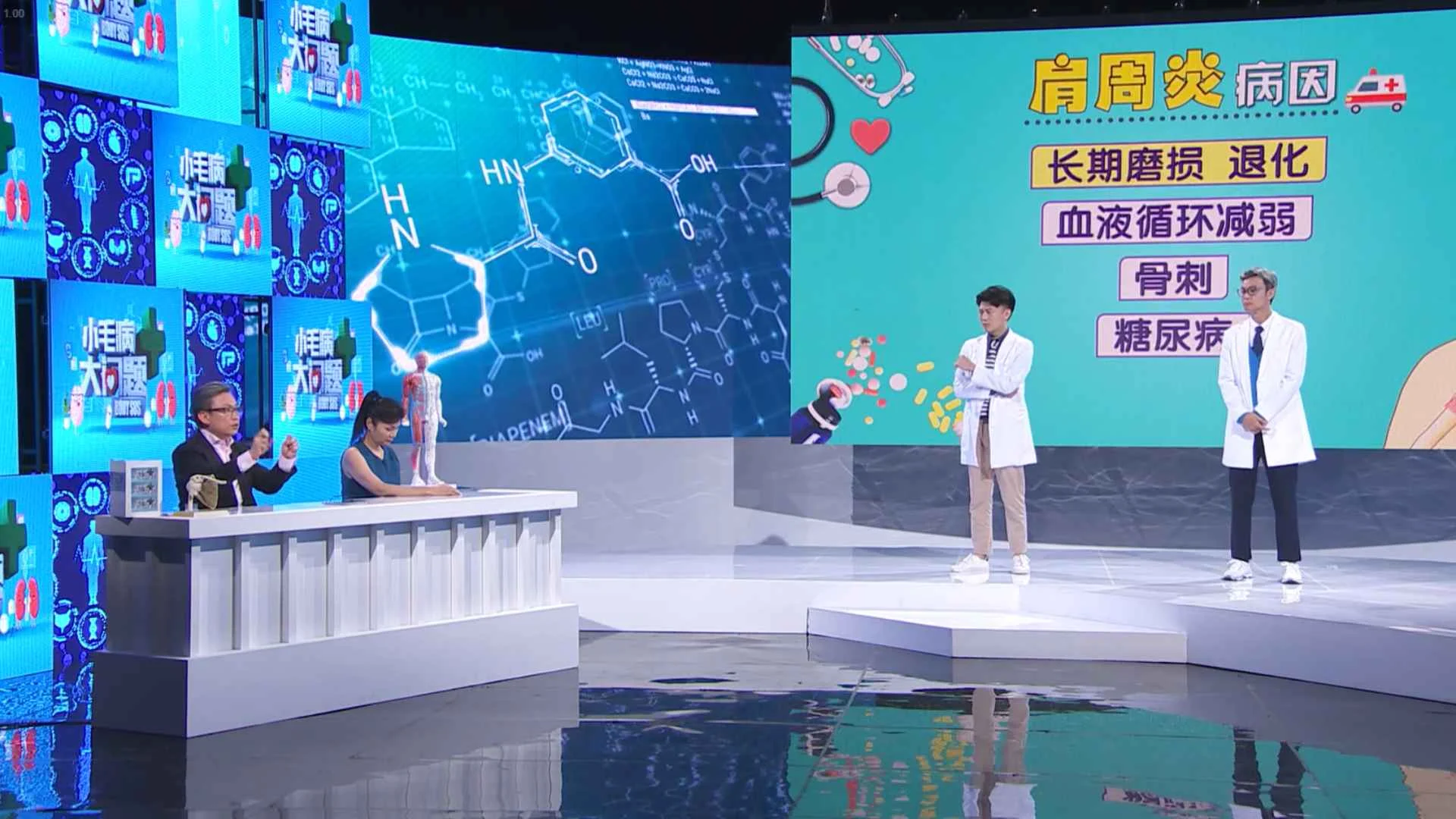
Dr. Bernard Lee Mun Kam on Frozen Shoulder — As Featured on Channel 8’s Body SOS
October 23, 2026
CONTENTS
You can’t reach the top shelf anymore. Pulling on a shirt hurts. The pain wakes you when you roll over at night.
That’s often how frozen shoulder starts. Look for answers and you’ll find plenty of advice. Some of it is wrong.
Mediacorp Channel 8’s health show Body SOS put three common beliefs about frozen shoulder “on trial”. Dr. Bernard Lee Mun Kam, Consultant Pain Specialist and founder of Singapore Paincare, gave the medical view.
Watch the episode: Body SOS (小毛病大问题), Season 9 Episode 21 — meWATCH
Key takeaways
- Headaches are not a symptom of frozen shoulder. They usually come from poor sleep or tight neck muscles.
- Being overweight is not a direct cause. Diabetes, which often comes with obesity, is a real risk factor.
- Hyaluronic acid injections are not a fit, Dr. Lee explained. The problem sits around the joint, not inside it.
- Treatment starts simple and steps up only if needed. Surgery is a last resort.
About the Episode
Body SOS (小毛病大问题) is a Channel 8 health show. It takes everyday health complaints and asks doctors to explain them.
Season 9, Episode 21 was set up like a courtroom. Frozen shoulder was on trial. In Chinese it’s called 肩周炎, or “50-year shoulder” (五十肩).
Dr. Bernard Lee was the expert witness for Western medicine. A TCM physician gave the TCM view. A jury of Channel 8 artistes heard both sides and voted on each claim.
Dr. Lee was interviewed on camera and answered each myth in his own words.
What Dr. Bernard Lee Mun Kam Explained on Body SOS
Where shoulder pain comes from
Dr. Lee began with an anatomy model. Three bones meet at the shoulder: the collarbone, the shoulder blade and the upper arm bone. Four tendons, called the rotator cuff, wrap around the joint.
Two of these tendons get hurt most often. One runs over the top of the shoulder (the supraspinatus). The other sits at the front (the subscapularis).
Under the tendons is the bursa. It’s a small, fluid-filled cushion that stops tendons rubbing on bone. When it’s inflamed, it hurts a lot.
Here’s why this matters. A tendon problem, a bursa problem and a joint problem can all feel the same. So the first step is finding which one is causing your pain. That’s the idea behind Painostic®, the diagnostic method Dr. Lee developed.
The three stages of frozen shoulder
Dr. Lee explained that frozen shoulder moves through three stages:
- Freezing. Pain is the main problem.
- Frozen. The shoulder gets stiff. It’s hard to lift your arm or reach behind your back. Pain may wake you at night.
- Thawing. Movement slowly comes back. But the muscles are often weak after months of rest, so rehab matters.
He shared that around 70% of patients get through the first two stages and reach the thawing stage.
His key point: if pain isn’t managed early, the shoulder can move on to the stiff stage.
Myth 1: “Headache is a symptom of frozen shoulder”
The verdict: False.
Headaches often come with frozen shoulder. But Dr. Lee explained they aren’t part of it. They’re a side effect of the pain, in two ways:
- Poor sleep. Shoulder pain keeps you up, and lack of sleep can bring on headaches.
- Tight muscles. When the shoulder hurts, you move it differently. Your neck and head muscles work harder and tighten up.
The lesson: where pain shows up isn’t always where it starts.
Myth 2: “Obesity causes frozen shoulder”
The verdict: False.
Dr. Lee said obesity is not a direct cause. But it’s linked in two indirect ways:
- Diabetes. Many people with obesity also have diabetes. Diabetes can make tendons and ligaments stiff and easier to injure.
- Sudden effort. People who rarely exercise are more likely to strain a shoulder when they suddenly do.
He listed the real causes recognised in Western medicine:
- An injury, such as a fall or a sudden jolt
- Lifting your arms overhead again and again, at work or in sports like tennis
- Poor blood flow to the shoulder
- A bone spur rubbing against a tendon
- Diabetes
Myth 3: “Hyaluronic acid injections treat frozen shoulder”
The verdict: False.
This one split the jury. If hyaluronic acid helps arthritis, why not frozen shoulder?
Dr. Lee explained the difference. Hyaluronic acid works like oil inside a joint. But frozen shoulder, as he described it, mainly involves inflamed tendons and bursae around the joint. Oil inside the joint doesn’t reach them.
The lesson: an injection only helps if it targets the real source of pain.
How frozen shoulder is treated
Dr. Lee described treatment as a ladder. Start with the simplest step. Move up only if pain or stiffness doesn’t improve.
- Hot or cold packs at home. Cold in the early, painful stage. Warm once the shoulder is stiff.
- Physiotherapy. Stretches to get movement back, and exercises to build strength. Dr. Lee often suggests swimming. It moves the shoulder fully and helps blood flow to the tendons.
- Medication. Anti-inflammatories, muscle relaxants and nerve-calming medicines, usually for later-stage cases.
- Targeted injections. These go into the injured tendons and bursae. Options include steroid injections, nerve blocks and PRP (platelet-rich plasma, made from your own blood to help repair).
- Radiofrequency treatment. Dr. Lee estimated about 10% of patients may need it.
- Surgery. A last resort. It’s mainly for people whose bone spurs are tearing a tendon.
This simplest-first approach, with minimally invasive options before surgery, is how Singapore Paincare plans treatment.
About Dr. Bernard Lee Mun Kam (李文鉴医生)
Dr. Bernard Lee Mun Kam is a Consultant Pain Specialist at Singapore Paincare Center. He is also Founder & CEO of Singapore Paincare Holdings Limited. He has more than 20 years of clinical experience.
- Tan Tock Seng Hospital (2002–2007): set up the Chronic and Interventional Pain Management Service. He was Director of the Pain Management Unit in the Department of Anaesthesia.
- KK Women’s and Children’s Hospital (2009–2018): founded Singapore’s first Women’s Pain Centre.
- Painostic®: developed the registered diagnostic method used at Singapore Paincare. It looks at how pain behaves, what’s physically wrong, how the nerves process pain and how pain affects mood. It goes beyond scans alone.
- Singapore Paincare Medical Group: led its listing on the Singapore Exchange (SGX) in 2020. It was the first pain management group in Singapore to list publicly.
- Singapore Paincare Academy: founded the group’s training school for allied health and medical staff.
- Clinical focus: shoulder pain, back and spine pain, nerve pain and joint pain.
Frequently Asked Questions
Can frozen shoulder cause headaches?
Not directly. On Channel 8’s Body SOS, pain specialist Dr. Bernard Lee explained that headaches linked to frozen shoulder have two common causes. Shoulder pain disturbs sleep, and poor sleep can bring on headaches. Pain also makes neck and head muscles tighten. If you have both, a specialist can check whether your neck is involved too.
Does being overweight cause frozen shoulder?
Not directly. Dr. Bernard Lee of Singapore Paincare explained on Body SOS that the link is indirect. Many people with obesity also have diabetes. Diabetes can make tendons and ligaments stiff and easier to injure. People who rarely exercise are also more likely to strain a shoulder when they suddenly make an effort.
Are hyaluronic acid injections used to treat frozen shoulder?
Dr. Bernard Lee Mun Kam explained on Channel 8’s Body SOS that hyaluronic acid is not a good fit for frozen shoulder. It works like oil inside a joint, which is why it’s used for some arthritis. Frozen shoulder mainly affects the tendons and bursae around the joint. Treatment should target the actual source of pain.
Will frozen shoulder go away on its own?
Frozen shoulder moves through three stages: freezing, frozen and thawing. On Body SOS, Dr. Bernard Lee shared that around 70% of patients reach the thawing stage, when movement slowly returns. But muscles may be weak after months of stiffness. Pain that isn’t managed early can also progress. Early care and rehab may help.
What treatments are available for frozen shoulder in Singapore?
Treatment usually starts simple and steps up. Dr. Bernard Lee described it on Body SOS: hot or cold packs, physiotherapy, then medication. If pain continues, targeted injections such as steroids, nerve blocks or PRP may help. A small number of patients may need radiofrequency treatment. Surgery is generally a last resort.
When should I see a specialist for frozen shoulder?
See a pain specialist if shoulder pain lasts more than four weeks or wakes you at night. The same applies if it’s hard to lift your arm, get dressed or reach behind your back. If you have diabetes or a thyroid condition, get new shoulder stiffness checked early. Singapore Paincare needs no referral.
Watch the Original Episode
Body SOS (小毛病大问题), Season 9 Episode 21, Mediacorp Channel 8. Runtime 22:36.
Stream it on meWATCH (you may need a free Mediacorp account): https://www.mewatch.sg/watch/Body-SOS-S9-E21-191621
This article is intended for general informational purposes only and does not constitute medical advice. Please consult a qualified healthcare professional for diagnosis and treatment tailored to your individual condition.