
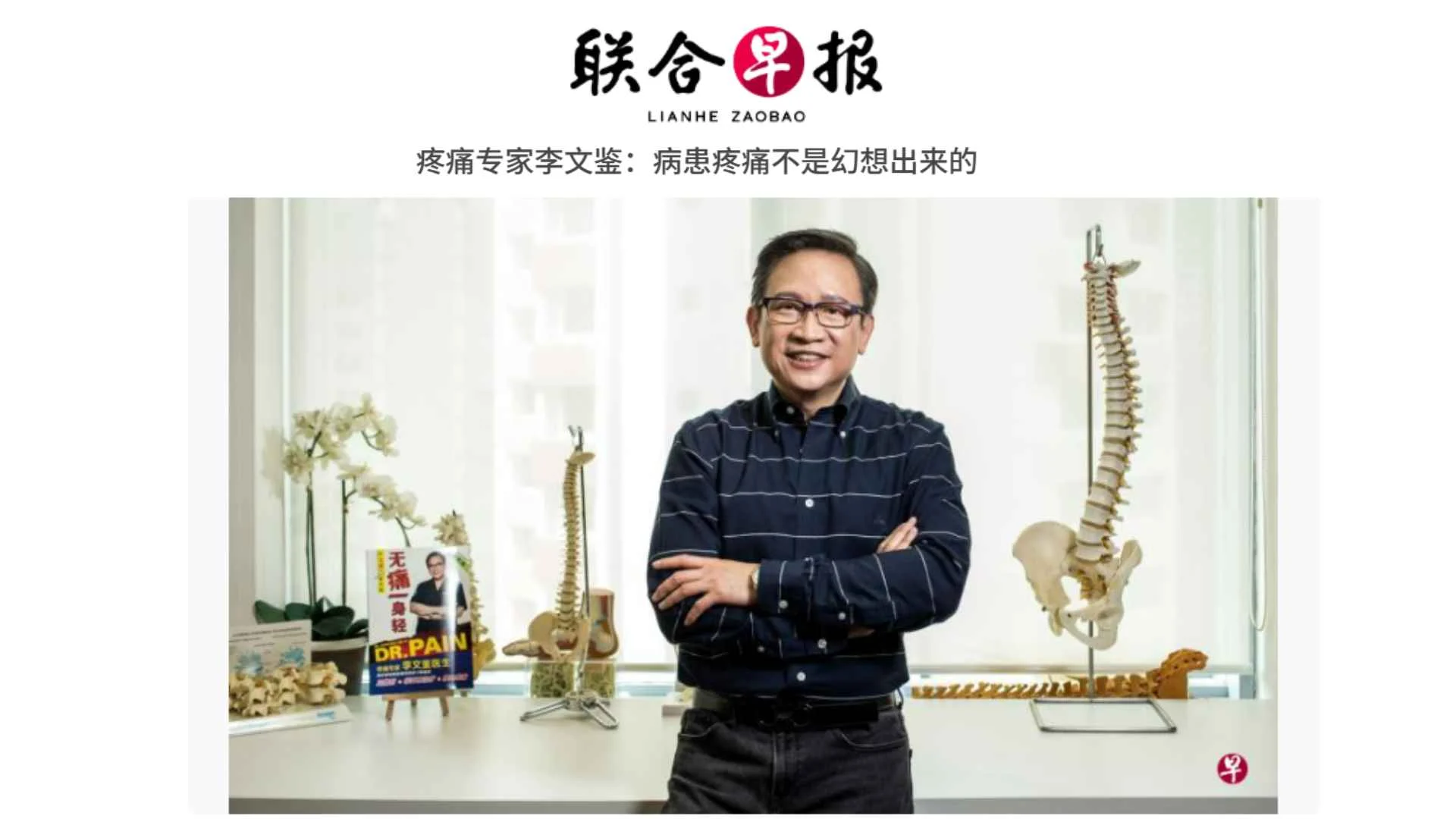
Dr. Bernard Lee on Chronic Pain Myths — As Quoted in Lianhe Zaobao
October 6, 2026
CONTENTS
“Just bear with it.” “It’s normal at your age.” “Rest until it stops hurting.” “If it’s that bad, you’ll need an operation.”
Many people with long-term pain have heard all of these. Some have heard worse: that the pain is all in their head.
So they put up with it. They take painkillers when it gets too much. And they wait — sometimes for years — thinking surgery is the only other choice.
Dr. Bernard Lee Mun Kam, a pain specialist in Singapore, has spent his career pushing back on these ideas. In August 2020, Lianhe Zaobao published his views on three of the most common chronic pain myths.
Where This Interview Appeared
On 4 August 2020, Lianhe Zaobao (联合早报) published an interview feature with Dr. Bernard Lee (李文鉴医生) in its beauty and health section.
The piece was an excerpt from the cover doctor interview in Issue 43 of 《健康No.1》, a health quarterly. It was compiled from reporting by 邱玉莲. In the interview, Dr. Lee was asked about his path into pain medicine and the pain myths he sees most often.
This was an interview. Dr. Lee did not write the article. He was the specialist being interviewed, and his answers were quoted.
What Dr. Lee Shared
Why an anaesthetist became a pain specialist?
Dr. Lee trained first in anaesthesia. Then something personal changed his path.
While he was still a medical student, his father had lung cancer that spread to the bone. Even on the strongest doses of morphine, his father could not sleep through the pain at night. Dr. Lee told the interviewer he felt helpless — he could only watch.
That experience is why, after qualifying as an anaesthetist, he went on to specialise in pain medicine.
He also described what pain care looked like in Singapore back then. Hospitals had no dedicated pain departments. If pain remained after a “successful” operation, patients were often just given more painkillers. Some were sent to psychiatrists, as if their pain wasn’t real.
Dr. Lee went on to help change that. He set up the Chronic and Interventional Pain Management Service at Tan Tock Seng Hospital, and later founded the Women’s Pain Centre at KK Women’s and Children’s Hospital.
Pain is real — and it affects the whole body
Dr. Lee was clear that pain is a real physical experience, not imagination. He explained that sudden (acute) pain can push up blood pressure, speed up the heart and upset blood sugar levels. Long-term (chronic) pain can disturb sleep and mood, and is linked to depression and anxiety.
His point for readers: pain is a medical problem worth investigating, not something to quietly tolerate.
Myth 1: “Getting older means living with pain”
Dr. Lee agreed that wear and tear with age can’t be reversed. But he drew a line between ageing itself and the inflammation and pain that often come with it — from arthritis, bone spurs or a slipped disc. Those, he said, can be treated.
His advice in the interview: if something hurts, see a doctor and find the source, so treatment can target the actual cause. In his words, we can “age gracefully, without pain.”
Myth 2: “If it hurts, don’t exercise”
This is where Dr. Lee’s answer showed real clinical nuance.
After an acute injury, he said, the injured area should be rested for a while. But once that phase passes, the right amount of movement can help healing. For chronic pain, too little movement can sometimes make the pain worse.
He gave frozen shoulder and back muscle strain as examples. You don’t need to wait until the pain is completely gone before moving. And if a condition stops you from exercising, the next step is to talk to your doctor and find out why.
Myth 3: “Surgery is the only real fix”
Dr. Lee acknowledged that surgery is sometimes unavoidable — for example, when nerves or other structures are damaged. But he stressed that it is not the only option.
He listed a range of approaches: minimally invasive procedures, laser, medication, physiotherapy, exercise, cognitive behavioural therapy (a talking therapy that helps change how you respond to pain) and acupuncture. These can be used alone or together.
He mentioned non-surgical options using targeted laser and balloon-based techniques for conditions such as slipped discs, pinched nerves, nerve pain, knee arthritis and frozen shoulder.
His vision
Dr. Lee ended the interview with a simple goal: “我的理想,就是迈进无疼痛的新世界” — his aim is to move towards a world without pain.
Frequently Asked Questions
Is it normal to have pain just because I’m getting older?
Not necessarily. Ageing brings wear and tear, but the pain linked to it — from arthritis, bone spurs or a slipped disc — can often be treated. Pain specialist Dr. Bernard Lee told Lianhe Zaobao that people don’t have to accept pain as part of ageing. Seeing a doctor helps find the cause so treatment can target it.
Should I stop exercising if I have chronic pain?
Not always. After a fresh injury, short-term rest is usually advised. But with chronic pain, too little movement can sometimes make pain worse. Dr. Bernard Lee says conditions like frozen shoulder or back strain may benefit from suitable movement. If pain stops you exercising, speak to a doctor first to find out why.
Do I need surgery to fix my back or joint pain?
Surgery is sometimes needed, but it is not the only option. Pain specialists may suggest minimally invasive procedures, medication, physiotherapy, exercise, cognitive behavioural therapy or acupuncture, alone or combined. Dr. Bernard Lee of Singapore Paincare says the right choice depends on what is actually causing your pain, so an accurate diagnosis comes first.
What does a pain specialist do that a regular doctor doesn’t?
A pain specialist focuses on finding where long-term pain comes from and treating that source. They may use detailed assessment, imaging and diagnostic nerve blocks, plus minimally invasive treatments. At Singapore Paincare, pain specialists use the Painostic® method, which looks at pain patterns, physical causes, how nerves process pain, and psychological factors.
Can chronic pain affect my sleep and mood?
Yes. Dr. Bernard Lee explained in Lianhe Zaobao that chronic pain can disturb sleep and affect mood, and is linked to depression and anxiety. Sudden, severe pain can also raise blood pressure and heart rate. This is why ongoing pain should be properly assessed by a doctor rather than simply endured.
Who is Dr. Bernard Lee Mun Kam?
Dr. Bernard Lee Mun Kam (李文鉴医生) is a Singapore pain specialist and the Founder & CEO of Singapore Paincare. He set up the pain management service at Tan Tock Seng Hospital, founded the Women’s Pain Centre at KK Women’s and Children’s Hospital, and developed the Painostic® diagnostic method. He has over 20 years of clinical experience.
Read the Original Article
Lianhe Zaobao (联合早报), 4 August 2020 — beauty and health section: https://www.zaobao.com.sg/zlifestyle/beauty-health/story20200804-1074267
The article is in Chinese. Some Lianhe Zaobao content may require a subscription to read in full. The original interview appeared in Issue 43 of the health quarterly 《健康No.1》.
This article is intended for general informational purposes only and does not constitute medical advice. Please consult a qualified healthcare professional for diagnosis and treatment tailored to your individual condition.