
Dr. Bernard Lee Mun Kam on Rheumatoid Arthritis Treatment: As Published in Wan Bao
August 6, 2026
CONTENTS
Your knees ache every morning. It takes almost an hour before your fingers loosen up enough to button a shirt. You put it down to age. But the stiffness doesn’t ease the way ordinary joint pain does. Lately you’ve felt unusually tired, with little appetite.
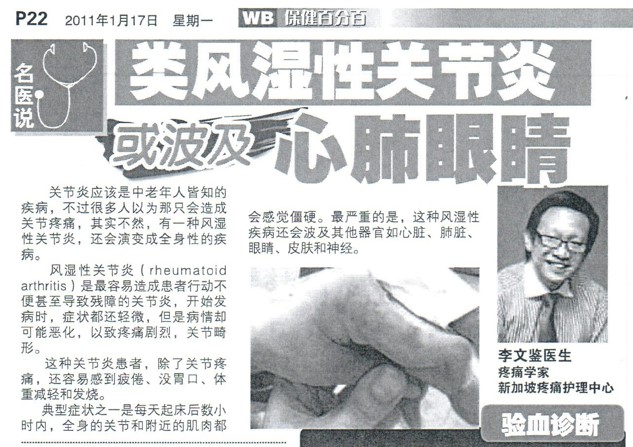
Dr. Bernard Lee Mun Kam addressed this exact confusion when he wrote for Wan Bao’s 名医说 (Doctor’s Talk) column in January 2011. Many patients assume all joint pain is the same “wear and tear” that comes with age. Dr. Lee explained why that assumption can delay the right diagnosis. Left untreated, one form of arthritis can reach far beyond the joints.
Published in Wan Bao’s 名医说 Column
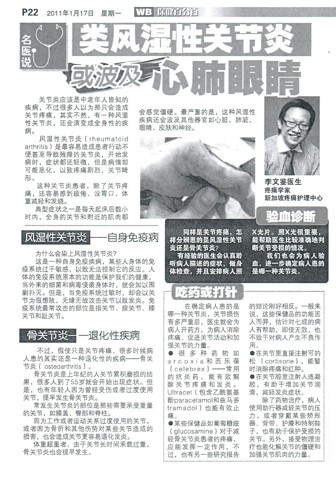
名医说 (Doctor’s Talk) is a column in 联合晚报 Wan Bao, one of Singapore’s established Chinese-language newspapers. Dr. Bernard Lee Mun Kam wrote this piece in his own name, drawing on his experience treating joint and musculoskeletal pain. It appeared on 17 January 2011, in Wan Bao’s 保健百分百 (Health 100%) section, page P22, under the headline 类风湿性关节炎或波及心肺眼睛 (“Rheumatoid Arthritis May Affect the Heart, Lungs, Eyes”).
What Dr. Lee Wrote About
Not All Joint Pain Is the Same
Dr. Lee opened by telling apart two conditions patients often confuse. Rheumatoid arthritis is an autoimmune disease: the immune system mistakenly attacks the joints. Osteoarthritis is different. It’s caused by joints wearing down over time. He noted that osteoarthritis symptoms usually start around age 55, though injury or overuse can bring it on earlier. The difference matters, because each condition needs its own diagnosis and treatment.
This same clear thinking runs through how Dr. Lee approaches pain diagnosis today. He later built it into the Painostic® methodology at Singapore Paincare. It looks beyond scans alone, to a patient’s pain patterns, pathology, perception, and psychology. These are the four pillars behind his diagnostic approach.
When Rheumatoid Arthritis Reaches Beyond the Joints
Dr. Lee explained that rheumatoid arthritis rarely stays in the joints alone. Patients often feel tired, lose their appetite, and lose weight without trying, on top of joint pain. There’s also a classic sign: stiffness that can last for hours after waking, in the joints and the muscles around them. In more advanced cases, he wrote, the disease can spread to the heart, lungs, eyes, skin, and nerves. Many patients don’t expect “just arthritis” to affect so much of the body.
Getting the Diagnosis Right
The column explained how doctors tell rheumatoid arthritis apart from osteoarthritis. They listen closely to how a patient describes their symptoms. They do a physical exam. They order X-rays to check joint damage. They run blood tests to confirm which type of arthritis it is. Dr. Lee’s point was clear: joint pain isn’t one single diagnosis. That same careful approach still shapes his clinical work today.
Treatment Options Dr. Lee Outlined
The column covered several ways to manage arthritis pain. Anti-inflammatory medication may help reduce pain and swelling. Combination pain relievers can support day-to-day symptom control. Dr. Lee was also honest about glucosamine supplements. Some patients report feeling better, but the research on how well they work is mixed. For more targeted relief, he described joint injections. Corticosteroid injections may bring short-term relief from swelling and pain. Lubricating gel injections can help ease joint movement. Simple supportive steps matter too: mobility aids, protective braces, and physiotherapy may help keep joints strong and reduce stiffness.
About the Doctor
Dr. Bernard Lee Mun Kam (李文鉴医生) Founder & CEO, Singapore Paincare Holdings Limited; Consultant Pain Specialist, Singapore Paincare Center
- Experience: Over 20 years of clinical practice
- Tan Tock Seng Hospital: Established the Chronic and Interventional Pain Management Service (2002 to 2007); Director, Pain Management Unit, Department of Anaesthesia
- KK Women’s and Children’s Hospital: Founded Singapore’s first Women’s Pain Centre (2009 to 2018)
- Painostic®: Developed Singapore Paincare’s proprietary, trademarked pain diagnosis methodology
- SGX Listing: Led Singapore Paincare Holdings’ listing on the Singapore Exchange in 2020, the first publicly listed pain management group in Singapore
- Relevant specialties: Joint pain, musculoskeletal pain, spine and back pain
Frequently Asked Questions
What’s the difference between rheumatoid arthritis and osteoarthritis?
Rheumatoid arthritis is an autoimmune disease. The immune system mistakenly attacks the joints, often causing stiffness that lasts for hours after waking. Osteoarthritis is different. It’s caused by joints wearing down over time, and usually affects weight-bearing joints like the knees, hips, and spine as people age.
Can rheumatoid arthritis affect organs other than the joints?
Yes. In more advanced cases, rheumatoid arthritis can spread beyond the joints to affect the heart, lungs, eyes, skin, and nerves. This is one reason accurate, early diagnosis matters. A pain specialist can help tell it apart from arthritis that stays only in the joints.
How is rheumatoid arthritis diagnosed in Singapore?
Diagnosis usually combines a detailed symptom history, a physical exam, blood tests, and X-rays. Together, these help confirm whether it’s rheumatoid arthritis, osteoarthritis, or another joint condition. A pain specialist can guide this process and recommend the right next steps.
What treatment options exist for rheumatoid arthritis?
Treatment may include anti-inflammatory medication, pain relievers, joint injections such as corticosteroids or lubricating gel, and support like physiotherapy or protective braces. The right combination depends on how severe the condition is, and should be guided by a pain specialist’s assessment.
Is rheumatoid arthritis curable?
There’s currently no cure for rheumatoid arthritis. But many patients feel meaningfully better with the right combination of medication, joint injections, and physiotherapy. Early diagnosis and steady management may help protect the joints and lower the risk of complications.
About the Original Article
This piece was originally published in the print edition of Wan Bao on 17 January 2011 (page P22, 保健百分百 section, 名医说 column).Read the original article here: 类风湿性关节炎或波及心肺眼睛.
Next Steps
Speak to a pain specialist to find out if this treatment is right for you.
Singapore Paincare Center @ Paragon 290 Orchard Road #18-03, Singapore 238859 Mon to Fri: 9am to 1pm, 2pm to 6pm | Sat: 9am to 1pm | Sun & PH: Closed
Singapore Paincare Center @ Novena 38 Irrawaddy Road #07-33, Singapore 329563 (Check site for current hours)
Medical Disclaimer: This article is intended for general informational purposes only and does not constitute medical advice. Please consult a qualified healthcare professional for diagnosis and treatment tailored to your individual condition.